AI Lease Abstraction: How It Turns Leases into Data
AI lease abstraction reads a lease and pulls out the terms that matter — rent, dates, options and obligations — into a summary a team can search, compare and act on.
On this page
Short answer
AI lease abstraction is the use of document-reading software to pull the key terms out of a lease — rent, term, renewal options, break clauses and obligations — and store them as structured data. Instead of opening each PDF to find a date or a clause, a team searches one summary per lease. A person still reviews the result before it is used for decisions.
What is AI lease abstraction?
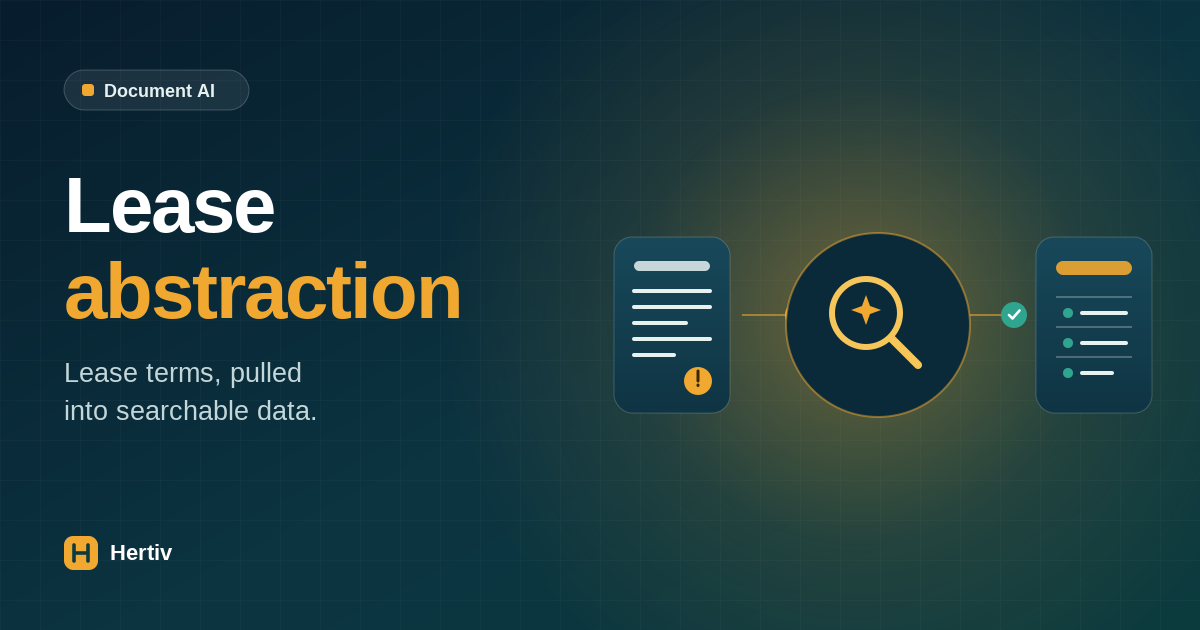
AI lease abstraction is the use of document-reading software to pull the key terms out of a lease and store them as structured data. Instead of opening each PDF to find a date or a clause, a team searches one short summary per lease that lists the rent, the term, the renewal options and the obligations.
The abstract is not the lease itself. It is a structured record built from the lease: a set of fields with values, each linked back to the page and clause it came from. A person reviews the abstract before it is used for decisions, because a wrong date or amount in the abstract is worse than no abstract at all.
| Field | What it records | Why it matters |
|---|---|---|
| Rent and escalation | Base rent, review dates, uplift formula | Forecasting income |
| Term and expiry | Start date, end date, break dates | Renewal planning |
| Options | Renewal and break options, notice periods | Missing a deadline |
| Deposit and guarantees | Amounts, return conditions | Cash planning |
| Obligations | Repairs, insurance, use restrictions | Disputes and costs |
Lease abstraction is one of the oldest uses of document AI: leases are long, repeat the same kinds of terms, and appear in large numbers, which is exactly where reading software earns its keep.
Which lease fields does AI abstraction pull out?
AI lease abstraction pulls out the fields a team needs to manage a lease without reading the whole document: money, dates, options and obligations. The exact field list depends on the portfolio, but most abstracts cover the same core set.
Money fields come first: base rent, how often it is paid, the review or escalation dates, the uplift formula, service charges and the deposit. These are the fields the finance team needs to forecast income and check that what was billed matches what the lease says.
Date fields come next: the start date, the expiry date, break dates, notice periods and the dates of any renewal options. A missed break date can lock a team into years of rent, so these fields are usually checked twice, once by the software and once by a person.
Obligation fields cover what each side must do: who repairs what, who insures what, what the property may be used for, and what happens if either side breaks the terms. These are harder to extract than dates and amounts, because they are written in sentences rather than numbers, so a person should check them.
How does AI lease abstraction work?
AI lease abstraction works in five steps: the lease is taken in, the document type is identified, the fields are pulled out, the results are checked against rules, and a person reviews the abstract. The software does the reading; the person does the judging.
- Take in. The lease arrives as a PDF or a scan. The software reads the text, including scanned pages, and splits the document into sections.
- Identify. It works out what kind of document it is — a lease, an amendment, a side letter — and which template or clause set applies.
- Extract. It pulls out the fields: dates, amounts, parties, options and obligations, each linked to the page and clause it came from.
- Check. Rules test the results: does the expiry date fall after the start date, does the rent match the schedule, is any required field missing?
- Review. A person checks the flagged fields and signs off the abstract before it goes into the system.
The link back to the source clause is the most important part. An abstract that says the break date is 1 June is only useful if the reviewer can click through and see the clause that says so. Teams that use document AI in real estate already work this way, and lease abstraction follows the same pattern.
Where does lease abstraction save the most time?
Lease abstraction saves the most time where a team holds many leases and needs the same facts from each of them: portfolio management, due diligence and renewal planning. A single lease is quick to read by hand; six hundred are not.
In portfolio management, the abstract turns a pile of PDFs into a table the team can search and sort. It can answer questions such as which leases expire next year, which rents are due for review, and which properties carry a break option, without opening a single file.
In due diligence, the abstract speeds up the review of a portfolio being bought or sold. Instead of reading every lease, the team reads the abstracts, then opens only the leases where the abstract flags something unusual, such as a missing break clause or a rent that does not match the schedule.
In renewal planning, the abstract warns the team months ahead of a break date or an option deadline. The cost of missing a break date is often years of rent on space the team no longer needs, so the warning alone can pay for the tool.
What does lease abstraction cost and how do teams start?
Lease abstraction usually costs a monthly platform fee plus a per-lease or per-page charge, with setup work to teach the software the team's lease types. Prices vary by vendor and volume, so check the vendor's own pricing page — see vendor site — before budgeting.
A team should start with one lease type and a small sample, not the whole portfolio. Pick the lease type the team sees most often, gather twenty or thirty real leases, and run them through the tool to see which fields it reads well and which it gets wrong.
The next step is to agree the field list and the review rules: which fields must a person check every time, which can be accepted on the software's say-so, and what happens when a field is missing or unclear. Write these rules down before the first abstract goes live, because they are the quality control.
Finally, decide where the abstracts live. They should sit in the system the team already uses for leases, not in a separate tool, or the team will stop looking at them. For teams building this into a wider document workflow, document AI in legal practice covers the same review and storage questions.
Example (hypothetical): a portfolio team with 600 leases
Example (hypothetical): a property team manages 600 leases. Reading each lease by hand takes about 30 minutes, so a full read of the portfolio takes 600 x 30 = 18,000 minutes, or 300 hours. The team cannot do that every year, so most leases sit unread until a problem appears.
With AI lease abstraction, the software reads all 600 leases and drafts an abstract for each. A person reviews each abstract, which takes about 5 minutes: 600 x 5 = 3,000 minutes, or 50 hours. The software flags 40 leases where a field is missing or unclear, and a person reads those in full at 30 minutes each: 40 x 30 = 1,200 minutes, or 20 hours.
The total is 50 + 20 = 70 hours, against 300 hours by hand, a saving of about 230 hours. Just as important, the team now has a searchable record of all 600 leases, so the next question about a break date or a rent review takes minutes instead of a day of reading.
What are the common mistakes?
The most common mistakes with AI lease abstraction are trusting the abstract without review, starting with the hardest leases, and treating the abstract as a replacement for the lease itself.
- Skipping the review step. An abstract with a wrong break date is worse than no abstract, because the team acts on it. Every abstract needs a human check before it is used.
- Starting with the hardest leases. Old scanned leases, handwritten amendments and unusual clauses are the worst first test. Start with clean, standard leases and add the hard ones later.
- Treating the abstract as the lease. The abstract is a summary. For any decision that turns on a clause, the team must read the clause itself, not the abstract's version of it.
- No source link. If the abstract does not link each field back to the page and clause it came from, the reviewer cannot check it, and the abstract cannot be trusted.
- Too many fields. Extracting fifty fields when the team needs fifteen slows the review and adds errors. Start with the fields the team actually uses.
Key takeaways
- AI lease abstraction turns each lease into a structured summary of rent, dates, options and obligations
- Every field should link back to the page and clause it came from
- It saves the most time across portfolios, due diligence and renewal planning
- A person must review the abstract before it is used for decisions
- Start with one clean lease type and the fields the team actually uses
Frequently asked questions
What is AI lease abstraction?
It is the use of document-reading software to pull the key terms out of a lease — rent, term, renewal options, break clauses and obligations — and store them as structured data that a team can search and compare, instead of opening each PDF.
Is the abstract the same as the lease?
No. The abstract is a summary built from the lease. For any decision that turns on a clause, the team must read the clause itself, not the abstract's version of it. The abstract points to the clause; it does not replace it.
Which fields does it extract?
The core fields are rent and escalation, start and expiry dates, break dates and notice periods, renewal options, deposits and guarantees, and the main obligations such as repairs and insurance. Teams usually add a few fields of their own.
How accurate is AI lease abstraction?
It reads clean, standard leases well, and struggles with old scans, handwritten amendments and unusual clauses. That is why a person reviews the abstract: the software finds the fields, and the person confirms the ones that affect money or deadlines.
How long does it take to set up?
A team usually starts with twenty or thirty leases of one type, agrees the field list and the review rules, and runs a small pilot before rolling it out across the portfolio. The setup work is mostly agreeing the fields and the rules.
What does AI lease abstraction cost?
Most vendors charge a monthly platform fee plus a per-lease or per-page charge, with setup work to teach the software the team's lease types. Prices vary, so check the vendor's own pricing page — see vendor site — before budgeting.