AI in Data Analytics: How It Finds Answers Faster
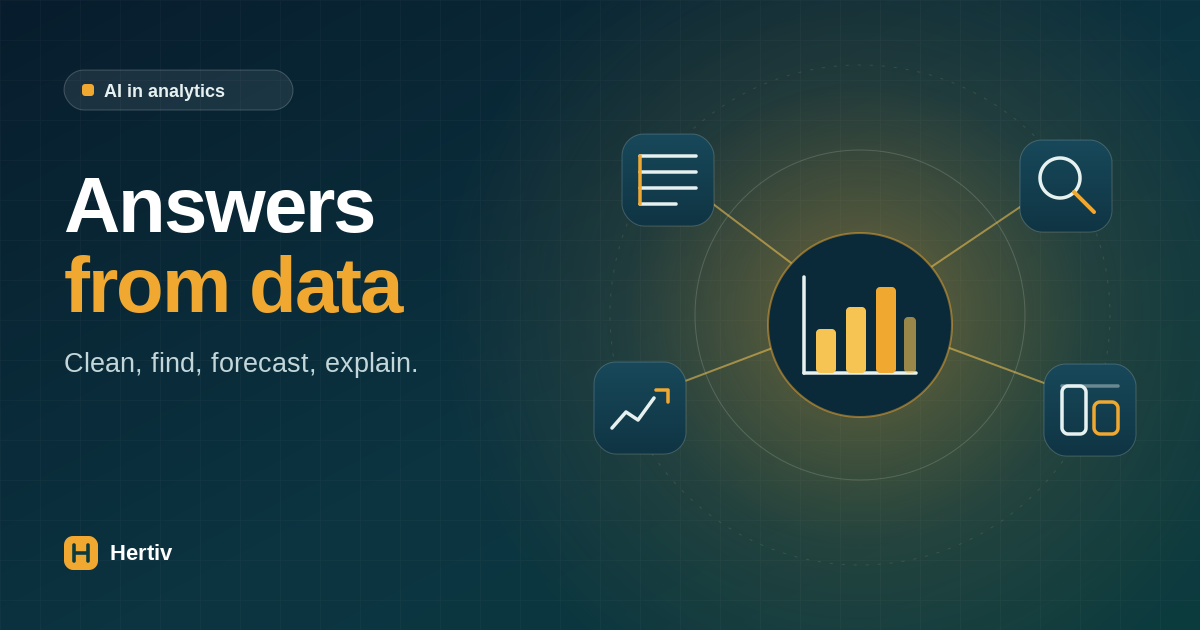
AI in data analytics means software that reads raw records, spots patterns and answers plain-language questions. Here is how it works and where it pays off.
On this page
Short answer
AI in data analytics is the use of machine learning models to clean, explore and explain business data. The model reads large tables of records, finds patterns a person would miss, and turns a plain-language question into a chart or a short answer. People still decide what to do with the answer.
What is AI in data analytics?
AI in data analytics is the use of machine learning models to clean, explore and explain business data. The software reads tables of records, finds patterns in them and turns a plain-language question into a chart, a forecast or a short written answer.
It does not replace the analyst. It takes over the slow parts — reading thousands of rows, checking for errors, drawing the first chart — so the analyst can spend time on the question that matters and on whether the answer can be trusted.
| Job | What the model does | Typical output |
|---|---|---|
| Cleaning | Finds missing values, duplicates and wrong formats | A clean table to work from |
| Exploring | Summarises columns and flags odd values | Charts and simple summaries |
| Pattern finding | Groups similar records and spots links | Segments and correlations |
| Forecasting | Projects a trend forward from past data | A forecast with a range |
| Answering | Turns a typed question into a query and a chart | A plain-language answer |
Most teams start with one job, usually cleaning or answering questions, and add the rest once the first one works. The data analytics for business guide explains the wider workflow this fits into.
How does AI clean and prepare data?
AI cleans data by learning what a normal record looks like and flagging the ones that break the pattern. A date written as text, a postcode in the wrong column, or the same customer spelled three ways all stand out to a model trained on the rest of the table.
The model suggests fixes, but it should not apply them on its own. A person reviews the suggestions, because a fix that looks right can hide a real problem — a missing value might mean a sensor failed, and filling it in with an average would erase that fact.
Good preparation also means labelling the data clearly. The model needs to know which column is the outcome you care about, which columns are dates and which values are allowed. Teams that skip this step get fast answers that are wrong in quiet ways.
How does AI find patterns in data?
AI finds patterns by comparing records across many columns at once. A person can scan a table of a few hundred rows; a model can weigh dozens of columns across millions of rows and notice, for example, that customers who buy one product on a Friday also cancel a service within a month.
The useful output is a short list of patterns ranked by strength, each with the records behind it. A pattern is only worth acting on if the records behind it make sense — a link between two things can be a coincidence, or both can be caused by something else entirely.
That is why the best tools show their working. When the model says a group of customers behaves differently, the analyst should be able to open that group and read the actual records. Predictive analytics uses the same idea to look forward instead of back.
What can AI forecast from data?
AI can forecast anything that repeats in a steady pattern: sales by week, stock levels, call volumes, or the number of support tickets after a release. It learns the shape of past demand — weekly cycles, seasonal peaks, the effect of a promotion — and projects it forward.
A forecast is a range, not a single number. The model should say how wide the range is, because a forecast that hides its uncertainty leads to bad plans. If the range is wide, the honest answer is that the data does not support a precise plan yet.
Forecasts fail when the world changes in a way the data has never seen: a new competitor, a price change, a supply shock. Teams that review their forecasts every week catch this drift early and retrain the model on fresh data instead of trusting an old one.
Where do teams use AI analytics today?
Sales teams use it to rank leads and predict which deals will close. Support teams use it to sort tickets and spot the issues that keep coming back. Finance teams use it to flag unusual payments and to forecast cash flow. Retail teams use it to plan stock and to see which products sell together.
The common thread is a repeated question with a lot of history behind it. If a team asks the same question every week and has a year of records to learn from, AI analytics usually helps. If the question is new and the records are thin, a spreadsheet and a careful analyst are the better choice.
Small teams often start with a plain-language question tool. Typing "which products sold least last month?" and getting a chart back is the fastest way to learn what the data can and cannot answer, and it is the core of generative AI for data analytics.
How do you start using AI in data analytics?
Start small, with one question and one clean dataset. The steps below keep the first project cheap and easy to judge.
- Pick one repeated question, such as why sales dipped last month.
- Gather the records that answer it into one table, with clear column names.
- Clean the table: fix formats, remove duplicates, note what is missing.
- Run the model and check its answer against a month you already know.
- Show the result to the people who will act on it and ask if it helps.
- Only then connect more data sources or automate the report.
Most first projects take a few weeks, not months. If the model cannot beat a simple rule on the test month, stop and fix the data before buying a bigger tool.
Example (hypothetical): a shop checks falling sales
Example (hypothetical): a shop with 12 stores notices sales fell in March. The analyst asks the model which stores fell most and what changed. The model groups the stores and finds that the five stores near a new road closure fell by about a fifth, while the other seven held steady.
The analyst checks the raw records: foot traffic counts near the closed road dropped from 400 to 150 visitors a day, while the other stores stayed near 380. The model also flags that online orders from the affected area rose by 60 orders a week, so the demand did not vanish — it moved.
The shop acts on that: it shifts stock to the online channel for those postcodes and runs a delivery offer there for two weeks. Checking the numbers by hand would have taken about 6 hours of spreadsheet work; the model produced the same grouping in under 10 minutes, and the analyst spent the saved time verifying the traffic counts.
What are the common mistakes?
The most common mistake is trusting an answer without checking the records behind it. A model can be confident and wrong, especially when the data is thin or the question is vague. Always open a sample of the records and read them.
Another mistake is feeding the model data that already contains the answer. If the training table includes a column that is only filled in after the outcome happens, the model looks accurate in testing and fails in real use. Remove any column that would not exist at decision time.
Finally, teams often skip the boring work of naming columns and documenting sources. Six months later nobody remembers what a column meant, and the model gets retrained on the wrong data. A short note for each column costs minutes and saves weeks.
Key takeaways
- AI analytics cleans, explores, finds patterns, forecasts and answers questions.
- A model is only as good as the records it learns from.
- Forecasts are ranges, not single numbers — check how wide the range is.
- Start with one repeated question and one clean dataset.
- Always verify an answer against records you can read.
Frequently asked questions
What is AI in data analytics?
It is the use of machine learning models to clean, explore and explain business data. The model reads large tables of records, finds patterns, forecasts trends and answers plain-language questions with charts or short written answers.
Do you need to know how to code to use it?
No. Many tools accept a typed question and return a chart, and most cleaning tools work through a simple interface. You do need to understand your own data well enough to judge whether an answer makes sense.
How is AI analytics different from normal analytics?
Normal analytics answers questions you already know how to ask, with fixed reports. AI analytics can search for patterns you did not ask about, handle plain-language questions, and forecast from past data without a hand-built formula.
What data does it need?
It needs clean, labelled records with enough history to learn from — usually months of data, not days. Missing values, mixed formats and unclear column names all weaken the result, so cleaning comes first.
Can AI analytics replace a data analyst?
No. The model does the slow reading and the first draft of an answer, but a person still has to frame the question, check the records, judge whether a pattern is real, and decide what to do about it.
What does AI analytics cost to start?
A first project is usually cheap: a small team, one dataset and a trial of an existing tool. Costs grow when you connect many sources or automate reports, so start with one question and measure the time it saves.