What Is Predictive Analytics, and How Does It Work?
Predictive analytics uses past data to estimate what is likely to happen next, from churn to demand. Learn how it works, what data it needs, and when it pays off.
On this page
Short answer
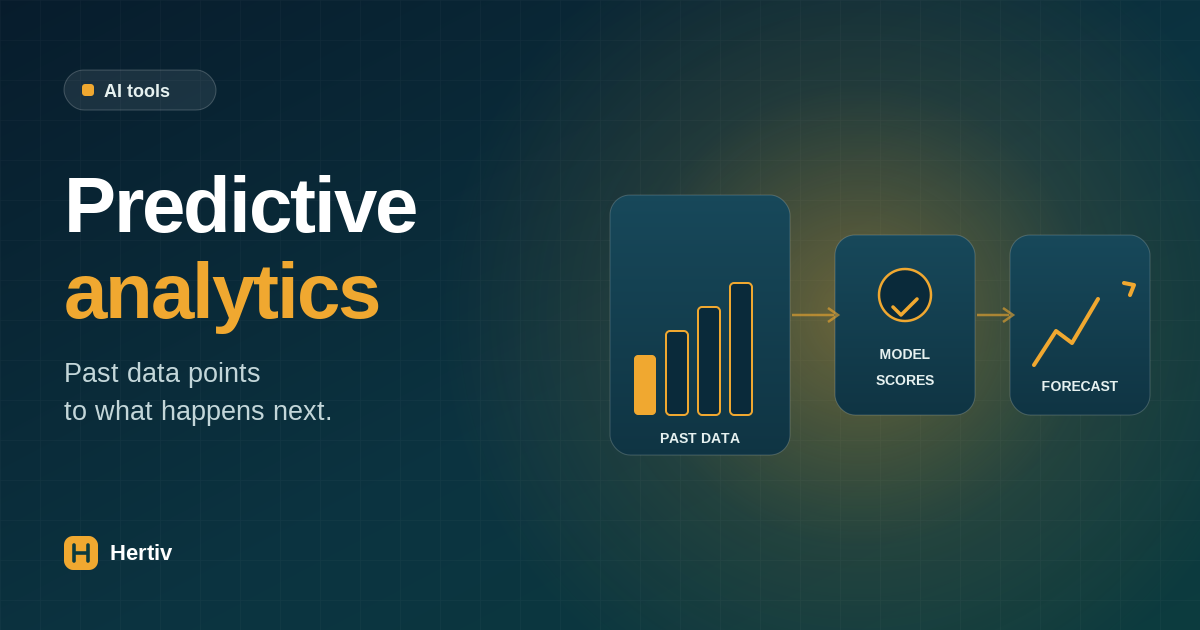
Predictive analytics is the use of past data and statistical models to estimate the likelihood of a future event, such as a customer leaving, a machine failing or demand rising. It works by finding patterns in historical data, building a model from them, and scoring new cases as they arrive. It gives probabilities, not certainties, so the value comes from acting on the scores.
What is predictive analytics?
Predictive analytics is the practice of using historical data to estimate what is likely to happen next. Instead of reporting what already happened, it scores the chance of a future event, such as a customer cancelling, a part failing or a product selling out.
The output is a probability, not a fact. A model might say a customer has a 70% chance of leaving in the next month. That number is only useful if someone acts on it, for example by calling the customer with a retention offer.
It sits between descriptive analytics, which summarises the past, and prescriptive analytics, which recommends an action. Predictive analytics answers the question "what is likely to happen?", and the business decides what to do about it.
How does predictive analytics work?
Predictive analytics works by learning patterns from past examples and applying them to new cases. The process has the same shape in most businesses, even when the models differ.
| Step | What happens | Example |
|---|---|---|
| Define the outcome | Pick one event to predict | Customer cancels in 30 days |
| Gather data | Collect past cases with outcomes | Usage, billing, support tickets |
| Build the model | Fit a model to the past data | Logistic regression or a tree model |
| Test it | Check it on cases it has not seen | Hold out the last three months |
| Score new cases | Rank live cases by likelihood | Weekly churn-risk list |
| Act and measure | Take action and track the result | Retention calls and saved accounts |
The model is the middle of the work, not the whole job. Data preparation and the action that follows the score usually take more time than choosing the algorithm. For a comparison with the other main approach, see predictive analytics vs machine learning.
What data does predictive analytics need?
Predictive analytics needs past cases where the outcome is already known, plus the signals that might explain it. Without labelled history, there is nothing for the model to learn from.
Three kinds of data matter most. First, the outcome itself, recorded consistently over time: who left, which machines failed, which orders were late. Second, the signals that come before it: usage, payments, sensor readings or behaviour. Third, context that changes the meaning of the signals, such as season, region or product version.
Data quality matters more than data volume. A small, clean set of past cases with a clear outcome beats a large, messy one. Common gaps are outcomes that were never recorded, such as churn that was never labelled, and signals that only exist for some customers.
Where do businesses use predictive analytics?
Businesses use predictive analytics wherever a repeated decision has a recorded outcome. The value comes from ranking cases so that people spend their time on the ones that matter most.
Common uses include churn scoring, where a subscription business ranks accounts by likelihood to leave; demand forecasting, where a retailer predicts sales by product and region; and predictive maintenance, where sensor data flags machines likely to fail before they break.
Other uses are fraud scoring, which ranks transactions by risk as they arrive; lead scoring, which ranks prospects by conversion likelihood; and credit scoring, which estimates repayment risk. Each of these is a ranking problem, and the model only needs to be good enough to change who gets attention first. A longer list of uses is in predictive analytics use cases.
Example: a subscription business predicting churn
Example (hypothetical): a subscription business has 10,000 customers and loses 400 a month. The team builds a churn model from usage, billing and support data, and each week it flags the 800 accounts most likely to leave.
The team calls the flagged accounts with a retention offer. If 25% of the 800 accept the offer and stay, that is 200 customers saved in the month. At $50 a month each, that is $10,000 of monthly revenue kept, or $120,000 over a year.
The arithmetic only works if the model is accurate enough. If the flagged 800 include only 200 customers who would really have left, the team still saves 50 of them with the same 25% response rate, which is $2,500 a month. That is why the team measures the model on recent data before trusting the forecast.
The lesson is to start with one decision and one action. A churn list that nobody calls is just a report; the value appears when the list changes who gets a call and when.
What are the limits of predictive analytics?
Predictive analytics has clear limits, and ignoring them is how projects fail. The biggest limit is that it predicts from the past, so it cannot foresee events that have no precedent in the data.
A model trained on normal trading will not predict a market shock. A churn model trained on last year's customers may miss a new segment that behaves differently. When the world changes, the model needs retraining on fresh data.
Other limits are bias in the training data, which the model will repeat, and false confidence, where a precise-looking score hides a weak model. A probability of 72% sounds exact, but if the model is only slightly better than guessing, the number is misleading. Always check the model against recent cases it has not seen before trusting it.
What are the common mistakes?
The most common mistakes in predictive analytics are predicting the wrong thing, skipping the action step, and trusting a model that was never tested on fresh data.
- Predicting what is easy, not what matters. A model that predicts something nobody acts on is a report, not a tool.
- No action attached to the score. A churn list with no retention playbook changes nothing. Define the action before building the model.
- Testing on the training data. A model always looks good on the data it learned from. Test it on recent cases it has not seen.
- Ignoring data drift. Customer behaviour changes over time. A model that is not retrained slowly goes stale.
- Overcomplicating the model. A simple model that the team understands and trusts beats a complex one nobody can explain.
- Confusing prediction with causation. A signal that predicts churn may not cause it. Acting on the wrong cause wastes effort.
If you are scoping a first model, predictive analytics services cover the data and modelling work from pilot to production.
Key takeaways
- Predictive analytics estimates the likelihood of a future event from past data, not a certainty
- The output is a score that only has value when someone acts on it
- It needs past cases with a recorded outcome, plus the signals that came before it
- Common uses are churn, demand, maintenance, fraud and lead scoring
- Test every model on recent unseen data, and retrain as behaviour changes
Frequently asked questions
What is the difference between predictive and descriptive analytics?
Descriptive analytics summarises what already happened, such as last month's sales. Predictive analytics estimates what is likely to happen next, such as which customers may leave. The two work together: you need good descriptive data before a prediction can be trusted.
Is predictive analytics the same as machine learning?
No, though machine learning is often the tool used. Predictive analytics is the goal of forecasting an outcome, while machine learning is one way to build the model. Simple statistical models also count as predictive analytics when they forecast from past data.
How much data do you need for predictive analytics?
You need enough past cases with a known outcome, usually at least a few hundred, plus the signals that might explain the outcome. Clean, well-labelled history matters more than sheer volume.
Can predictive analytics predict the future accurately?
It gives probabilities, not certainties. A good model ranks cases well enough to guide action, but it cannot foresee events with no precedent in the data. Its value comes from better decisions, not perfect forecasts.
What is a good first predictive analytics project?
Churn scoring or demand forecasting are good first projects, because the outcome is recorded, the action is clear, and the result can be measured within weeks. Pick one decision, one model and one action to start.
How often should a predictive model be retrained?
Retrain when the data changes or the model's accuracy drops on recent cases. Many teams retrain monthly or quarterly, and sooner after a product change or a shift in customer behaviour.


