AI in Commercial Loan Operations: Faster Credit, Fewer Errors
AI in commercial loan operations speeds up business lending: it reads financials, drafts credit memos and watches covenants. Here is how it works.
On this page
Short answer
AI in commercial loan operations is the use of machine learning across business lending, from application and credit analysis to covenant monitoring, servicing and collections. It reads financial statements, flags weak borrowers early and drafts the paperwork, so lenders decide faster with fewer errors. Credit officers still set policy, approve large loans and handle workouts.
What is AI in commercial loan operations?
AI in commercial loan operations is software that helps lenders handle business loans, from the first application through to repayment or workout. It reads financial statements, tax returns, bank data and loan documents, then drafts analysis, flags risk and tracks the loan after it closes.
Business lending differs from consumer lending in ways that matter for AI. The borrowers are companies with varied financials, the loans are larger, and the terms include covenants, collateral and personal guarantees. A model that works for credit cards will not understand a construction loan or a revolving credit line.
Five jobs cover most of what the tools do today:
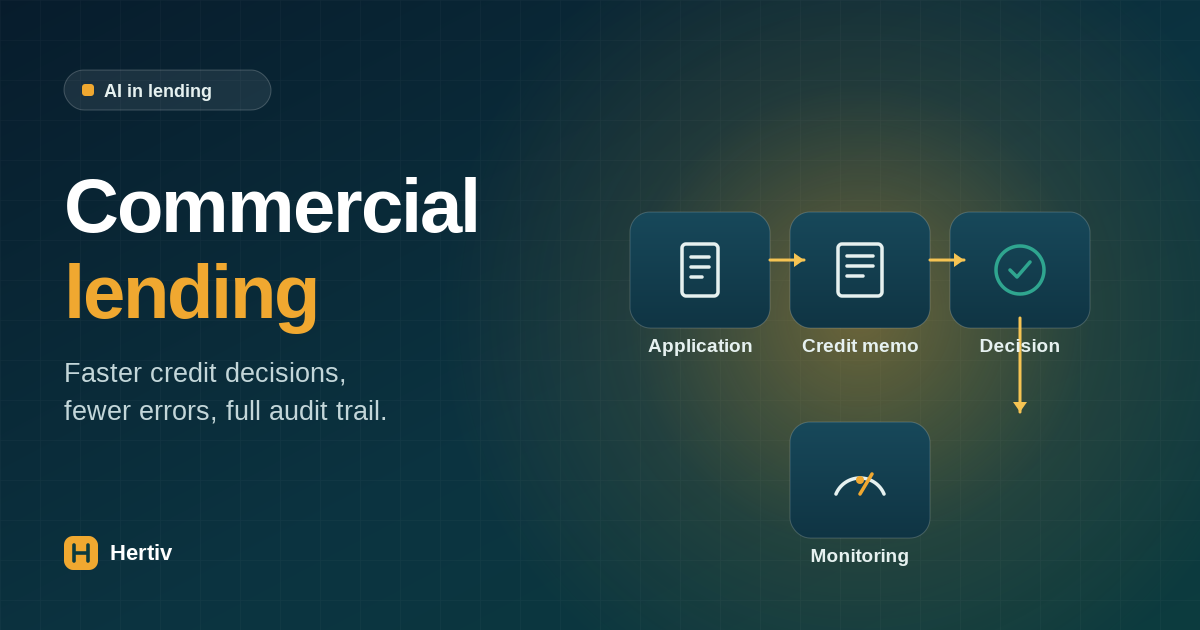
| Stage | What the AI does | Who checks it |
|---|---|---|
| Origination | Reads applications and pulls financials into one file | Relationship manager |
| Credit analysis | Spreads statements and drafts the credit memo | Credit analyst |
| Decision | Scores the borrower and suggests terms | Credit committee |
| Monitoring | Watches covenants and payment patterns | Portfolio manager |
| Collections | Ranks late accounts and drafts reminders | Collections team |
The pattern is the same at every stage: the model prepares the work and a person decides. A credit memo drafted by AI still needs an analyst who understands the business, and a covenant breach flagged by AI still needs a person to call the borrower.
How does AI help originate business loans?
AI helps originate business loans by taking the document pile off the relationship manager's desk. A typical application arrives with financial statements, tax returns, bank statements and a business plan, often as scanned PDFs in different formats.
The model reads those documents, pulls out revenue, profit, debt and cash flow, and builds a single borrower file. It can also check the company against public records, sanctions lists and prior lending history. What used to take a day of copying numbers now takes an hour of review.
The gain is not just speed. When the data is pulled the same way every time, the credit team compares borrowers on a like-for-like basis instead of arguing about which spreadsheet is right. That consistency matters when a committee has to defend a decision to auditors or regulators.
Origination is also where bad data does the most damage. A misread financial statement at this stage follows the loan all the way to the committee. Every extracted figure needs a check against the source document before it enters the credit file.
How does AI change credit analysis and underwriting?
AI changes credit analysis by spreading financial statements and drafting the credit memo, which is the slowest part of underwriting a business loan. The analyst still writes the judgement, but the arithmetic and the first draft are done for them.
The model can also score the borrower against the lender's own history, showing how similar loans performed. It might note that borrowers in a certain sector with a certain debt level defaulted more often, or that a borrower's cash flow is thinner than peers. Those comparisons help the analyst ask better questions.
Where the model must stay in its lane is the final decision. A score is an input, not an approval. Large loans, unusual structures and first-time borrowers all need a credit committee that can weigh factors the model cannot see, such as the quality of the management team or a change in the borrower's market.
Regulators also expect an explanation. If a loan is declined, the lender must be able to say why in plain language. A model that cannot explain its score is a risk, so most lenders keep the AI as an adviser and keep the decision and its reasons with people. For the underwriting step itself, AI loan underwriting explains how lenders decide faster without losing that explanation.
What does AI do after the loan closes?
After the loan closes, AI watches the borrower and the loan so problems surface early. It tracks covenant tests, payment patterns and new financial filings, and alerts the portfolio manager when something moves in the wrong direction.
Covenant monitoring is the clearest win. A business loan may have quarterly tests on debt levels, cash flow and working capital. Checking those by hand across hundreds of loans is slow, so tests are often late. A model can run the tests the week the financials arrive and flag the breaches the same day.
Payment behaviour is another early signal. A borrower who starts paying a few days late, or whose account balances are thinning, may be heading for trouble months before a missed payment. The model ranks accounts by risk so the team calls the right borrowers first instead of working through a list in order.
When a loan does go late, AI drafts the reminders and the collections file, pulling the payment history and the relevant clauses into one place. The collections officer still makes the call and decides the approach, but they start with the facts in front of them. The servicing side is covered in more depth in AI in loan servicing.
How do you start using AI in commercial lending?
You start using AI in commercial lending by picking one stage of the loan process and proving the tool there, before touching the credit decision itself. Document reading and covenant monitoring are the safest first jobs.
- Pick one stage. Choose a repeated task such as spreading financials, drafting memos or running covenant tests. Leave the final credit decision with people.
- Collect your documents. Gather a sample of recent applications and financials, including the messy ones. If the tool only works on clean files, it will fail on real ones.
- Run a blind trial. Have the model spread ten recent loans and compare its figures with the analysts' own spreads. Measure accuracy first, speed second.
- Write the review rule. Decide who checks the output, what counts as a pass, and what happens when the model and the analyst disagree. Put it in writing.
- Check explainability. Make sure every score and flag can be traced to the data behind it. If the vendor cannot show that, the tool is not ready for regulated lending.
- Expand slowly. Add a second stage only after the first has run clean for a month or two. Keep a log of errors and fixes so the team learns from them.
Talk to compliance early, not after the trial. Lending is regulated, and a tool that cannot explain its outputs or keep an audit trail will be blocked no matter how fast it is.
Example: a lender reviews 120 applications a month
Example (hypothetical): a regional lender receives 120 business loan applications a month. Each one takes a credit analyst about 6 hours to spread, check and draft into a memo, so the team spends about 720 hours a month on first drafts, or roughly four and a half full-time analysts.
The lender trials an AI document tool. The model spreads the financials and drafts the memo, so each application now takes the analyst about 3 hours: 1 hour checking the extracted figures and 2 hours on judgement, questions and the final recommendation. The monthly total falls to 360 hours, saving about 360 hours, or roughly two full-time analysts' worth of time.
The saving is real, but only because the check step stayed in place. In the trial month, the model misread the revenue line on 5 of the 120 applications, and the analysts caught all five. Without that check, five credit files would have gone to the committee with wrong numbers.
The lender keeps the 3-hour review as a fixed rule and uses the saved time for site visits and borrower calls, which is where the real credit judgement happens.
What are the common mistakes?
The most common mistakes in commercial loan AI are trusting extracted figures without checking them, letting a score replace the credit decision, and buying a tool that cannot explain its outputs to a regulator.
- Skipping the figure check. A misread financial statement follows the loan to the committee. Check every extracted number against the source document.
- Score as decision. A model score is one input. Large loans, unusual structures and new borrowers need a committee that can weigh what the model cannot see.
- Unexplainable models. If a declined borrower or a regulator asks why, the lender must answer in plain language. Keep the decision and its reasons with people.
- Dirty document samples. A trial run only on clean, typed financials proves nothing. Test on scanned, messy and incomplete files too.
- Ignoring covenant drift. A model that only checks covenants quarterly will miss a borrower sliding between tests. Run the checks as soon as new financials arrive.
Credit scoring is the narrowest piece of this picture; AI credit scoring use cases covers where scores help and where they mislead.
For the agent angle, see AI agents for finance teams.
Key takeaways
- AI in commercial loan operations covers origination, analysis, decision support, monitoring and collections
- Document reading and covenant monitoring are the safest first jobs; the credit decision stays with people
- A misread financial statement follows the loan to the committee, so every figure needs a source check
- Covenant tests run the week financials arrive catch trouble months earlier than quarterly checks
- Every score and flag must be explainable in plain language for borrowers and regulators
Frequently asked questions
What is AI in commercial loan operations?
It is machine learning used across business lending: reading applications and financials, spreading statements, drafting credit memos, scoring borrowers, watching covenants and ranking late accounts. It prepares the work so credit officers can decide faster, with fewer errors, and with a clear audit trail.
Can AI approve a business loan on its own?
It should not. A score is an input, not an approval. Large loans, unusual structures and first-time borrowers need a credit committee that can weigh management quality, market changes and other factors a model cannot see. Regulators also expect a plain-language reason for every decision.
How does AI help with covenants?
A business loan may have quarterly tests on debt, cash flow and working capital. A model can run those tests the week new financials arrive and flag breaches the same day, instead of the team finding them months later when the next review comes round.
What is the biggest risk in using AI for lending?
Bad data at the start. A misread revenue or debt figure follows the loan through analysis, decision and monitoring. The fix is a fixed review step where an analyst checks every extracted figure against the source document before it enters the credit file.
How long does it take to start?
A small trial on one stage, such as spreading financials, can run in a few weeks if the documents are available. Expanding across the whole loan process takes longer, because compliance, explainability and staff training all need to be in place first.
Does AI replace credit analysts?
No. It removes the slow arithmetic and drafting so analysts spend their time on judgement, borrower calls and site visits. In trials, the review step still catches model errors, which is exactly why the analyst role matters more, not less.