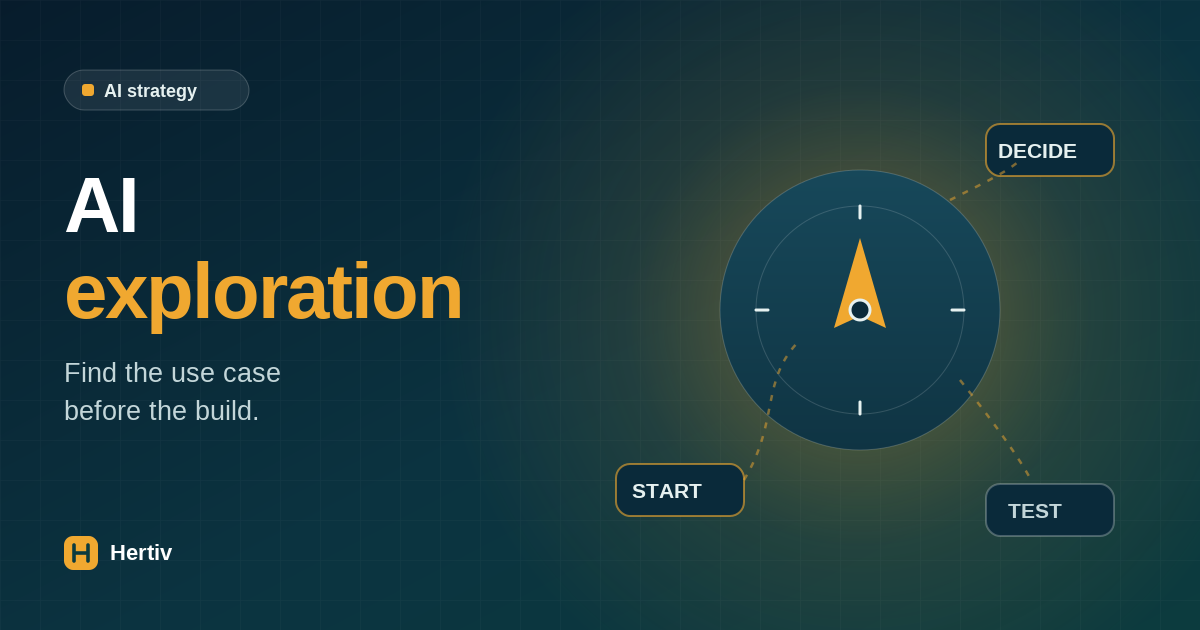
AI Exploration: How Teams Find and Test AI Opportunities
AI exploration is the search for where AI can help your business: finding use cases, testing them cheaply, and keeping only the ones that prove their value.
On this page
Short answer
AI exploration is the structured process of finding where artificial intelligence can help a business, testing those ideas cheaply, and keeping only the ones that prove their value. It sits before building: a short phase of interviews, data checks and small experiments that answers which use cases are real, which data exists, and what a first version should do.
What is AI exploration?
AI exploration is the deliberate search for useful AI work inside a business, done before any serious building starts. It means listing the workflows where people spend time on repetitive judgement, checking whether the data for those workflows exists, and running small tests to see which ideas hold up.
It is not a technology purchase and not a strategy document. It is a short, practical phase: talk to the people doing the work, look at the data they already have, and try the cheapest possible version of the most promising idea. The output is a ranked list of use cases with evidence, not a slide deck of possibilities.
Exploration matters because most AI ideas fail on data, not on models. A workflow that sounds perfect in a meeting often turns out to have its key information trapped in email threads, scanned PDFs or one person's head. Finding that out in a two-week exploration is cheap; finding it out after a six-month build is not.
Think of it as prospecting. You are looking for the places where a model can do real work with data you already hold, and you are ruling out the places where it cannot, before you commit budget.
How is exploration different from a pilot or a readiness check?
Exploration, readiness checks and pilots answer different questions, and mixing them up is how teams waste money. Exploration asks which use cases exist. A readiness check asks whether the organisation can deliver them. A pilot asks whether one chosen use case works in production.
| Phase | Question it answers | Typical length |
|---|---|---|
| Exploration | Where could AI help, and is the data there? | Two to four weeks |
| Readiness check | Can we deliver AI safely and reliably? | Two to six weeks |
| Pilot | Does this one use case work in production? | Four to twelve weeks |
| Production build | Can it run reliably at full volume? | Months |
Exploration comes first because it is the cheapest place to kill bad ideas. A readiness check on a use case that does not exist wastes the check. A pilot of a use case nobody needs wastes the pilot.
If you have already run a readiness assessment, exploration still helps: it turns a general statement that the organisation is ready into a specific list of what to build first. For the assessment itself, see what an AI readiness assessment covers.
Where do good AI opportunities hide?
Good AI opportunities hide in workflows where people move information between systems, make repeated judgements from documents, or answer the same questions again and again. Those patterns show up in almost every department, and the people doing the work can usually name them in a single conversation.
Look for volume first. A task done hundreds of times a month with a clear right answer is a better candidate than a rare, high-stakes decision. Then look for review: if a human already checks the output today, the AI version has a safety net built in.
Data is the filter that removes most candidates. The workflow needs digital inputs, a record of past decisions, and a way to tell whether the output was right. A team that keeps its knowledge in chat messages and memory will struggle, while a team with a ticket history, a document store or a CRM has something to build on.
Talk to the people closest to the work, not just to managers. Support agents know which tickets eat their day. Finance staff know which reconciliation takes the longest. The best exploration interviews are thirty minutes with the person who does the task, not a workshop with the people who manage it.
How do you run a small AI experiment?
You run a small AI experiment by picking one workflow, assembling a small sample of real inputs with known good outputs, and testing the cheapest version that could work. The point is learning, not launching.
- Pick one workflow. Choose the highest-volume task with a clear right answer and an existing reviewer.
- Gather twenty examples. Real inputs with known good outputs, taken from actual work, not invented cases.
- Try the simplest approach. A prompt over your own documents, or a small model on the sample, before any fine-tuning or building.
- Score it honestly. How many outputs were right, how many needed fixing, and how long did the fix take?
- Decide with a threshold. Agree in advance what good looks like, such as eight of ten outputs needing no correction.
Keep the experiment small enough to finish in days. An experiment that takes a month to set up is a project wearing an experiment's clothes, and it will be judged as a project.
Document what you tried, including the failures. A failed experiment that explains why is worth more than a successful demo that nobody can reproduce. When an experiment passes its threshold, the next step is a proof of concept with a fixed evaluation set.
How do you decide what to build, buy or drop?
You decide by scoring each candidate on value, data readiness and effort, then sorting honestly. The scoring does not need to be elaborate; a simple table that the team fills in together beats a complex model that nobody trusts.
Value means time saved, errors reduced or revenue protected, measured on the real workflow rather than guessed. Data readiness means the inputs exist digitally and the past decisions are recorded. Effort means integration, evaluation and change management, not just model work.
Build when the workflow is core to how you compete and no product covers it well. Buy when a product already does the job and the cost of integrating it is lower than building. Drop when the data is not there, the value is vague, or the task needs judgement the model cannot show its working for.
Be willing to drop most candidates. A good exploration ends with two or three use cases worth building and a longer list of ideas that were tested and set aside with reasons. That list is an asset: it stops the same ideas returning every quarter as if they had never been examined.
What does a good exploration sprint look like?
A good exploration sprint lasts two to four weeks, has a named owner, and ends with a ranked list and a decision. It is structured enough to produce evidence and short enough that nobody loses interest.
Week one is interviews and data checks. Talk to the people doing the work in each candidate area, and check whether the data those workflows need actually exists in a usable form. By the end of the week you should have a long list of candidates and a short list worth testing.
Week two is experiments. Run the cheapest test on each shortlisted idea with real examples, score the results against the threshold you set, and record what failed and why.
Week three is the decision. Present the ranked list with evidence: what was tested, what the scores were, what it would take to build each one, and what was dropped and why. The decision is which one or two ideas go to a proof of concept, and who owns them.
Keep the sprint team small: one owner, one person who knows the data, and one person who can run the experiments. A large committee explores slowly and decides rarely.
Example (hypothetical): a 120-person distributor explores AI in three weeks
Example (hypothetical): a 120-person distributor wants to know where AI could help. The owner interviews ten staff and finds three candidates: answering repeat customer questions, matching supplier invoices, and forecasting stock for 400 product lines.
Week two tests all three on real samples. The customer-question test uses 20 past tickets and drafts answers that need correction on 6 of 20, passing the threshold of 8 in 10 needing no fix. The invoice test matches 17 of 20 invoices to purchase orders. The forecasting test fails: sales history lives in three spreadsheets with different product codes, and cleaning it would take a month.
The decision is to take the customer-question and invoice ideas to a proof of concept, and to drop forecasting until the product codes are unified. The three-week cost is about 60 hours of staff time, and the team now has a ranked list with evidence instead of three opinions.
Notice the pattern: two ideas passed because the data was ready and the task had a clear right answer. The third failed on data, not on the model, which is the most common reason exploration kills a candidate.
What are the common mistakes?
The most common mistakes are exploring without a decision at the end, testing on invented data, and letting the loudest idea win instead of the best-evidenced one.
- No decision date. Exploration without a deadline becomes permanent research.
- Testing on made-up examples. Invented inputs flatter every approach. Use real work.
- Skipping the data check. A use case with no usable data is a wish, not a candidate.
- Letting seniority decide. The best-evidenced idea should win, not the most senior person's favourite.
- Exploring everything at once. A long list with no tests is a brainstorm, not an exploration.
- Hiding the failures. Dropped ideas with reasons save the next quarter's time; hidden failures get repeated.
Once exploration points at a real candidate, implementing an AI readiness assessment checks whether the organisation can deliver it safely.
Key takeaways
- AI exploration finds use cases with evidence; it is not a purchase or a strategy document
- Start with high-volume work where a human already reviews the output
- Data readiness kills most candidates, so check the data before testing the model
- Run small experiments on real examples with a pass threshold agreed in advance
- A good sprint ends with two or three build candidates and a list of dropped ideas with reasons
- Exploration comes before readiness checks and pilots, because it is the cheapest place to kill bad ideas
Frequently asked questions
How long should AI exploration take?
Two to four weeks is enough for most teams. Week one covers interviews and data checks, week two runs small experiments on real examples, and week three ends with a ranked list and a decision. Longer than that, and exploration turns into research without a deadline.
What do we need before we start exploring AI?
Very little: access to the people doing the work and to the data they already use. You do not need a platform, a vendor or a budget for building. You need permission to look at real tickets, documents and records.
How is AI exploration different from an AI readiness assessment?
Exploration finds which use cases exist and whether their data is ready. A readiness assessment checks whether the organisation can deliver AI safely, covering data, skills, governance and infrastructure. Exploration comes first; it gives the assessment something specific to assess.
How many use cases should exploration produce?
A good sprint ends with two or three candidates worth building and a longer list of ideas tested and dropped with reasons. If everything passes, the tests were too easy. If nothing passes, the data is probably not ready yet.
What if our data is messy?
Then exploration has done its job by finding that out cheaply. Fix the specific data gap the best candidate needs, such as unifying product codes or digitising a record, rather than launching a general data programme with no use case attached.
Who should run AI exploration?
A small team: one owner, one person who knows the data, and one person who can run experiments. Keep it close to the people doing the work, and keep the decision meeting short, with evidence on the table.