Ambient Intelligence in Manufacturing: How It Works
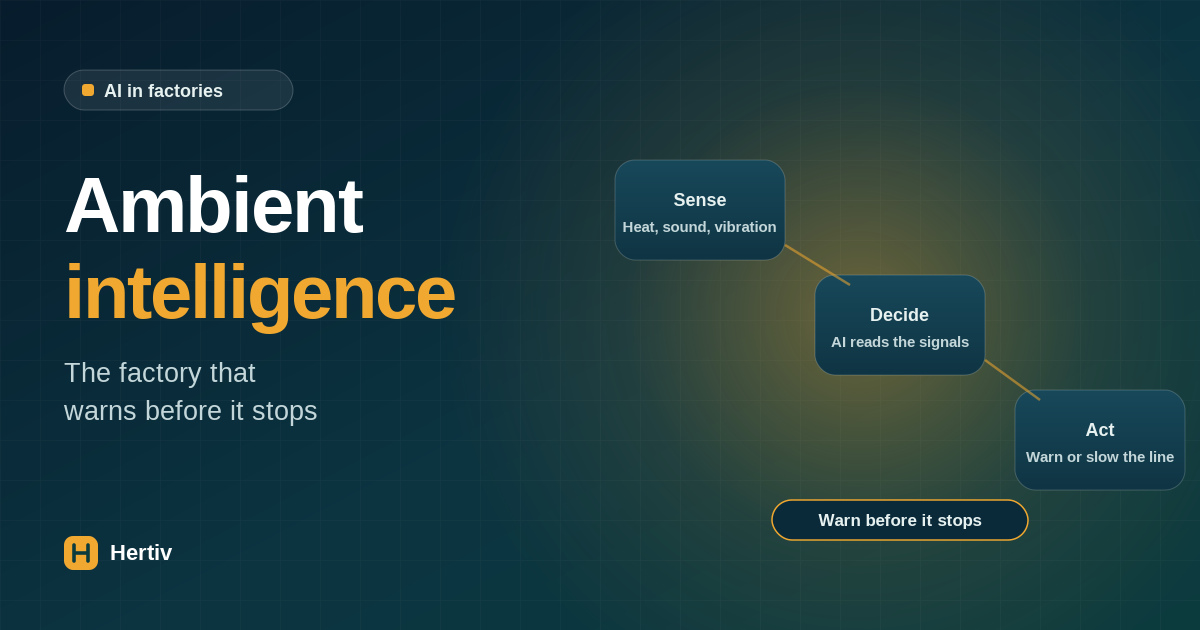
Ambient intelligence means the factory senses what is happening, understands it and acts, so machines warn before they fail and workers get help without asking.
On this page
Short answer
Ambient intelligence in manufacturing is a factory environment where sensors, cameras and connected machines gather data all the time, AI makes sense of it, and the system responds on its own, for example by warning an operator before a machine fails or by slowing a line when a part is out of place. The intelligence lives in the environment, not in one device.
What is ambient intelligence in manufacturing?
Ambient intelligence in manufacturing is a factory where the environment itself senses, understands and responds. Sensors, cameras and connected machines collect data all the time, AI turns that data into decisions, and the system acts, for example by warning an operator, adjusting a machine or calling for maintenance, without anyone asking it to.
The word "ambient" matters. The intelligence is not a screen a worker must check or a report a manager must read. It is built into the space, so the right information reaches the right person at the right moment, often as a light, a sound or a message on a device the worker already uses.
| Part | What it does | Example in a factory |
|---|---|---|
| Sense | Collects data from the floor | Vibration, heat, sound, camera images |
| Understand | Turns data into a picture of the state | A bearing is wearing out, a part is misaligned |
| Decide | Chooses the best response | Warn now, slow the line, call maintenance |
| Act | Carries out the response | Alert, speed change, work order |
| Learn | Improves from what happened | Fewer false alarms, earlier warnings |
Ambient intelligence is not one product. It is a way of connecting sensors, AI models and machines so the factory reacts to what is happening instead of waiting for a person to notice. A factory that already collects machine data is closer than it thinks, because the sensing layer is often the hardest part to build. The AI side starts with the same ideas as machine learning.
How does ambient intelligence work on a factory floor?
Ambient intelligence works on a factory floor by running a loop: sense, understand, decide, act, and then learn from the result. The loop runs all the time, on every machine that is connected, and it gets faster and more accurate as more data flows through it.
Sensing comes first. Vibration sensors watch bearings, heat sensors watch motors, cameras watch the line, and microphones listen for sounds that mean wear or a loose part. The sensors send their data to a local system on the factory floor, which filters out the noise and keeps the signals that matter.
Then the AI models read those signals and work out what is happening. A model might learn the normal vibration pattern of a machine and flag a change that a person would miss. Another model might read camera images and spot a part that is out of place.
The system then decides what to do: warn the operator, slow the line, or open a maintenance job. The decision is usually a small, safe action, and the risky actions stay with a person.
Where does ambient intelligence help most?
Ambient intelligence helps most where small problems become big ones if nobody notices them in time. The clearest wins are in maintenance, quality and safety, because those are the places where an early warning is worth the most.
In maintenance, the system watches for the early signs of wear and warns days before a failure, so the repair can be planned instead of forcing an unplanned stop. In quality, cameras and sensors catch a defect as it happens, so only one bad part is made instead of a whole batch.
In safety, the system can slow a machine when a worker steps into a marked zone, or warn a team when a forklift is close.
It also helps with energy and flow. A system that watches the whole line can spot a bottleneck, suggest a change in the order of jobs, or switch off a machine that is waiting for parts.
The gains are often small on their own, but they add up across a shift, a week and a month. The same staged thinking is used in building an AI proof of concept: start with one clear problem and measure the result.
What data and systems do you need first?
Before ambient intelligence can work, a factory needs data it can trust, machines it can reach, and a clear picture of what "normal" looks like. Without those three, the AI has nothing solid to learn from, and the warnings will be wrong as often as they are right.
Start with the data. The factory needs sensors on the machines that matter, a way to store the readings, and a record of what happened when a machine failed or a part was bad. That history is what the models learn from, so a factory that has kept maintenance logs and quality records is in a strong position.
Then comes the system. The sensors need a network that reaches them, a local computer or gateway that can filter the data, and a link to the systems that hold orders, schedules and maintenance jobs. The AI does not need to replace those systems; it needs to read from them and write its warnings back into them, so the operator sees the warning where they already work.
How do you start ambient intelligence in a factory?
You start ambient intelligence in a factory by picking one machine and one problem, proving the loop works there, and then spreading it to the next machine. A big rollout across the whole plant is the wrong first step, because the data, the models and the habits are all new at once.
- Pick one painful problem. Choose a machine that stops often, a defect that costs the most, or a safety risk the team already worries about.
- Put sensors on that machine. Measure the signals that matter, such as vibration, heat or sound, and collect them for a few weeks.
- Build the picture of normal. Use the collected data to learn what the machine looks like when it is healthy.
- Set the first warning. Pick one clear signal, such as vibration above a level, and send a warning to the operator when it happens.
- Check the warnings. Track which warnings were right and which were false alarms, and adjust the level until the team trusts it.
- Spread what works. Copy the working loop to the next machine, using what you learned about sensors, data and warnings.
Each step should take weeks, not months, and each step should end with a working result the team can see. Testing the models as you go matters, so follow the same care as testing AI models before they reach the floor.
Example (hypothetical): a packaging line that warns before it stops
Example (hypothetical): a food factory has a packaging line that stops about 20 times a month. Each stop lasts about 25 minutes while an operator finds the fault and restarts the line, so the line loses about 500 minutes a month, which is 8 hours and 20 minutes.
The team puts vibration and heat sensors on the two machines that stop most often and collects data for a month. The data shows that a bearing starts to vibrate more than usual about two days before it fails. The team sets a warning: when the vibration passes a level, the operator gets a message and checks the bearing at the next planned stop.
Over the next month, the line stops 6 times instead of 20, and each stop still lasts about 25 minutes, so the lost time is 150 minutes, or 2 hours and 30 minutes.
The saving is 350 minutes, about 5 hours and 50 minutes a month, and the team now plans the bearing change instead of reacting to a breakdown. The sensors cost less than one month of the saved time, so the team copies the same setup to the next line.
What are the common mistakes?
The most common mistakes in ambient intelligence are sensing everything and understanding nothing, trusting the first model, and building a system the operators do not use.
- Sensing without a question. Sensors that nobody reads are just cost, so start from the problem, not the hardware.
- Trusting the first model. Early models give false alarms, and a team that loses trust stops looking at the warnings.
- Ignoring the operators. If the warning goes to a screen nobody watches, the system changes nothing.
- Letting the system act alone. Risky actions, such as stopping a line, should stay with a person until the system has proved itself.
- Skipping the data history. Without records of past failures, the model cannot learn what "going wrong" looks like.
Key takeaways
- Ambient intelligence means the factory senses, understands and acts on its own
- The loop is sense, understand, decide, act, then learn from the result
- Start with one machine and one painful problem, not a plant-wide rollout
- The warning must reach the person who can act, within minutes
- Check the warnings and fix the false alarms, or the team will stop trusting them
Frequently asked questions
Is ambient intelligence the same as the Internet of Things?
No. The Internet of Things is the network of connected sensors and devices. Ambient intelligence is what happens when AI reads the data from those devices and the environment responds to it. IoT provides the sensing; ambient intelligence adds the understanding and the action.
Does ambient intelligence replace factory workers?
No. It changes what workers do, from watching and reacting to checking warnings and making decisions. The system handles the routine watching, while people handle the judgement calls, the repairs and the exceptions the system cannot resolve on its own.
How much does it cost to start?
A small pilot on one machine costs far less than a plant-wide system, because it needs only a few sensors, a gateway and a simple model. Teams should get quotes from their own sensor and software providers, since prices vary, and compare the cost with the downtime the pilot is meant to save.
What if the factory has old machines with no sensors?
Old machines can still be fitted with external sensors, such as vibration, heat and sound sensors that attach to the outside. The sensors do not need to change the machine itself, so a factory can start without replacing its equipment.
How do you stop false alarms from annoying the team?
Start with a warning level that only fires when the signal is clear, and track every warning to see if it was right. Adjust the level until the team trusts it. It is better to miss an early warning than to send so many false alarms that the team stops looking.
Can ambient intelligence work in a small factory?
Yes, and it often helps most there, because a small team cannot watch every machine at once. A pilot on the one machine that stops most often is a good start, and the lessons from that pilot apply directly to the next machine.


