AI Agent Repair Cost Predictor: What It Is and How It Works
An AI agent repair cost predictor reads a photo or description of damage, looks up parts and labour, and returns a cost estimate before anyone picks up a tool.
On this page
Short answer
An AI agent repair cost predictor is software that estimates what a repair will cost before the work starts. It takes a photo or a written description of the damage, works out which parts and how much labour the job needs, and returns a price range. The agent part means it can ask follow-up questions, look up prices, and keep the estimate up to date as new information arrives.
What is an AI agent repair cost predictor?
An AI agent repair cost predictor is a software agent that turns damage into a number. A car owner photographs a dent, a homeowner describes a leaking pipe, or a workshop uploads a fault report, and the agent returns an estimate of parts, labour and total cost.
The agent is different from a simple price list because it can act: it can ask for another photo, check the price of a part, look up the labour time for a job, and revise the estimate when the answers come in. The human still approves the final quote, but the agent does the gathering and the arithmetic.
| Input | What the agent reads | Example |
|---|---|---|
| Photo | Damage type, size and location | A dent on a car door |
| Description | Symptoms in plain words | A washing machine that will not spin |
| Fault code | Diagnostic code from a device | An engine warning light code |
| Model details | Make, model and year | A 2021 hatchback or a 2019 boiler |
| Location | Local labour rates | A garage in one city versus another |
The estimate is a range, not a promise. A photo can hide damage, and the true cost is only known once the item is opened up. A good predictor says so, and gives the range with the reasons behind it.
How does a repair cost predictor work?
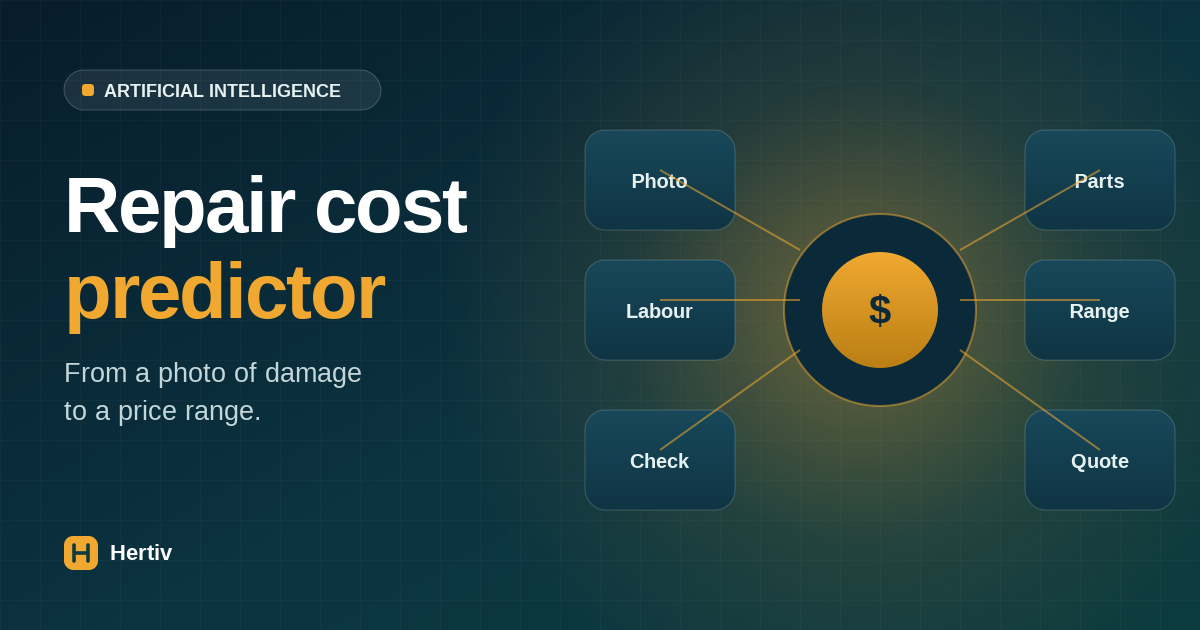
A repair cost predictor works in four steps. First it identifies the damage: the model reads the photo or the description and names the fault, such as a cracked bumper or a failed pump. Then it lists the parts the job needs and looks up their prices from a parts catalogue or a supplier.
Next it estimates the labour: the time the job should take, based on a labour guide for that make and model, multiplied by the local hourly rate. Finally it adds the parts, the labour and any taxes or fees, and returns a range with the assumptions written out.
The agent layer sits on top of these steps. It can ask the user for a closer photo, for the model number, or for the postcode, and it can re-run the estimate when the answer arrives. For how teams test models like this, see how to test AI models.
Where are repair cost predictors used?
Repair cost predictors are used where a quick estimate saves a visit or a phone call. Car insurers use them to triage claims: a photo of the damage gives a rough cost in minutes, and the claim moves faster. Garages use them to give customers a price before the car arrives, so the customer can decide whether to book.
Home repair is another common use. A homeowner describes a leak or a broken appliance, and the predictor returns a range for the visit, the parts and the labour. That helps the homeowner decide whether to repair or replace, and it helps the tradesperson plan the job.
Appliance and electronics firms use them for warranty triage: a fault code and a photo tell the support team whether the fix is a part, a reset, or a visit. The pattern is the same in every case: the estimate turns a vague problem into a number the customer can act on.
What data does a repair cost predictor need?
A repair cost predictor needs three kinds of data: examples of damage with the correct cost, a parts catalogue with prices, and a labour guide with times. The examples teach the model what damage looks like and what it costs to fix. The catalogue and the guide supply the numbers.
The parts catalogue is the part teams underestimate. Prices change, parts are replaced by new versions, and the same part can cost different amounts from different suppliers. The catalogue needs a regular update, or the estimates drift from the real prices. Teams usually buy a catalogue from a data provider rather than building one.
The labour guide is simpler: a list of jobs with the time each one should take for each make and model. The team multiplies that time by the local hourly rate, which it sets itself. The rate is the number that varies most between cities, so the predictor should ask for the location. For the cost side of building this, see the cost of implementing AI.
Example (hypothetical): a garage estimates a dented door
Example (hypothetical): a garage uses a repair cost predictor for a dented car door. The customer sends a photo, and the agent identifies a dented front door panel that needs repair and repainting. The parts list is small: paint and materials at $120, and no new panel is needed.
The labour guide says the job takes 4 hours: 2 hours to repair the dent, 1 hour to prepare and paint, and 1 hour to refit and check. At the garage's rate of $80 an hour, the labour is 4 x $80 = $320. The total is $120 + $320 = $440, and the agent returns a range of $400 to $480, allowing for paint matching and small surprises.
The customer books on the strength of that range. When the car arrives, the garage finds the door handle is also cracked, which adds $60 for the part and 30 minutes of labour, or $40. The final bill is $440 + $60 + $40 = $540, which is above the range. The garage updates its process so the agent asks for a photo of the handle next time.
What are the limits of a repair cost predictor?
The main limit is that a photo hides damage. A dent can hide a bent frame, a leak can hide a cracked pipe, and a fault code can hide a second fault. The predictor can only price what it can see, so the range should be wide enough to cover what it cannot.
Parts prices are the second limit. A catalogue that is a month out of date can be wrong by enough to matter, and a part that is out of stock may need a dearer substitute. The predictor should say when the price was last checked, and the final quote should always come from a person who has seen the item.
The third limit is the model's confidence. A predictor that is right nine times out of ten is still wrong once, and that once can be the expensive job. Teams should track how often the estimate is close, and widen the range when the error rate rises. For a small first version, see what an AI MVP costs to develop.
What are the common mistakes?
The most common repair cost predictor mistakes are giving a single number instead of a range, trusting an old parts catalogue, and letting the estimate replace the human quote.
- One number, no range. A single price looks certain and is usually wrong. A range with the reasons behind it is more honest.
- Old parts prices. A catalogue that is not updated makes the estimates drift. Update it on a schedule and date the prices.
- No human check. The estimate is a starting point, not a quote. A person should confirm the final price after seeing the item.
- Skipping the photo check. A blurry or dark photo hides damage. Ask for a better photo instead of guessing.
- Hiding the assumptions. If the estimate assumes a part is fine, say so. The customer should know what could change the price.
Key takeaways
- A repair cost predictor turns a photo or description of damage into a cost range
- It adds parts from a catalogue and labour from a guide, then returns a range, not a promise
- The parts catalogue needs regular updates, or the estimates drift from real prices
- A photo hides damage, so the final quote should always come from a person
- Track how often the estimate is close, and widen the range when the error rate rises
Frequently asked questions
What is an AI agent repair cost predictor?
An AI agent repair cost predictor is software that estimates what a repair will cost before the work starts. It takes a photo or a written description of the damage, works out which parts and how much labour the job needs, and returns a price range. The agent can ask follow-up questions and revise the estimate as new information arrives.
Is a repair cost predictor the same as a quote?
No. A predictor gives an estimate, usually as a range, based on what it can see in a photo or description. A quote is a firm price from a person who has seen the item. The predictor helps the customer decide whether to book, but the final price should always be confirmed after an inspection.
Can a repair cost predictor work from a photo alone?
It can give a rough range from a clear photo, but the range will be wide, because a photo hides damage. A dent can hide a bent frame and a leak can hide a cracked pipe. A good predictor asks for more photos or details when the first one is not enough, instead of guessing.
How accurate are repair cost predictors?
Accuracy depends on the job: simple, visible damage is easier to price than hidden faults. Teams track how often the estimate is close to the final bill, and they widen the range when the error rate rises. No predictor is right every time, which is why the result is a range and the final quote comes from a person.
What does a repair cost predictor cost to build?
Cost depends on scope, the parts catalogue and the model. A small first version that covers one kind of repair and one city costs far less than a full product with many categories and a live catalogue. The worked example in this article shows how teams build the number from hours, rates and services.
Do repair cost predictors replace mechanics and tradespeople?
No. They replace the first phone call, not the repair. The predictor gives a rough cost so the customer can decide whether to book, and the tradesperson still inspects the item, confirms the price and does the work. The tool saves time on both sides, but it does not do the repair.


