What Does AI Accounting Software Cost to Develop?
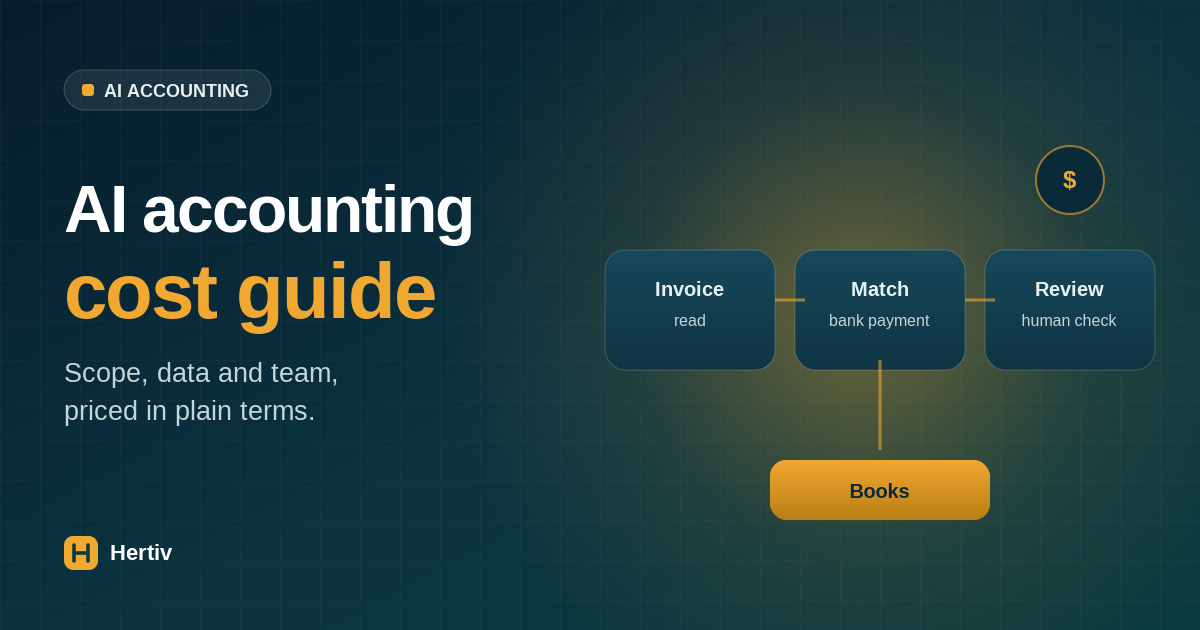
AI accounting software ranges from a pilot to a full product. A first version that reads invoices and matches payments costs far less than a ledger and tax suite.
On this page
Short answer
AI accounting software is software that reads invoices, matches bank transactions and drafts journal entries using AI, and its development cost depends on how much of the accounting work it automates. A first version that reads invoices and matches payments costs far less than a full suite with ledgers, tax and reporting, because the data work and the checks grow with every feature.
What is AI accounting software?
AI accounting software is software that uses AI to do the repetitive parts of accounting: reading invoices and receipts, matching bank transactions to bills, sorting expenses into categories, and drafting journal entries for a human to approve. The AI reads documents that used to be typed in by hand, and it suggests matches that a person used to find by eye.
The software does not replace the accountant. It removes the data entry and the first pass of matching, so the accountant spends time on the cases that need judgement, such as an unusual invoice or a payment that does not match any bill. The product is judged on how many documents it reads correctly and how few of its suggestions a person has to fix.
For the wider cost of building AI products, see the cost of implementing AI. The rest of this article breaks down what drives the cost of the accounting version: scope, data, team and running costs.
What drives the cost?
Four things drive the cost of AI accounting software: the scope of features, the data work, the team, and the running costs. Scope matters most, because each accounting feature brings its own rules, checks and edge cases.
| Cost driver | What it covers | Why it moves the price |
|---|---|---|
| Scope | Invoicing, matching, ledger, tax, reports | Each feature adds rules and checks |
| Data work | Document samples, categories, test cases | Bad data means wrong readings and rework |
| Team | Developers, AI engineer, accountant, tester | Accounting knowledge is the scarce skill |
| Running costs | Model calls, storage, hosting, support | Every document read costs money each month |
| Compliance | Audit trails, data rules, backups | Financial data must be traceable and safe |
Data work is the part teams underestimate. An invoice reader needs hundreds of real invoice samples in different layouts, and a matching engine needs real bank statements with the messy descriptions banks actually write. Collecting and labelling those samples takes weeks, and skipping it means the AI reads well in a demo and badly on real documents.
What does the AI part cost?
The AI part of the cost is the model, the prompts and the checks. Most teams use a ready-made document-reading model and a language model for matching and drafting, rather than training their own. That keeps the build cost down, but it creates a running cost: every invoice read and every match suggested uses model calls that are billed per document or per token.
The build cost of the AI part is mostly the work around the model: writing the prompts, building the checks that catch bad readings, and creating the test set that proves the reader works on real documents. A reader that is right 95 times in 100 is not good enough for accounting, because the 5 wrong readings land in the books. The team must build a review step where a person checks the uncertain cases.
That review step is part of the product, not an afterthought.
For a small first version, the model bill is usually the smaller cost. The bigger cost is the accounting knowledge: someone who knows how a journal entry should look and when a match is wrong.
Without that person, the team will build a reader that works and a product that accountants do not trust. For the cost of a small first version, see what an AI MVP costs to develop.
What team and timeline does it take?
A first version of AI accounting software usually takes a team of four or five people: two developers, one AI engineer, one accountant who knows the rules, and one tester. The accountant is not optional. The team needs someone who can say whether a suggested match is right, and that judgement cannot come from a developer guessing.
A realistic first version takes about three to four months. The first month is data: collecting invoice samples, bank statements and the chart of accounts, and writing the test cases. The second month is the reader and the matcher. The third month is the review screen, the audit trail and the fixes that the test cases expose.
A team that skips the data month will spend the third month fixing readings instead of finishing the product.
The timeline grows when the product must connect to existing accounting systems.
Each connection needs its own mapping of fields and its own tests, and a bank feed that drops transactions will break the matching. Budget a month per major connection, and test each one with real data before launch.
Example (hypothetical): a first version for small firms
Example (hypothetical): a startup builds a first version for small firms that reads supplier invoices, matches them to bank payments, and drafts journal entries. The team is two developers, one AI engineer and one part-time accountant, working for 14 weeks at 40 hours a week. That is 3.5 people x 14 weeks x 40 hours = 1,960 hours. At $75 an hour, the build costs 1,960 x 75 = $147,000.
On top of that, the team spends $6,000 on document samples and labelling, $4,000 on hosting and tools during the build, and $3,000 on a security review. The total is $147,000 + $6,000 + $4,000 + $3,000 = $160,000, plus a 10% reserve of $16,000, which makes $176,000 for the first version.
The running costs are separate. If the product reads 5,000 invoices a month and each one costs about $0.04 in model calls, the model bill is 5,000 x $0.04 = $200 a month, plus hosting of about $300 a month. The team plans the price so that the monthly bill per customer covers the $500 running cost several times over. For the model pricing behind that bill, see LLM API cost per month.
What are the common mistakes?
The most common AI accounting software mistakes are trusting the reader too much, skipping the audit trail, and pricing the product before the running costs are known.
- Trusting the reader. A reader that is right 95 times in 100 still puts 5 wrong entries in the books. Build a review step for uncertain cases.
- No audit trail. Every entry must show where it came from and who approved it. Without that, an accountant cannot defend the books.
- Skipping real data. A reader tested on clean sample invoices will fail on real ones. Test on the messy documents customers actually send.
- Forgetting running costs. Model calls are billed per document, so a busy customer costs more to serve. Price for the busiest month, not the average.
- No accountant on the team. Without one, the product will read documents well and handle the accounting badly.
Key takeaways
- Scope, data work, team and running costs set the price, in that order
- A first version with invoice reading and payment matching costs far less than a full suite
- Real document samples and an accountant on the team matter more than the model
- Every document read is a running cost, so price for the busiest month
- An audit trail and a human review step are part of the product, not extras
Frequently asked questions
How much does a first version cost?
A first version that reads invoices, matches bank payments and drafts journal entries typically costs in the low six figures for a small team over three to four months. The exact number depends on scope, data work and rates. A full suite with ledgers, tax and reporting costs several times more, because each feature brings its own rules and checks.
Do I need to train my own AI model?
Almost never. Most teams use a ready-made document-reading model and a language model for matching and drafting. The work that matters is the prompts, the checks that catch bad readings, and the test set of real documents. Training a model from scratch needs far more data and money than a startup has.
How accurate does the invoice reader need to be?
High enough that an accountant trusts it, which usually means a human reviews the uncertain cases. A reader that is right 95 times in 100 still puts 5 wrong entries in the books, so the product needs a review screen and an audit trail. The target is not perfect reading; it is a reading that a person can check quickly.
What are the running costs?
The main running costs are model calls per document, hosting, storage and support. If the product reads 5,000 invoices a month at about $0.04 each in model calls, the model bill is about $200 a month, plus hosting. The bill grows with the number of documents, so the price must cover the busiest month.
Does AI accounting software replace accountants?
No. It removes data entry and the first pass of matching, so accountants spend time on the cases that need judgement, such as an unusual invoice or a payment that matches nothing. The product is judged on how many documents it reads correctly and how few of its suggestions a person has to fix.
What should a startup build first?
Invoice reading and bank matching, with a review screen and an audit trail. Those two features cover the daily work of a small firm, and they prove the product works on real documents. Ledgers, tax and reporting come later, once the reading is trusted and the review step is fast.


