Agentic Payments for Enterprises: How They Work
Agentic payments let an AI agent pay suppliers and settle invoices inside limits a human sets. Here is how they work and the controls that keep them safe.
On this page
Short answer
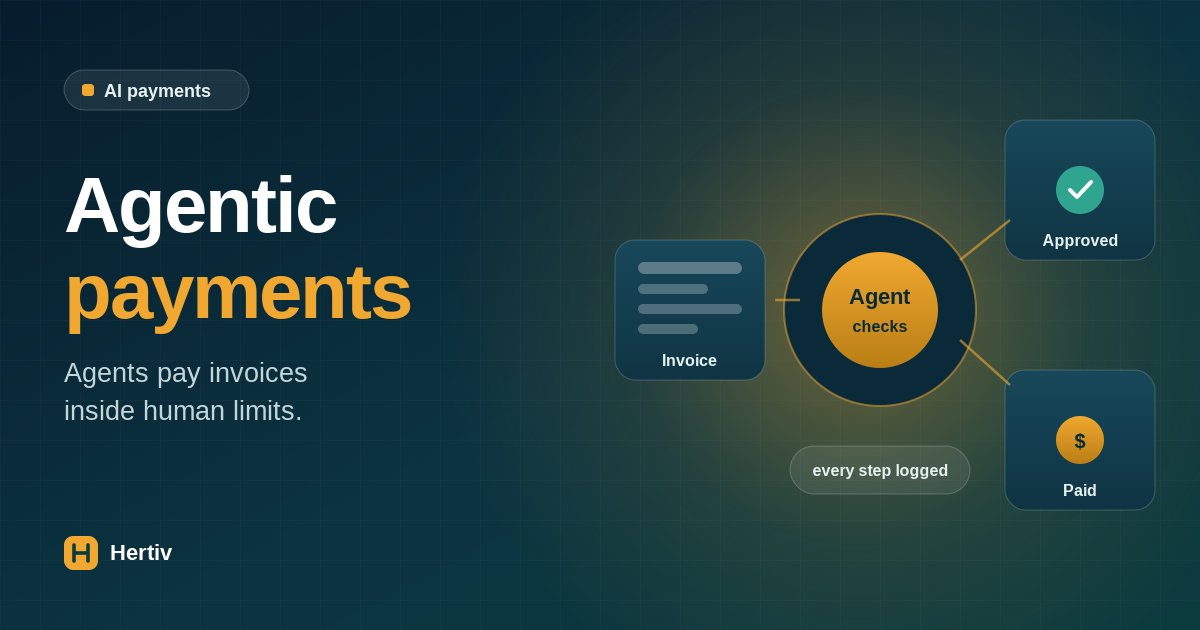
Agentic payments are payments an AI agent makes on a company's behalf, inside spending limits, approved payees and rules set by a human. The agent checks an invoice, confirms the amount and the payee, and then sends the payment through a normal payment rail, while every step is logged for review, and this guide explains how agentic payments work, where they fit, and the controls that keep them safe.
What are agentic payments?
Agentic payments are payments made by an AI agent on a company's behalf, inside spending limits, approved payees and rules set by a human. The agent does the routine work of checking an invoice and sending the payment, while people keep control of the limits and the exceptions.
They are different from a scheduled payment, which always pays the same amount on the same day. An agentic payment adapts: the agent reads the invoice, checks it against the order and the contract, and only pays when the details match.
They are also different from a person paying by hand. The agent can work through hundreds of invoices without getting tired, but it cannot use judgement the way a person can, which is why the rules and limits around it matter so much. AI agents in business already handle similar routine work in support and operations.
The idea is new, and the tools are still maturing. A company that starts now should treat agentic payments as a controlled pilot, not as a replacement for its finance team.
How do agentic payments work?
An agentic payment follows the same steps a careful finance worker would follow, with a check at each step and a human in the loop for anything unusual.
- Receive the invoice. The agent picks up the invoice from email, a supplier portal or the finance system.
- Check the details. It reads the supplier name, amount, due date and reference, and matches them against the purchase order and the contract.
- Apply the rules. It checks the spending limit, the approved payee list and any payment terms, such as early-payment discounts.
- Decide. If everything matches and the amount is inside the limit, the agent prepares the payment. If anything is off, it flags the invoice for a person.
- Send the payment. The agent sends the payment through the company's normal bank or payment rail, using stored credentials it cannot read or copy.
- Record everything. Every check, decision and payment is logged with a timestamp, so finance can review the full trail later.
| Step | What the agent does | What the human does |
|---|---|---|
| Receive | Collects invoices from email and portals | Sets which sources the agent may use |
| Check | Matches invoice, order and contract | Reviews flagged mismatches |
| Decide | Pays inside limits, flags the rest | Sets limits and approves exceptions |
| Send | Sends payment through the normal rail | Reviews the payment log |
The agent never moves money on its own authority. Its authority comes from the limits and rules a human wrote, and those limits are enforced by the payment system, not just by the agent's instructions.
What can an AI agent pay for?
An AI agent can pay for routine, repeatable costs where the amount is known and the supplier is already approved. The safest first payments are the ones finance already handles the same way every month.
| Payment type | Why it fits | What to watch |
|---|---|---|
| Supplier invoices | Fixed suppliers, matched to orders | Amount changes and duplicate invoices |
| Software renewals | Same vendor, same amount, known date | Price rises and unused seats |
| Utilities and rent | Regular amounts, fixed payees | Tariff changes and new charges |
| Travel bookings | Policy-based fares and hotels | Upgrades outside policy |
| Ad spend top-ups | Capped amounts, known accounts | Budget drift across campaigns |
New suppliers, large one-off payments and anything outside the usual pattern should stay with a person. The agent is good at routine; a person is better at judgement.
Start with one payment type and one supplier group. Once the checks work and finance trusts the logs, add the next type, rather than handing the agent the whole accounts payable queue at once.
What controls keep agentic payments safe?
Agentic payments are safe only when the controls sit outside the agent, in the payment system and the finance rules, so a mistaken or misled agent cannot move money it should not.
- Spending limits. A per-payment cap and a daily cap, enforced by the payment system, so the agent cannot exceed them even if its instructions change.
- Approved payee list. The agent may only pay suppliers and accounts that finance has already approved.
- Matching rules. The invoice must match a purchase order and a contract amount before payment, or the invoice goes to a person.
- Separate credentials. The agent uses scoped credentials that can only send payments inside the rules, and it cannot read or copy them.
- Full logging. Every check, decision and payment is written to a log that finance reviews, with alerts for anything unusual.
- Kill switch. One control that stops all agent payments at once, known to the finance team and tested before launch.
These controls are not optional extras. An agent with access to money and no limits is a risk no company should accept, however good the agent seems in testing.
A small proof of concept is the right way to test these controls, with a small limit and a small supplier group, before any real money moves at scale.
Example (hypothetical): an agent pays 200 supplier invoices
Example (hypothetical): a mid-size company receives 200 supplier invoices a month. A finance worker spends about 4 minutes checking each one against the order and the contract, which is 800 minutes, or about 13 hours, of checking each month.
An agent takes over the routine checks. It pays 170 invoices that match their orders exactly and flags 30 for a person, because the amount changed, the order is missing or the supplier is new. The person spends 4 minutes on each flagged invoice, or 120 minutes, which is 2 hours.
The saving is 800 minutes minus 120 minutes, or 680 minutes, which is about 11 hours a month. The finance worker spends that time on the 30 flagged invoices and on checking the agent's log, instead of on routine matching.
The point of the example is not the hours. It is that the agent handles the routine cases and the person handles the judgement, with the limit and the payee list keeping the agent inside its bounds.
Should your company build or buy agentic payments?
Whether to build or buy agentic payments depends on how much control the finance team needs and how soon the first payment must move.
Buying is faster. Payment and agent platforms now offer agent payment features with limits, payee lists and logs built in, and a company can run a pilot in weeks. The trade-off is that the rules live in a vendor's product, so the finance team must check that the controls match its own policies.
Building gives more control. A team can wire its own agent to its own finance system, with limits enforced in its own payment service. That takes longer and needs engineers who understand both AI agents and payments, and the team owns the security of the whole setup.
Most companies start by buying a pilot on one payment type, then decide whether to build once they know which rules matter. The cost of implementing AI in finance depends on the same choice, and a pilot is the cheapest way to learn it.
What are the common mistakes?
The most common agentic payment mistakes are giving the agent too much authority, skipping the logs, and starting with the hardest payments instead of the routine ones.
- No hard limits. Limits written only in the agent's instructions can be talked around; limits enforced by the payment system cannot.
- Paying new suppliers. A new payee needs a human check, because the agent cannot tell a real supplier from a fake invoice.
- Skipping the logs. If nobody reviews what the agent paid and why, errors stay hidden until they are expensive.
- Starting too big. Handing the agent every invoice at once hides problems that a small pilot would have shown.
- No kill switch. The team must be able to stop all agent payments in one action, and it must have practised doing so.
Key takeaways
- Agentic payments let an AI agent pay routine invoices inside limits, payees and rules set by a human
- The agent checks, matches and pays, while a person handles exceptions and reviews the logs
- Hard limits, approved payees and a kill switch must be enforced by the payment system, not just by the agent's instructions
- Start with one routine payment type and a small supplier group, then expand once finance trusts the logs
- New suppliers, large one-off payments and anything outside the pattern should stay with a person
Frequently asked questions
Are agentic payments the same as scheduled payments?
No. A scheduled payment always pays the same amount on the same day, while an agentic payment reads the invoice, checks it against the order and contract, and only pays when the details match. The agent adapts to each invoice instead of repeating a fixed instruction.
Can an AI agent pay any supplier?
No. An agent should only pay suppliers and accounts that finance has already approved, inside a spending limit. New suppliers, large one-off payments and anything outside the usual pattern need a human check before payment.
What happens if the agent pays the wrong amount?
The payment system should block any payment that breaks the limits or the matching rules, and the full log shows what the agent checked and why it paid. Finance reviews the log, reverses the payment if the bank allows it, and fixes the rule that let the error through.
Do agentic payments need a new bank account?
Usually not. The agent sends payments through the company's normal bank or payment rail, using scoped credentials that can only pay inside the set rules. The bank sees a normal payment, while the agent's log shows why it was made.
How do I start with agentic payments?
Start with one routine payment type, such as software renewals, with a small limit and a small supplier group. Run it as a pilot, review the logs each week, and expand to the next payment type only once finance trusts the checks.
What does an agentic payment pilot cost?
The cost depends on whether you buy a platform feature or build your own agent, and on the size of the pilot. A small pilot with one payment type and a few suppliers is the cheapest way to learn what the controls and the checks really need.


