Agentic Coding vs Vibe Coding: What Changes?
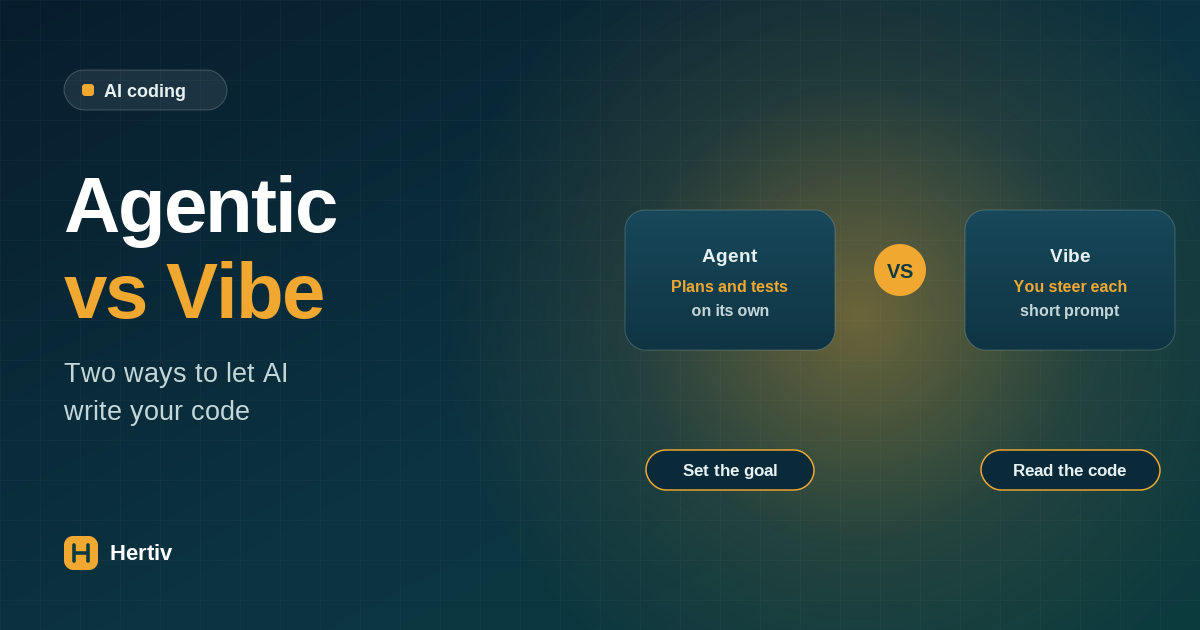
Agentic coding lets an AI agent plan, write and test code on its own, while vibe coding keeps the developer driving with short prompts.
On this page
Short answer
Agentic coding is a way of building software where an AI agent plans the work, writes the code, runs the tests and fixes its own errors, with the developer setting goals and checking results. Vibe coding is a lighter style where the developer describes what they want in plain words and the AI writes code in short rounds, with the developer steering each step.
What is agentic coding?
Agentic coding is a way of building software in which an AI agent takes a goal, breaks it into steps, writes the code, runs the tests and fixes the errors it finds, all without waiting for a prompt at each step. The developer sets the goal, gives the agent access to the codebase and tools, and reviews what it produces.
The agent works in a loop. It reads the code, makes a change, runs the build and the tests, reads the failures and tries again. A developer who wants this kind of help should first understand how AI agents plan and act, because the same loop drives both.
| Part of the work | Agentic coding | Vibe coding |
|---|---|---|
| Planning | The agent breaks the goal into steps | The developer plans, prompt by prompt |
| Writing code | The agent writes and edits files itself | The AI writes code when asked |
| Testing | The agent runs tests and fixes failures | The developer runs tests and reports errors |
| Control | Goal-based, with review at checkpoints | Step by step, with review after each round |
| Best for | Well-defined tasks in a known codebase | Prototypes, small features and learning |
The key idea is autonomy with limits. The agent has tools and permission to act, but the developer still decides what it may touch and checks the result before anything ships. Without those limits, an agent can change code the team did not intend it to change.
What is vibe coding?
Vibe coding is a style of building software where the developer describes what they want in plain words and lets the AI write the code, then reads the result and asks for the next change. The developer stays in the driver's seat and the AI acts like a fast typist that also knows common patterns.
A typical round goes like this: the developer writes a short prompt such as "add a login form with email and password", the AI produces the code, and the developer reads it, tries it and asks for fixes. The name comes from the relaxed feel of the process, but the work still needs care. Code the developer does not read is code the developer does not understand.
Vibe coding works best when the goal is small and the result is easy to check. A landing page, a small script or a first version of a form are good fits. It is a poor fit for code that handles money, personal data or security, because a wrong guess by the AI can sit unnoticed until a user finds it.
How do the two workflows differ in practice?
The two workflows differ in who holds the plan. In agentic coding, the plan lives with the agent: it decides the order of the steps and keeps going until the goal is met or it gets stuck. In vibe coding, the plan lives with the developer, who decides each next step and asks the AI to carry it out.
That difference shows up in the rhythm of the work. An agentic session can run for many minutes while the developer watches the log and waits for a checkpoint. A vibe coding session is a fast back-and-forth of short prompts, and the developer reads and tests after every round. Both styles need the developer to read the code, but agentic coding asks the developer to read larger chunks at once.
The tooling differs too. Agentic coding needs an agent with access to files, a terminal, tests and a way to stop it. Vibe coding needs little more than a chat box in the editor. A team that wants to compare approaches can read how to build an AI proof of concept and try each style on the same small task.
When should you use agentic coding?
You should use agentic coding when the task is well defined, the codebase is known, and the work can be checked by tests. Good examples are adding a standard feature to an existing app, writing tests for existing code, or carrying out a small refactor that touches many files in the same way.
Three conditions make agentic coding pay off. First, the goal must be written down clearly enough that the agent cannot guess wrong. Second, the tests must be good enough to catch a wrong change. Third, the developer must have time to review the result properly, because the agent can produce a lot of code quickly.
Agentic coding is a poor choice when the requirements are still unclear, when the code is new and the design is undecided, or when a mistake would be costly. In those cases the developer should stay close to the work and use short rounds instead.
When should you use vibe coding?
You should use vibe coding when you want a quick first version, when you are exploring an idea, or when you are learning a new tool or library. It is fast for prototypes, demos, small scripts and personal projects where the cost of a mistake is low.
Vibe coding also helps when the developer knows what they want but not the exact syntax. The AI fills in the details, and the developer checks the result. That makes it a useful way to learn: the developer reads working code, changes it and sees what breaks.
Do not use vibe coding for production code you cannot test. If the code touches payments, passwords, personal data or health records, the developer must read every line and run real tests. A quick prompt can produce code that looks right and fails in a way that only shows up later. The same care applies to testing AI-built features before they reach users.
Example (hypothetical): building a small login form two ways
Example (hypothetical): a developer needs a login form with email and password for a small internal tool. With vibe coding, the developer writes six prompts, each taking about 5 minutes to write and check, which is 30 minutes, plus 20 minutes to read the final code and fix two small errors. The total is 50 minutes.
With agentic coding, the developer writes one clear goal and gives the agent access to the project. The agent works for 12 minutes, writes the form, adds a test and fixes one failure. The developer then spends 15 minutes reading the result and the test. The total is 27 minutes.
The agentic route is faster here, but only because the task was clear and the test could catch mistakes. If the login form had needed a new design or a new way to store passwords, the developer would have spent more time fixing the agent's guesses than writing the code by hand. The lesson is to match the style to the task, not to pick one style for everything.
What are the common mistakes?
The most common mistakes in agentic and vibe coding are skipping the review, giving a vague goal, and trusting code that was never tested.
- Shipping code nobody read. If no developer reads the code, nobody owns it when it breaks.
- Writing a vague goal. "Make it better" gives the agent room to guess wrong; a clear goal lists what to build and how to check it.
- Skipping tests. Code that was never run is a guess, and AI code is no exception.
- Letting the agent touch secrets. An agent with wide access can read keys and tokens, so limit what it can reach.
- Using vibe coding for risky code. Payments, passwords and personal data need a careful review, not a quick prompt.
Key takeaways
- Agentic coding gives the AI agent a goal and lets it plan, write and test
- Vibe coding keeps the developer in charge, with the AI writing code in short rounds
- Agentic coding fits clear tasks with good tests; vibe coding fits prototypes and learning
- Both styles need a developer who reads the code and runs the tests
- Match the style to the task instead of using one style for everything
Frequently asked questions
Is vibe coding the same as using an AI code assistant?
No. An AI code assistant suggests small completions as you type, while vibe coding means describing a whole feature in plain words and letting the AI write it. Vibe coding covers larger chunks of work, so the developer needs to read and test more of the result.
Can agentic coding replace a developer?
No. An agent follows a goal, but it cannot decide what to build, judge a design trade-off, or take responsibility for a mistake. The developer still sets the goal, limits what the agent can touch, reviews the result and owns the code once it ships.
Which style is faster?
It depends on the task. For a clear, well-tested task, agentic coding is often faster because the agent works without waiting for prompts. For a vague or new task, vibe coding is often faster, because the developer can steer each step instead of fixing the agent's wrong guesses.
Is agentic coding safe for production code?
It can be, if the tests are strong and the developer reviews the result. The risk is not the agent itself but the review: an agent can write a lot of code quickly, and a rushed review can miss a real problem. Keep the agent's access narrow and run the full test suite before anything ships.
What tools do I need for each style?
Vibe coding needs little more than an AI chat in your editor. Agentic coding needs an agent with access to your files, a terminal and your tests, plus a way to stop it and a clear goal written down. Start with vibe coding, and move to agentic coding when a task is clear and well tested.
How do I start with agentic coding?
Pick one small, clear task in a codebase you know, write the goal down with a way to check the result, and give the agent access to only the files it needs. Run the tests, read the result, and keep the first few tasks small until you trust the review step.


