Agentic AI vs Generative AI: What Is the Difference?
Generative AI creates text, images and code from a prompt. Agentic AI plans multi-step work, calls tools and acts for you, with human checks along the way.
On this page
Short answer
Generative AI is software that creates new content, such as text, images, code or summaries, from a prompt, using patterns learned from training data. Agentic AI builds on that ability: it takes a goal, breaks it into steps, calls tools, checks results and acts on its own, asking a person only when a decision or a risk needs one. The difference is what happens after the first answer.
What is the difference between agentic AI and generative AI?
Agentic AI is software that pursues a goal through several steps, using tools and checking its own work, while generative AI creates new content from a single prompt. The two overlap, because an agent usually contains a generative model, but they solve different problems.
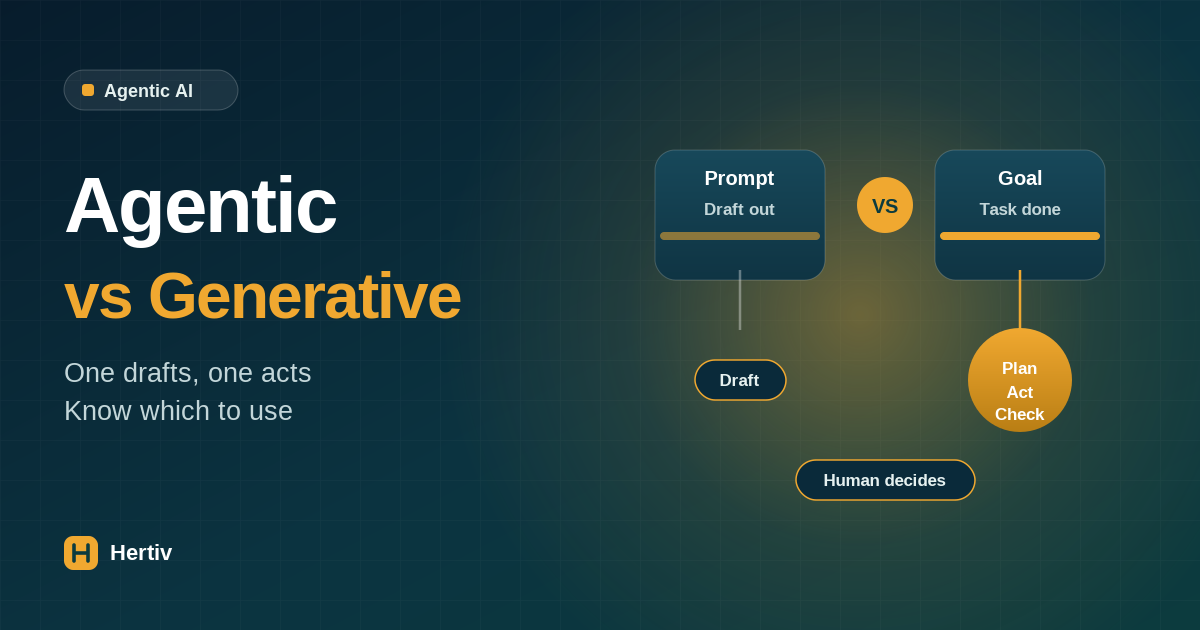
Think of it this way: generative AI answers a question or makes a draft. Agentic AI takes a job, works through it, and comes back with a result. One produces content; the other produces an outcome.
| Question | Generative AI | Agentic AI |
|---|---|---|
| What do you give it? | A prompt | A goal |
| What does it produce? | New content: text, images, code | A finished task, with content along the way |
| How many steps? | Usually one pass | Several steps, with checks between them |
| Does it use tools? | Usually no, or one call | Yes: databases, APIs, email, files |
| What does the person do? | Reviews the output | Reviews key decisions and results |
| Best for | Drafts, summaries, ideas | Routine multi-step work |
The table above is the quickest way to tell them apart. If the work ends when the text is written, generative AI is enough. If the work needs follow-up steps, such as looking something up, sending a message or updating a record, you are looking at an agentic system.
How does generative AI work?
Generative AI works by predicting the next piece of content, word by word or pixel by pixel, based on patterns it learned from large amounts of training data. You give it a prompt, and it produces a reply that fits the pattern of the request.
The model does not know facts the way a database does. It produces text that is likely to fit, which is why it can be fluent and wrong at the same time. That is also why a person should check its output before it reaches a customer.
Common uses include:
- Drafting. Emails, product descriptions, summaries and first drafts of documents.
- Explaining. Turning a long report or a set of notes into a short plain-language summary.
- Coding help. Suggesting functions, tests and fixes for a developer to review.
Generative AI is at its best when the output is easy to check and cheap to fix. A wrong draft costs a few minutes; a wrong action sent to a customer costs far more. That difference is what decides whether you need an agent or just a model.
How does agentic AI work?
Agentic AI works by turning a goal into a plan, then running the plan step by step with tools, checking each result before moving on. The generative model inside it writes the text and reasons about the next step, while the surrounding system does the real work.
A typical agent loop looks like this:
- Take the goal. The user states what should happen, such as 'refund this order and tell the customer'.
- Plan. The agent breaks the goal into steps: find the order, check the refund policy, process the refund, send the message.
- Call tools. It looks up the order in the system, checks the policy, and calls the refund function.
- Check. It reads the result of each step and decides whether to continue, retry or stop.
- Ask when unsure. If a step is unclear or risky, it hands the decision to a person instead of guessing.
The agent needs limits to be safe: which tools it may call, which actions need approval, and how much it may spend or change. Without those limits, a small error in one step can spread through the rest of the plan. For more on how teams test these systems, see the guide to how to build an AI proof of concept.
When should you use generative AI?
You should use generative AI when the job is to produce content that a person will review before it is used. Drafting, summarising and brainstorming are the clearest cases, because the cost of a bad draft is low and the review is fast.
It also fits when the task is open-ended and has no single right answer. Writing options for a headline, rephrasing a help article, or turning meeting notes into a summary all play to the model's strengths.
Generative AI is the wrong choice when the work must be exact, such as prices, dates or account balances. For those cases, the model should draft the words while the numbers come from your own systems. The same caution applies to anything that changes a record or sends money, where a wrong guess is expensive.
When should you use agentic AI?
You should use agentic AI when the same multi-step job repeats often and the steps are clear enough to write down. Refunding orders, triaging support tickets, booking follow-ups and chasing missing information are all jobs that fit.
The best first candidates are jobs where a person already follows a written checklist. If the checklist exists, the agent can follow it too, and the team can check the result against the same list. Jobs with many judgement calls or rare edge cases are a poor first choice.
Start with one narrow job and a small set of tools. Give the agent read access first, then add write actions one at a time once the team trusts the results. Teams that begin with a wide, open-ended agent usually spend more time fixing its mistakes than the agent saves. The guide to AI agent use cases shows where teams usually start.
Example: a support team using both
Example (hypothetical): a support team of six people receives 300 questions a day. Each answer takes about 5 minutes to write by hand, so the team spends 300 x 5 = 1,500 minutes, or 25 hours a day, on replies.
First the team adds generative AI. The model drafts each reply, and a person checks and sends it in about 1.5 minutes. The daily total falls to 300 x 1.5 = 450 minutes, or 7.5 hours a day, saving about 17.5 hours.
Next the team adds an agent for the 200 simplest questions, such as order tracking and password resets. The agent answers those on its own, and a person reviews the other 100 questions at about 1 minute each, or 100 minutes a day. Review time is now about 1 hour 40 minutes a day, and the team spends the saved time on the harder cases that need a person.
The lesson is the order: generative AI first, because it is easy to check, then an agent for the narrowest jobs, with a person still reviewing the rest. Testing each step before it goes live is what keeps the numbers honest, which is why teams test AI models before they trust them with customers.
What are the common mistakes?
The most common mistakes are giving an agent too much freedom too early, and expecting a generative model to be accurate about facts it cannot check.
- Letting an agent act without approval. Start with read-only access and add write actions one at a time.
- Trusting model output as fact. Numbers, prices and policy details should come from your own systems, not from a model.
- No plan for failure. Every agent needs a clear stop rule: what happens when a step fails or the result looks wrong.
- Measuring the wrong thing. Count tasks completed correctly, not just tasks attempted.
- Skipping the human review. A person should still check the results that reach customers.
Key takeaways
- Generative AI creates content from a prompt; agentic AI completes multi-step jobs toward a goal
- An agent usually contains a generative model, plus tools, a plan and checks
- Use generative AI for drafts and summaries a person will review
- Use agentic AI for repeated jobs with a clear written checklist
- Start narrow, with read-only access, and add write actions one at a time
Frequently asked questions
Is agentic AI just a chatbot?
No. A chatbot usually answers one question at a time in a conversation, while an agent can plan several steps, call tools and finish a task without being asked at each step. Some agents do talk to users, but the conversation is only one part of the work.
Does agentic AI replace generative AI?
No, it builds on it. The agent uses a generative model to write text and reason about the next step, then adds planning, tools and checks around it. If you remove the model, the agent has no way to understand the goal or draft a reply.
What tools does an agent need?
It depends on the job, but most agents need a way to read your data, a way to act on it, and a way to ask a person for help. Common tools are databases, email, calendars, ticketing systems and payment functions, each with strict limits on what the agent may do.
How do you keep an agent safe?
Give it the smallest set of permissions that fits the job, require approval for risky actions such as refunds or deletions, and log every step it takes. Review the logs regularly, and set a clear rule for when the agent must stop and hand over to a person.
Can a small team use agentic AI?
Yes, if the job is narrow. A small team can start with one repeated task, such as triaging support tickets, and a small set of tools. The cost comes from building the checks and the handover, not from the size of the team.
What should you build first?
Build the generative AI version first: a draft a person reviews. Once that works and the team trusts the output, add the agent for the narrowest steps. That order keeps the risk low and shows the value before you automate the whole job.


