Agentic AI in Healthcare: Where It Works
Agentic AI can take on multi-step admin work in clinics and hospitals, from booking to follow-up. Here is where it helps, what it needs and how to start safely.
On this page
Short answer
Agentic AI in healthcare is software that carries out multi-step tasks such as booking appointments, chasing referrals, drafting notes and following up with patients, then hands anything uncertain to a human. It works best on routine admin work with clear rules, clean data and a human approval step, and it should never make clinical decisions on its own.
What is agentic AI in healthcare?
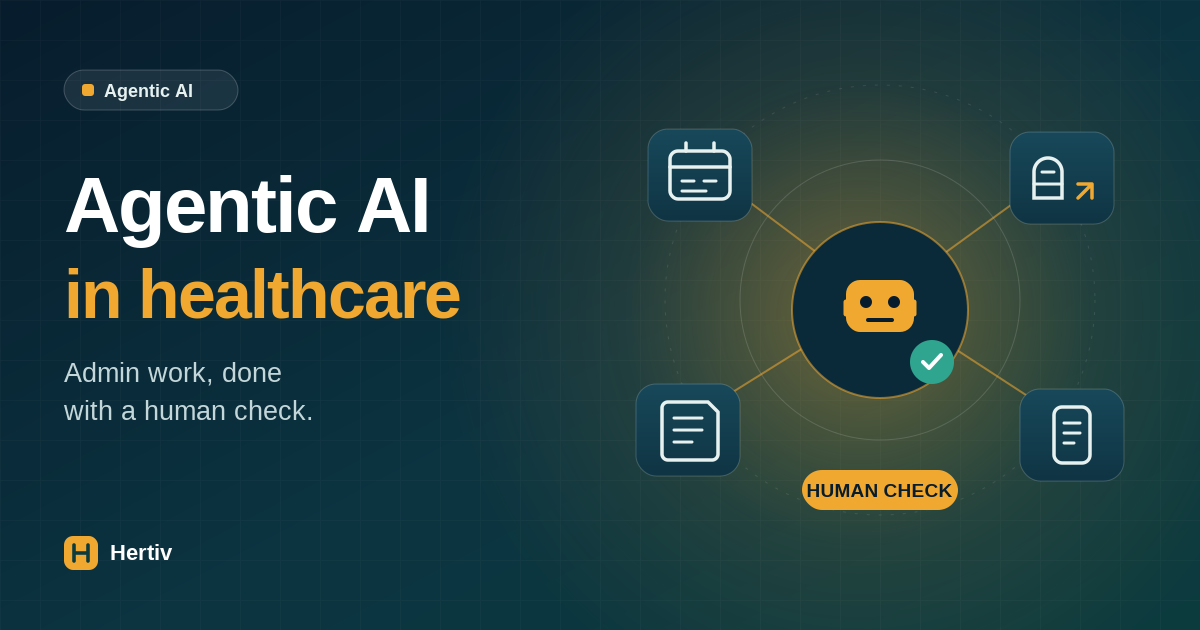
Agentic AI in healthcare is software that plans and completes a multi-step task on its own, such as booking a patient, checking insurance details, sending reminders and updating the record, and then asks a human to approve anything it cannot verify. Unlike a chatbot that only answers one question at a time, an agent works across systems and keeps track of where a task stands between steps.
The difference matters in a clinic, where most admin work is a chain of small steps. A single request to book a follow-up can involve checking the diary, finding a slot the patient can attend, confirming the referral, sending a reminder and recording the outcome. An agent can run that chain and stop for a person when the diary is full or the referral is unclear.
| Tool | What it does | Where it fits |
|---|---|---|
| Chatbot | Answers one question at a time | Simple FAQs and directions |
| Workflow automation | Runs fixed steps in a set order | Forms and reminders that never change |
| Agentic AI | Plans steps, uses tools, adapts | Multi-step admin with exceptions |
Agents are best seen as junior staff with strict rules: they do the routine work fast, they log everything, and they escalate the moment something falls outside the rules. See AI agents in pharma for how the same idea works in drug development, where the tasks and the checks are different.
Where does agentic AI help in healthcare?
Agentic AI helps most where the work is high volume, repetitive and spread across systems, which describes most clinic admin. The strongest first uses are scheduling, intake, documentation support, referrals and follow-up, because each one is a chain of small steps with a clear end point.
Scheduling agents can offer slots, handle reschedules and fill cancellations from a waitlist. Intake agents can collect history and consent before the visit, so the clinician starts with a clean record. Documentation agents can draft a visit summary from the consultation notes for the clinician to check and sign. Referral agents can chase missing paperwork and confirm receipt with the receiving clinic.
Follow-up agents can check how a patient is doing after a procedure, remind them about medication and book the next visit. Billing agents can check claim details and flag the ones that need a person. Each of these saves staff time, but each one also needs a clear rule for when to stop and hand over.
The work to avoid is anything that needs clinical judgement: diagnosis, treatment choices, dose changes and risk assessment. An agent can gather the facts for a clinician, but the decision stays with a qualified person. That line should be written down before the first agent goes live.
What data and systems does an agent need?
An agent needs read and write access to the systems where the task lives, plus the rules that say what it may and may not do. In most clinics that means the electronic health record, the scheduling system, the messaging tool and the referral inbox, connected through approved interfaces rather than screen scraping.
Data quality decides whether the agent works. If appointment slots, patient contact details and referral statuses are out of date, the agent will book the wrong slot or chase the wrong clinic. Before building, clean the fields the agent will read and agree who owns each one.
Every agent action needs a log: what it did, which records it touched, what it decided and why. The log is what lets a clinic answer a complaint, pass an audit and spot a pattern of mistakes. See RAG in healthcare for how retrieval over clinical documents works, since many agents use the same pattern to find the right guidance before acting.
Access should be narrow. Give each agent only the records and actions its task needs, and nothing else. A scheduling agent does not need prescribing history, and a billing agent does not need clinical notes.
How do you start with agentic AI in healthcare?
You start with agentic AI in healthcare by picking one high-volume admin task, writing the rules for it, and running a small pilot with a human checking every action before it goes out.
- Pick one task. Choose work that is frequent, slow and rule-based, such as appointment reminders or referral chasing, and define what done looks like.
- Write the rules. List the steps, the checks, the data sources and the exact cases that must go to a person.
- Connect the systems. Give the agent narrow access to the scheduling and record systems it needs, with a full log of every action.
- Run a supervised pilot. Let the agent draft actions for a human to approve, and review every mistake for two to four weeks.
- Open up in stages. Move to automatic action only for the cases that passed review, and keep the rest supervised.
- Review weekly. Check error rates, escalation rates and time saved, and pause the agent if errors rise.
A pilot with one clinic and one task teaches more than a plan for the whole hospital. It shows where the data is wrong, where the rules are unclear and where staff actually save time. For the governance side, see AI governance for how to set the approval and review structure around the agent.
Example: a clinic appointment agent
Example (hypothetical): a 12-doctor clinic receives about 300 appointment calls a week, and each call takes around 4 minutes of reception time. That is 300 x 4 = 1,200 minutes, or 20 hours a week, spent on booking and rescheduling.
The clinic adds an agent that handles booking, rescheduling and reminders. It resolves 70% of calls on its own, which is 210 calls x 4 minutes = 840 minutes, or 14 hours a week. The other 90 calls go to reception, which is 90 x 4 = 360 minutes, or 6 hours. The clinic saves about 14 hours of reception time a week, and the agent's log shows exactly which calls it handled and why.
Reception staff use the saved time to handle the complex cases: patients who need an interpreter, urgent slots and referrals that need a phone call. The clinic reviews the agent's error rate each week and keeps the escalation rule simple: any request the agent cannot match to a slot or a rule goes straight to a person.
What are the common mistakes?
The most common agentic AI mistakes in healthcare are letting the agent decide clinical questions, giving it broad access to records, and launching without a human review stage.
- No clear line on clinical work. If the agent can act on anything a patient says, it will eventually touch a clinical decision. Write the line down and enforce it.
- Too much access. An agent with full record access can leak or change data it never needed. Give it only what its task requires.
- No supervised pilot. Launching straight to automatic action means the first mistakes reach patients. Approve every action for the first weeks.
- Dirty data. Out-of-date slots, contacts and referral statuses make the agent look broken when the data is the problem.
- No owner. If nobody reviews the logs and the error rate, the agent drifts and nobody notices until a patient complains.
- Overpromising. Telling staff the agent will remove all admin work sets up disappointment when the hard cases remain.
How do you measure whether it works?
You measure an agent by the share of tasks it completes correctly, the share it escalates, the time staff save and the error rate, reviewed every week.
Useful measures include the completion rate for the pilot task, the escalation rate, the average time from request to done, the number of corrections staff make to agent actions, and the patient complaint rate. If corrections rise, the rules or the data need work, not more agent features.
Ask staff and patients, not only the dashboard. Staff know which cases the agent handles badly, and patients will say whether the agent felt helpful or confusing. A short monthly survey of both groups catches problems the numbers miss.
Set a stop rule before launch: if the error rate passes an agreed level, or a serious mistake reaches a patient, the agent pauses and a person takes over until the cause is fixed. See machine learning in healthcare for the wider picture of where models help and where human judgement stays in charge.
Key takeaways
- Agents do multi-step admin work; chatbots answer one question at a time
- Start with one high-volume task, such as booking or referral chasing
- Give each agent narrow access and a full log of every action
- Never let an agent make clinical decisions on its own
- Run a supervised pilot, review errors weekly and keep a stop rule
Frequently asked questions
What is agentic AI in healthcare?
Agentic AI in healthcare is software that plans and completes multi-step admin tasks, such as booking, referrals and follow-up, across the clinic's systems, and asks a human to approve anything it cannot verify. It differs from a chatbot because it acts across systems and keeps track of a task between steps.
Can an agent make clinical decisions?
No, an agent should never diagnose, choose treatment or change a dose. It can gather facts, draft summaries and chase paperwork, but clinical decisions stay with a qualified person, and that line should be written down before the agent goes live.
How much does agentic AI cost a clinic?
A pilot for one task often costs $30,000 to $80,000, depending on the systems it connects to and the review process. The main running costs are monitoring, maintenance and the weekly review. Savings come from staff hours freed for complex cases.
What data does an agent need?
It needs narrow access to the systems its task touches, such as the schedule, the record and the referral inbox, plus clean data in those systems. Every action should be logged, so the clinic can answer questions, pass audits and spot mistakes.
Is patient data safe with an agent?
It can be, if the agent has narrow access, encrypts data in transit and at rest, and logs every action. The clinic must also follow its local privacy rules, including who can see what and how long logs are kept.
How long does a pilot take?
A single-task pilot usually takes six to ten weeks from a fixed scope to a supervised launch, including data cleaning, rule writing and staff training. Moving to automatic action for the cases that passed review takes another few weeks of observation.


