Machine Learning in Healthcare: What It Does
Machine learning reads scans, flags risk and trims admin work in healthcare, but it needs clean data and a clinician in the loop. Here is where it helps most.
On this page
Short answer
Machine learning in healthcare is the use of trained models to find patterns in clinical data, such as scans, lab results and patient records, and to turn those patterns into predictions or suggestions. It helps with diagnosis support, triage, drug discovery and admin work, but it supports clinicians rather than replacing them.
What is machine learning in healthcare?
Machine learning in healthcare is the use of trained models to find patterns in clinical data, scans, lab results, patient records and device readings, and to turn those patterns into predictions or suggestions for clinicians. The model learns from past cases and applies what it learned to new ones.
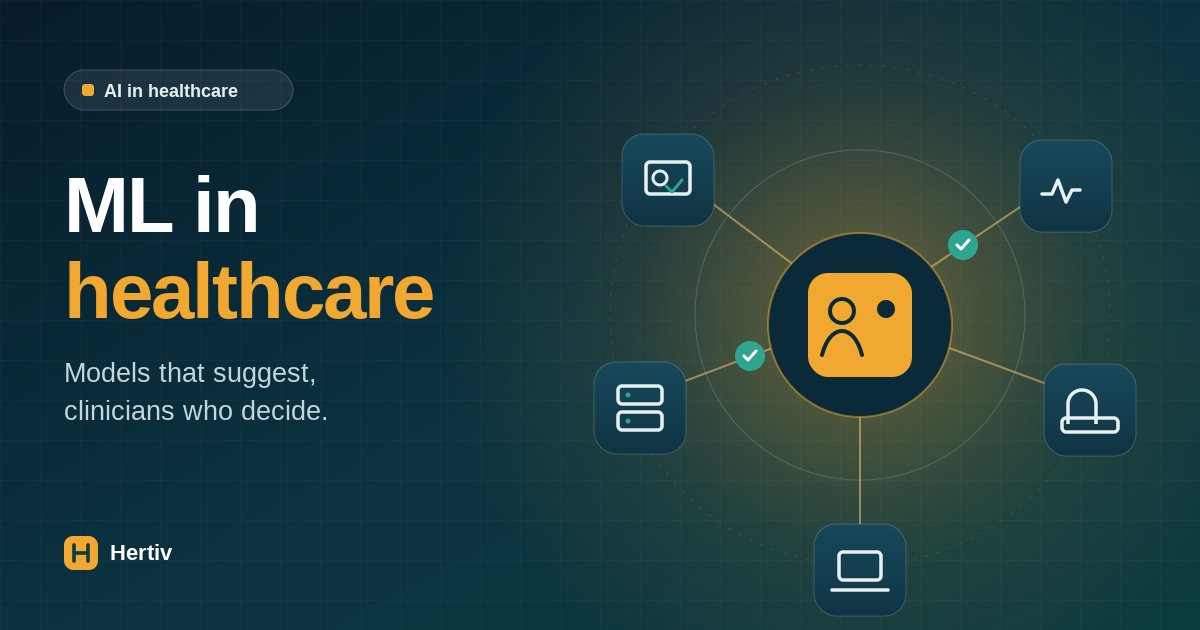
It is a tool for clinicians, not a replacement for them. A model can flag a scan that needs a closer look or rank patients by risk, but the decision and the responsibility stay with the clinician. That boundary shapes every serious healthcare project: the model suggests, the human decides.
| Area | What the model does | Example |
|---|---|---|
| Medical imaging | Spots patterns in scans | Chest X-rays, mammograms |
| Diagnosis support | Ranks cases by likelihood | Risk scores from records |
| Drug discovery | Screens compounds worth testing | Shortlists for lab work |
| Triage and risk | Flags patients who need early review | Emergency department queues |
| Admin and scheduling | Reads letters, codes procedures | Referral summaries, coding |
| Remote monitoring | Flags changes in device data | Heart rate and oxygen alerts |
The field has grown because hospitals now hold large amounts of digital data and the models have become good enough to use on it. Even so, a model is only as good as its training data, and healthcare data is messy, incomplete and private, which is why most projects spend more time on data than on modelling.
How does machine learning help with diagnosis?
Diagnosis support is the best-known use: models trained on labelled scans and records learn to spot patterns that point to disease. They are used most in imaging, chest X-rays, mammograms, retinal scans and skin images, where the input is a picture and the output is a shortlist of findings.
The model does not give a diagnosis. It ranks cases by likelihood and highlights the region it used, so a radiologist can check the suspicious ones first. In a busy imaging department this changes the order of work: the riskiest cases get read first instead of last.
Results depend on the training set. A model trained on scans from one hospital may perform worse on scans from another with different equipment or patient mix. That is why validation on local data, not just published results, is part of every deployment. AI for healthcare teams usually start with a narrow, well-labelled use case.
Where does machine learning help beyond the clinic?
Outside diagnosis, machine learning helps in drug discovery, hospital operations and admin work. In drug research, models screen large sets of compounds and predict which ones are worth testing in the lab, which cuts the number of dead ends before human researchers get involved.
In operations, models predict admissions, no-shows and bed demand, so managers can staff ahead of time instead of reacting. In admin work, models read referral letters, code procedures and draft summaries, which frees clinical staff from paperwork. These uses are less glamorous than diagnosis but often deliver value sooner, because the risk of a wrong prediction is lower.
Remote monitoring is another growing area: wearable devices send heart rate, oxygen and activity data, and models flag changes that suggest a patient needs attention. The flag goes to a nurse, who decides what happens next. The model never acts on its own.
What data does it need, and what can go wrong?
A healthcare model needs large sets of labelled, representative data: scans with confirmed findings, records with known outcomes, and enough variety to cover the patients it will serve. Collecting and labelling that data is usually the longest part of a project.
Three things can go wrong. First, biased data: if the training set under-represents a group, the model performs worse for that group. Second, drift: as practice and equipment change, the model's accuracy falls unless it is rechecked. Third, privacy: patient data is sensitive, so access, consent and de-identification must be settled before modelling starts.
Regulation is part of the design, not an afterthought. In most countries, software that influences diagnosis or treatment counts as a medical device and needs approval, evidence and monitoring after release. Plan the evidence and the approval path at the start, not after the model is built. Machine learning development for healthcare starts with these constraints.
How to start a machine learning project in healthcare in six steps
A healthcare machine learning project starts with a clinical problem and a clinician owner, not with a model. The steps below keep the work grounded in something a care team actually needs.
- Pick one narrow problem with a clinician who owns the outcome.
- Check the data: is it labelled, complete and legally usable?
- Build a small prototype on past cases and measure it against current practice.
- Validate on local data from your own patients and equipment.
- Run a supervised pilot with clinicians reviewing every output.
- Monitor accuracy, drift and user feedback after launch, and set a review date.
Each step has a gate: no data, no prototype; no local validation, no pilot. Teams that skip a gate usually find the problem later, when it is more expensive to fix.
Example (hypothetical): a triage pilot in a clinic
Example (hypothetical): a clinic sees 2,000 patients a month and wants a model to flag the ones who need early review. The model flags 15% of patients, which is 300 cases a month.
A nurse spends 10 minutes reviewing each flagged case, which is 300 x 10 = 3,000 minutes, or 50 hours a month. Of the 300 flagged cases, 60 turn out to need same-day care, and the clinic catches them days earlier than before.
The pilot runs for three months with every model output reviewed by a nurse. At the end, the clinic compares the flagged cases against the old first-come-first-served order and decides whether the 50 hours a month are worth the earlier care. The model stays a suggestion tool either way.
What are the common mistakes?
The most common mistakes in healthcare machine learning are building before the data is ready, trusting published results over local validation, and removing the clinician from the loop. Each one has caused real projects to fail.
- Training on data from one hospital and assuming it works everywhere.
- Measuring accuracy on a test set that looks like the training set.
- Letting the model act without a clinician reviewing its output.
- Ignoring privacy and consent until the model is already built.
- Launching without a plan to monitor drift and retrain.
A short check before launch covers most of these: validate on local data, keep a clinician in the loop, and set a date to review the model's performance. If any of those three is missing, the project is not ready. The future of AI in healthcare covers where the field is heading next.
Key takeaways
- Machine learning in healthcare finds patterns in scans, records and device data and turns them into suggestions
- The model suggests and the clinician decides; that boundary shapes every serious project
- Imaging, triage and drug discovery are the strongest uses; admin and operations deliver value sooner
- Training data decides quality: biased or narrow data makes a model that fails on real patients
- Validate on local data, keep a clinician in the loop, and monitor for drift after launch
Frequently asked questions
Can machine learning diagnose patients?
No, not on its own. A model can rank cases by likelihood and highlight patterns, but the diagnosis and the responsibility stay with a clinician. Systems that influence diagnosis usually count as medical devices and need approval, evidence and monitoring after release.
What data does a healthcare model need?
It needs large sets of labelled, representative data: scans with confirmed findings, records with known outcomes, and enough variety to cover the patients it will serve. Collecting and labelling that data is usually the longest part of a project, and privacy rules must be settled first.
Is machine learning in healthcare safe?
It can be, when it is validated on local data, supervised by clinicians and monitored after launch. The main risks are biased training data, accuracy that falls as practice changes, and models used without human review. Each risk has a known control, but none of them manage themselves.
Where does machine learning help most in healthcare?
Imaging support, triage and risk ranking are the strongest clinical uses, while drug discovery, bed and staff planning, and admin work such as coding and summaries deliver value sooner because a wrong prediction costs less.
How long does a healthcare machine learning project take?
A narrow pilot with clean data can take three to six months, but most of the time goes to data access, labelling and validation rather than modelling. Regulated uses that need approval take longer, since the evidence must be gathered before launch.
Do small clinics need machine learning?
Usually not a custom model. Small clinics get more from off-the-shelf tools for scheduling, documentation and triage that already include machine learning, rather than building their own. Custom work makes sense once the data volume and the clinical question justify it.


