5G and AI for Business: Where the Combination Pays Off
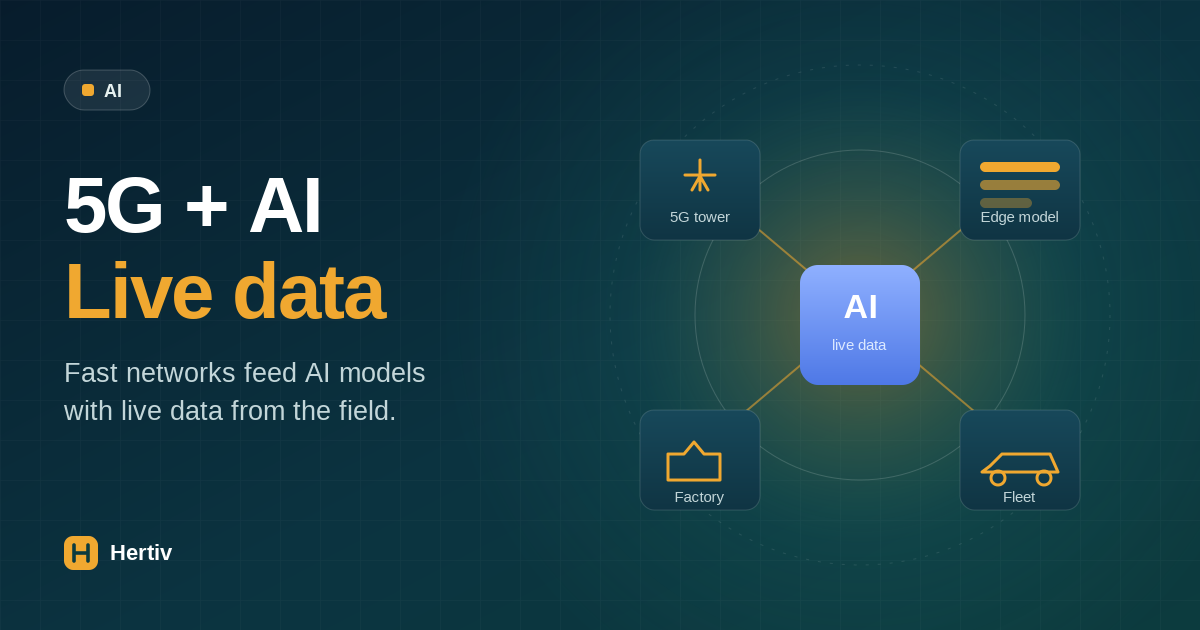
5G gives AI models fast, low-delay access to live data from machines, vehicles and cameras, so a business can act on what is happening now instead of hours later.
On this page
Short answer
5G is the fifth generation of mobile networks, and AI is software that learns patterns from data and makes predictions or decisions. Together they let a business run AI on live data from the field: sensors, cameras and vehicles send data over 5G, a model reads it at the edge or in the cloud, and the answer comes back in under a second.
What is 5G and AI for business?
5G and AI for business means pairing a fast mobile network with models that read live data and act on it. 5G is the fifth generation of mobile networks, built for high speed, low delay and many connected devices at once. AI is software that finds patterns in data and turns them into predictions, alerts or decisions.
On their own, each has limits. AI models are only as useful as the data they receive, and slow or patchy connections mean the data arrives late. 5G on its own is only a faster pipe. Together they close the loop: a camera, sensor or vehicle sends data over 5G, a model reads it within a second, and the business can act while the moment still matters.
The combination matters most where timing decides the outcome. A factory that spots a faulty part in seconds saves a batch. A delivery fleet that reroutes around a road closure saves fuel and missed slots. A shop that counts queues in real time can open another till before customers leave. You can read how teams start small with an AI proof of concept before committing to a network rollout.
What does 5G change for AI?
5G changes three things that matter to AI: delay, capacity and reliability. Delay, or latency, is the time a message takes to travel to the network and back. On 5G that can drop to tens of milliseconds, which is fast enough for a model to steer a machine or flag a hazard in near real time.
Capacity is the second change. A 5G network can serve many more devices in one area than older networks, so a warehouse can connect hundreds of sensors, scanners and robots without the network becoming the bottleneck. Reliability is the third: 5G supports private networks and network slicing, which reserve capacity for one job so a video feed does not stall when the office Wi-Fi gets busy.
| What changes | Older mobile networks | 5G |
|---|---|---|
| Delay | Often 50 to 100 ms | As low as 10 to 20 ms |
| Devices per area | Thousands | Up to a million per square kilometre |
| Video from many cameras | Stalls under load | Steady high-definition streams |
| Private network | Hard to guarantee | Private 5G or a reserved slice |
| Edge computing | Data goes to a distant cloud | Models run close to the site |
The practical point is that AI stops waiting for data. When the model sits at the edge, next to the factory or the store, the round trip shrinks from seconds to a blink, and the business can trust the answer enough to act on it automatically.
Where does the combination help most?
The combination helps most in five areas. In manufacturing, cameras and vibration sensors feed models that spot defects and worn parts before they stop a line. In logistics, vehicles and parcels report their position and condition, and a model reroutes loads as traffic and weather change.
In field service, a technician with a connected headset can send video to a model that identifies a faulty part and shows the fix, which cuts repeat visits. In retail, cameras count queues and shelves, and the model tells staff when to open a till or restock a shelf.
In remote sites such as farms, mines and ports, 5G reaches places where fixed lines are costly, and AI reads sensor data that no person could watch around the clock.
These are not the only uses, but they share a pattern: the data is live, the decision is time-sensitive, and the site has many devices. If the data can wait until tomorrow, a cheaper connection will do. If the answer is needed now, 5G earns its place. AI agents in business show the same pattern: live data in, a useful action out.
How do 5G and AI work together in practice?
In practice the flow has four steps. First, devices collect data: a camera films a production line, a sensor measures vibration, a vehicle reports its speed and location. Second, 5G carries that data to a nearby edge server or to the cloud without long delays.
Third, a model reads the data and decides. It might flag a cracked part, predict that a machine will fail within a day, or suggest the fastest delivery route. Fourth, the answer goes back to a person or a machine: an alert on a dashboard, a command to slow a conveyor, or a new route on a driver screen.
Keeping the model close to the site matters. An edge server in the factory can answer in milliseconds and keeps working if the link to the cloud drops. The cloud still has a role: it trains the model on data from many sites and sends the improved version back to the edge.
How to start in five steps
A business can test the combination in five steps without rebuilding its network first. The steps keep the pilot small, measurable and easy to stop if it does not pay off.
- Pick one slow decision. Choose a decision that is late or wrong today, such as spotting defects, counting stock or rerouting deliveries.
- Check the data. Confirm the data exists, is labelled, and is clean enough for a model to learn from. Fix the data before buying anything.
- Run a small pilot. Connect a handful of devices on existing 5G or a private trial network, and run the model on a small edge server.
- Measure the result. Compare the pilot against the old way on time saved, errors caught and cost per job, over four to six weeks.
- Decide what scales. If the numbers work, plan the wider rollout, the device list and the running costs. If they do not, keep the lesson and stop.
The pilot should have one owner, one clear target and a fixed end date. A pilot that runs forever teaches nothing, because nobody has to judge whether it worked. Read what machine learning is if the team is new to models and wants the basics first.
Example (hypothetical): a warehouse that counts stock faster
Example (hypothetical): a warehouse holds 600 pallets and counts them by hand once a week. A worker checks one pallet in about 5 minutes, so a full count takes 600 × 5 minutes, which is 50 hours of staff time every week.
The warehouse trials cameras on the aisles and a model that reads pallet labels. The cameras scan all 600 pallets in 30 minutes, and the model flags 30 pallets it cannot read clearly. Staff then check only those 30, at 3 minutes each, which is 90 minutes. The full count now takes 30 minutes plus 90 minutes, or 2 hours, instead of 50 hours.
The saving is 48 hours a week, and the count is fresh enough to run daily instead of weekly. The catch is that the model must be checked against hand counts for the first month, because a wrong count is worse than a slow one. The business only scales the system after the flagged-pallet rate stays low and the counts match.
Common mistakes
The first mistake is buying the network before finding the decision. 5G coverage is easy to buy and hard to justify if no decision needs live data. The second is skipping the data work: a model trained on dirty or mislabelled data will give confident wrong answers, and fast delivery only spreads them sooner.
The third is ignoring running costs. Devices, edge servers, data plans and model maintenance all cost money every month, and a pilot that looks cheap can become expensive at scale. The fourth is treating the pilot as a demo. If nobody measures the result against the old way, the project drifts on and the business never learns whether it paid off.
The fix is simple: one decision, one pilot, one measured result. If the result is clear, scale it. If it is not, stop and try a different decision. That discipline is what turns a network upgrade into a business result.
Key takeaways
- 5G gives AI live data, so models can act in seconds instead of hours.
- Low delay, many devices and private networks are the three 5G changes that matter.
- Factories, fleets, field service, retail and remote sites gain the most.
- Start with one slow decision and a small measured pilot, not a network rollout.
- A warehouse example cut a weekly count from 50 hours to 2 hours with cameras and a model.
- Dirty data and unmeasured pilots are the two mistakes that waste the budget.
Frequently asked questions
Does AI need 5G to work?
No. Most AI runs on office networks, Wi-Fi or wired connections, and works well there. 5G matters when the data comes from moving devices, many devices in one place, or a site where a fast answer decides the outcome. If the data can wait, a normal connection is enough.
What is network slicing in simple terms?
Network slicing reserves a slice of a 5G network for one job, such as a factory's cameras or a fleet's tracking. The reserved slice keeps its speed even when the rest of the network is busy. It is useful when a dropped video feed or a late alert would cost money.
What is edge computing?
Edge computing runs software on a server close to the site, such as inside a factory or a store, instead of in a distant cloud. The model answers in milliseconds and keeps working if the cloud link drops. The cloud still trains the model and sends improved versions to the edge.
How much does a 5G and AI pilot cost?
It depends on the devices, the edge server and the data work, so there is no single figure. A small pilot with a handful of cameras or sensors and one edge server is the cheapest way to test the idea. Ask vendors for a written quote and compare the running costs, not only the setup price.
Which businesses should try it first?
Businesses with live, time-sensitive decisions should try it first: factories, warehouses, fleets, field service teams and retailers with busy stores. A business whose data can wait until tomorrow will usually gain more from fixing its data and running a simple AI pilot on its current network.
Is private 5G worth it for a small business?
Usually not at first. A small business can test the idea on a public 5G plan or a trial network and only consider private 5G if the pilot proves the value and the site needs guaranteed capacity. Private 5G makes sense for a large factory or port with many devices and strict uptime needs.


