Zero Trust Architecture in Australia: How to Implement It
Zero trust in Australia means verifying every user and device, lined up with the Essential Eight, the ISM and the Privacy Act. Here is how teams implement it.
On this page
Short answer
Zero trust architecture in Australia is a security model that verifies every user, device and request before granting access, and maps those controls to Australian rules such as the Essential Eight, the Information Security Manual and the Privacy Act 1988. Implementation starts with identity and multi-factor authentication, then adds device checks, least-privilege access and monitoring, in small tested steps.
What is zero trust architecture in Australia?
Zero trust architecture is a security model that assumes no user, device or network is trusted by default and requires every access request to be verified before it is allowed. In Australia, teams implement it against local rules and guidance, not in a vacuum: the Australian Cyber Security Centre publishes the Essential Eight and the Information Security Manual, and the Privacy Act 1988 sets the duties for personal information.
The model replaces the older idea of a trusted internal network surrounded by a firewall. Staff work from home, contractors connect from their own devices, and applications run in cloud accounts that a firewall cannot meaningfully enclose. In zero trust, being inside the office network means nothing on its own. Each request is checked against identity, device health, location, time and the sensitivity of the resource.
It is not a single product. It is an architecture and a set of operating practices that touch identity, networking, endpoints, applications and data. The Australian angle is which rules the controls must satisfy and which guidance auditors will check against. For the general model, see what is zero trust security.
Which Australian rules shape a zero trust rollout?
Australian rules shape a zero trust rollout because they decide which controls are expected, what must be logged and what happens after a breach. The table below shows the main ones and what each one asks for.
| Rule or guide | Who it applies to | What it asks for |
|---|---|---|
| Essential Eight | All Australian organisations | Patching, MFA, least privilege, app control |
| Information Security Manual | Government and suppliers | Controls for systems and data |
| Privacy Act 1988 | Most businesses and agencies | Protect personal information |
| Notifiable Data Breaches scheme | Covered entities | Report eligible breaches |
| SOCI Act 2018 | Critical infrastructure owners | Risk management and reporting |
| APRA CPS 234 | APRA-regulated entities | Information security controls |
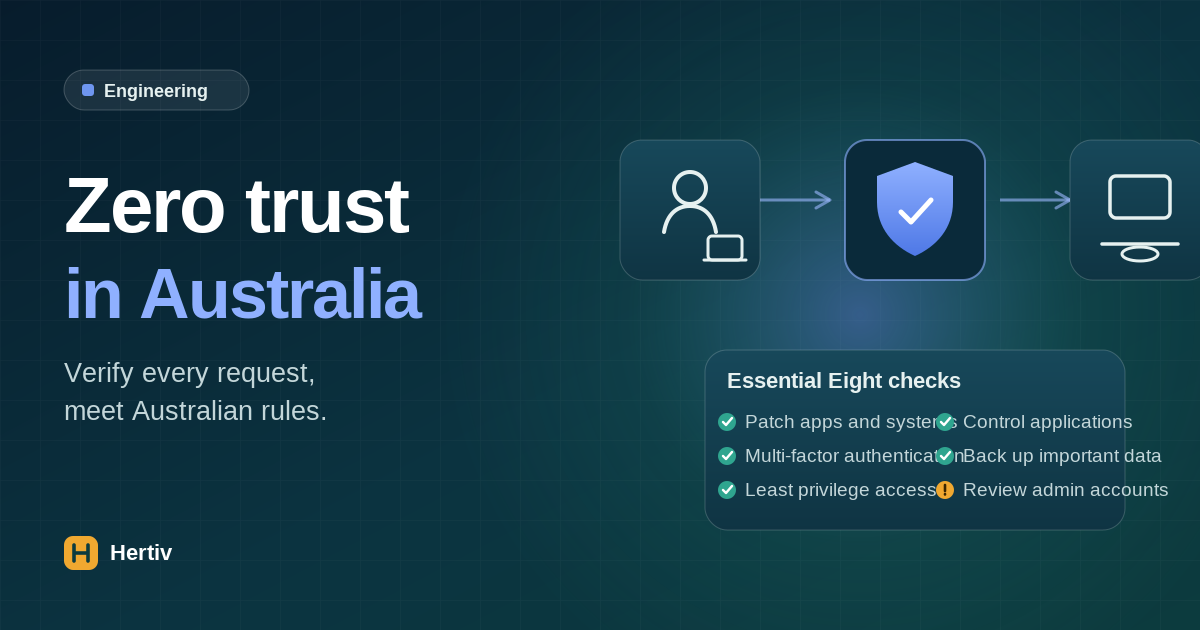
The Essential Eight is the practical starting point for most teams, because its eight strategies map closely onto zero trust controls: multi-factor authentication, patching, application control and restricting admin privileges are all zero trust controls by another name. The Information Security Manual is the deeper reference, and auditors for government work check against it directly.
The Privacy Act matters because zero trust collects signals about people: sign-in locations, device details and access patterns. Those signals are personal information, so the team needs a reason to collect them, a place to store them safely and a limit on how long they are kept. The Notifiable Data Breaches scheme adds a duty to report an eligible breach, which is why logging and detection matter as much as prevention.
How do you implement zero trust in Australia?
You implement zero trust in Australia by mapping your most sensitive assets, then closing the biggest gaps first in small, tested steps rather than trying to change everything at once.
- Inventory identities and applications. List human users, service accounts, APIs and third-party integrations, and note which systems hold personal or sensitive data.
- Protect the identity layer. Enforce multi-factor authentication, remove stale accounts and review privileged roles. This is the highest-value early step.
- Add device checks. Require managed, patched devices for sensitive applications, and define what happens when a device fails the check.
- Introduce least privilege. Replace broad roles with scoped permissions and time-limited access for admin work.
- Segment the network. Separate production, staging and corporate networks, starting with the highest-value systems.
- Instrument and monitor. Log access decisions and anomalies somewhere your team reviews, and test the breach reporting path before you need it.
Treat this as a series of funded steps tied to real risks, not a single migration project. A step-by-step version of the same sequence is in how to implement zero trust security.
What changes for critical infrastructure and regulated sectors?
For critical infrastructure and regulated sectors, zero trust is not just good practice — it is part of a legal duty. The Security of Critical Infrastructure Act 2018 requires owners of critical infrastructure to manage cyber risk and to report incidents, and the regulator can ask for evidence that the controls exist and work.
That changes the rollout in three ways. First, the team needs records: which controls are in place, who approved them and when they were last tested. Second, incident reporting needs a tested path, because a slow or unclear report is itself a failure. Third, suppliers and service providers come into scope, since an attacker can reach a critical system through a contractor's account.
APRA-regulated entities face a similar position under CPS 234, which requires information security controls, testing and reporting to the board. For these teams, zero trust controls double as evidence: access logs, MFA coverage and privilege reviews are the same records an auditor or regulator asks to see. If your sector has a regulator, check its guidance before choosing tools, because the reporting format matters as much as the control.
Example: a mid-size Australian firm rolls out zero trust
Example (hypothetical): a 180-person Australian firm runs its product in one cloud account and its internal tools on a flat office network. Staff, contractors and automated jobs share a handful of broad roles, and nobody can say who has access to customer data.
The team starts with identity. It enforces multi-factor authentication for all staff and contractors. Enrolling 180 people at 15 minutes each takes 180 times 15 minutes, which is 2,700 minutes, or 45 hours of staff time spread over two weeks. It also removes dormant accounts and splits one shared admin role into scoped roles for engineering, finance and support.
Next it requires managed devices for access to production dashboards, so a personal laptop can no longer reach customer data. Then it separates production, staging and corporate networks, and gives automated jobs their own service accounts with narrow permissions and rotating credentials. Finally, it centralises access logs and sets alerts for unusual sign-in locations and failed authorisation attempts.
The programme is not finished after this, but the highest-risk paths are now verified and logged. The team maps the next steps against the Essential Eight and schedules a quarterly review of roles and service accounts, so the controls stay current as the team changes.
What are the common mistakes?
The most common zero trust mistakes in Australian rollouts are treating it as a product purchase, skipping identity hygiene, and forgetting the privacy and reporting duties that come with the new controls.
- Buying a tool before defining policy. A zero trust network access product without clear access rules just moves the problem.
- Ignoring service accounts and APIs. Automated credentials often have more access than any human and are rarely reviewed.
- Collecting signals without a privacy basis. Sign-in locations and device details are personal information under the Privacy Act. Know why you collect them and how long you keep them.
- No breach reporting path. If the team cannot report an eligible breach in time, the detection work is wasted. Test the reporting path before an incident.
- Blocking work without an alternative. If a control makes a task slow with no approved path, people find workarounds.
- Big-bang rollouts. Trying to convert every system at once stalls and creates outages. Start with one system and prove the controls work there.
How do you keep zero trust working after launch?
You keep zero trust working after launch by reviewing access on a schedule, testing the controls, and updating them as the team and the rules change. A rollout that nobody reviews decays within a year.
Set a quarterly review of roles and service accounts, and remove access that is no longer needed. Test the controls the same way an attacker would: try a dormant account, try a personal device on a production system, and try to reach data from an unusual location. Fix what the tests find before an auditor does.
Keep the logging and alerting honest. Access decisions that nobody reviews provide little security value, and alerts that nobody acts on train the team to ignore them. Review the alert list each month and remove the ones that never lead to action.
Finally, track the Australian guidance. The Essential Eight and the Information Security Manual are updated over time, and the Privacy Act and sector rules change as well. A yearly check against the current guidance keeps the architecture aligned with what auditors and regulators expect. For the wider security picture, cybersecurity services covers the controls that sit around zero trust.
The privacy side matters just as much: data security and compliance covers how to handle the personal information that zero trust controls collect and store.
Key takeaways
- Zero trust verifies every user, device and request — it does not trust the office network
- In Australia, the Essential Eight, the ISM and the Privacy Act shape which controls are expected
- Start with identity and MFA, then add device checks, least privilege and monitoring
- Critical infrastructure and APRA-regulated entities need records and tested reporting paths
- Review roles quarterly, test the controls, and check the guidance yearly
Frequently asked questions
Is zero trust required by Australian law?
No single law requires zero trust by name. The duties come from the rules around it: the Privacy Act for personal information, the SOCI Act for critical infrastructure, APRA CPS 234 for regulated entities, and the Essential Eight as the expected baseline. Zero trust is how teams meet those duties in practice.
What is the Essential Eight?
The Essential Eight is a set of eight mitigation strategies published by the Australian Cyber Security Centre, covering patching, multi-factor authentication, application control, admin privileges and backups. It is the practical baseline most Australian teams start from, and several of its strategies are zero trust controls.
How long does a zero trust rollout take in Australia?
It is an ongoing programme rather than a fixed project. Many teams close the highest-risk gaps, such as multi-factor authentication and privileged access, within a few months, then expand coverage over one to several years depending on size and legacy systems.
Does zero trust replace a VPN?
No. A VPN typically grants broad network access once connected, while zero trust grants access to specific applications per request after checking identity and device context. Some organisations replace VPN access with zero trust network access tools, but the model is broader than any single tool.
What does the Privacy Act mean for zero trust?
Zero trust collects signals about people, such as sign-in locations and device details, and those signals are personal information. The team needs a reason to collect them, a safe place to store them and a limit on how long they are kept, and a duty to report eligible data breaches.
Where should an Australian team start with zero trust?
Start with identity: enforce multi-factor authentication, remove stale accounts and review privileged roles. Then add device checks for sensitive applications, introduce least-privilege access, and segment the network, starting with the highest-value systems.


