XRPL in Real Estate Tokenization: How It Works
XRPL can issue, trade and settle property tokens using trust lines, its built-in exchange and escrow. Learn how tokenized property works and what to check first.
On this page
Short answer
XRPL in real estate tokenization means issuing tokens on the XRP Ledger that represent shares in a property or a property fund. Tokens are issued through trust lines, traded on the ledger's built-in exchange, and paid out in proportion to holdings, while the legal wrapper, custody and compliance checks sit off-ledger.
What is XRPL in real estate tokenization?
XRPL in real estate tokenization means issuing digital tokens on the XRP Ledger that represent shares in a property or a property fund, so investors can buy, hold and trade fractions of real estate. The ledger records who owns each token and settles transfers between accounts.
The idea is simple: a property or fund is held by a legal entity, tokens are issued against it, and each token gives its holder a defined claim, such as a share of rental income or a share of sale proceeds. XRPL provides the rails for issuing, trading and settling those tokens.
Tokenization does not change property law. The legal structure, the custodian and the compliance checks sit outside the ledger; XRPL handles the token mechanics, not the legal rights themselves.
What does XRPL provide for tokenization?
XRPL has built-in features that map well to tokenized assets, so teams need less custom smart contract code than on some other chains. The table below covers the parts that matter for real estate.
| XRPL feature | What it does | Why it matters for property |
|---|---|---|
| Issued currencies | Tokens issued by an account and held through trust lines | Property shares are issued and held on-ledger |
| Decentralised exchange | Built-in order book for trading issued tokens | Investors can trade shares without a separate exchange |
| Escrow | Time- or condition-based release of funds | Staged payouts and locked distributions |
| Multi-signing | Several signatures required for a transaction | Fund managers and custodians approve together |
| NFT standard (XLS-20) | Unique tokens for one-of-one assets | A deed or a unique unit can be represented |
| Payment channels | Fast off-ledger settlement between parties | Frequent small payouts, such as rent shares |
These features are part of the ledger itself, which keeps the token logic simpler to audit. The trade-off is less flexibility than a general-purpose smart contract platform, so complex payout rules may still need off-ledger code.
How does a tokenized property work on XRPL?
A tokenized property follows the same sequence on XRPL as on other chains: a legal wrapper holds the asset, tokens are issued against it, and investors trade them under the rules set at issuance.
- Set up the legal wrapper. A company or fund holds the property, and its documents define what token holders receive.
- Issue the tokens. The issuer creates tokens on XRPL and sets the total supply, so each token maps to a fixed share.
- Open trust lines. Investors open trust lines to the issuer, which lets them hold the tokens in their own wallets.
- Run compliance checks. Identity and eligibility checks happen before tokens are distributed, usually off-ledger.
- Distribute income. Rental income is paid to token holders, either on-ledger or through a payment rail, in proportion to their holdings.
- Enable trading. Holders trade on the built-in exchange or a secondary venue, subject to the transfer rules.
Each step needs a responsible party: the issuer, the custodian, the compliance provider and the platform. XRPL settles the token movements; it does not replace those roles.
What can be tokenized, and who uses it?
Tokenization fits income-producing property and property funds better than single homes for personal use, because the value is in the cash flow and the shares are easier to standardise.
- Rental apartments and offices. Shares in a building pay out rental income in proportion to holdings.
- Property funds. A fund's units are tokenized so investors can enter and exit more easily.
- Development projects. Tokens can fund a build in stages, with escrow releasing money as milestones are met.
- Fractional ownership platforms. Platforms let smaller investors buy into property that would otherwise need large capital.
The users are usually fund managers, developers and platforms, not individual buyers of a single home. Retail access depends on local regulation, and in many places tokenized property is limited to qualified investors.
What are the costs and checks before you start?
The costs of an XRPL tokenization project sit mostly off-ledger: legal structuring, compliance, custody, platform build and ongoing administration. Ledger fees for issuing and transferring tokens are small compared with those costs.
Before you start, check the rules in every jurisdiction where investors live. Securities law, marketing restrictions and tax treatment differ by country, and a token that is a security in one place may be treated differently elsewhere.
- Legal opinion. Confirm how the token is classified and what disclosures are required.
- Custody. Decide who holds the property documents and the reserve assets.
- Investor checks. Identity verification and eligibility checks must run before distribution.
- Exit path. Investors need a way to sell, so confirm where secondary trading can happen.
For the broader picture, real estate tokenization covers platforms and legal structures.
Other asset types follow the same pattern; RWA tokenization covers how funds, commodities and other assets are tokenized.
Example: a property fund tokenized on XRPL
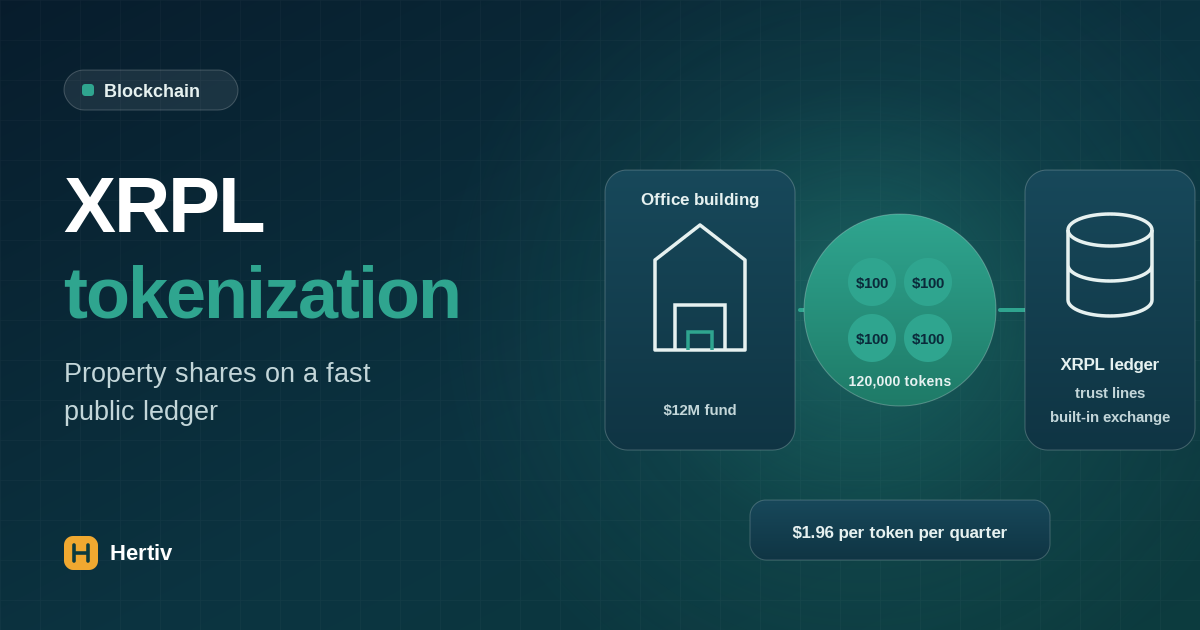
Example (hypothetical): a fund holds a small office building valued at $12 million and wants to offer shares to 120 investors. It creates 120,000 tokens, each priced at $100, so the full issue is worth $12 million.
The building earns $240,000 in net rent each quarter. That is $2.00 per token per quarter, since $240,000 divided by 120,000 tokens equals $2.00. A 2% administration fee takes $4,800 of the quarter's rent, leaving $235,200, or $1.96 per token.
Investors hold their tokens through trust lines to the issuer, and the fund distributes the $1.96 per token each quarter. If an investor holds 500 tokens, that investor receives $980 per quarter. The arithmetic is straightforward; the hard parts are the legal wrapper, the compliance checks and the payout process, which all sit off-ledger.
What are the common mistakes?
The most common mistakes are treating the token as the legal right itself, skipping compliance, and assuming the ledger provides liquidity on its own.
- Confusing tokens with title. The token is a claim defined by legal documents; the ledger alone does not transfer property ownership.
- Skipping jurisdiction checks. A compliant offer in one country can be an unregistered security offer in another.
- Assuming instant liquidity. A token is only tradable if buyers exist and a venue allows the trade.
- No payout process. Rental income needs a reliable distribution process, not just a token.
- Weak custody. If the property documents and reserves are not properly held, the token's backing is unclear.
For the basics of the underlying technology, what is blockchain explains how ledgers, consensus and tokens fit together.
Key takeaways
- XRPL tokens represent shares in a property or fund, not the title itself
- Trust lines, the built-in exchange, escrow and multi-signing cover most token mechanics
- The legal wrapper, custody and compliance checks sit off-ledger
- Income-producing property and funds fit tokenization best
- Check securities law, custody and the exit path before issuing
Frequently asked questions
Does XRPL tokenization transfer property ownership?
No. The token represents a claim defined in legal documents, such as a share in the fund or company that holds the property. Ownership of the property itself changes through the normal legal process, not through a token transfer.
Why use XRPL instead of another chain?
XRPL has token issuance, a built-in exchange, escrow and multi-signing as native features, so teams write less custom contract code. The trade-off is less flexibility than a general-purpose smart contract platform.
Can anyone buy tokenized property on XRPL?
Not necessarily. In many jurisdictions tokenized property is treated as a security, so sales may be limited to qualified investors and require identity checks. Check the rules where each investor lives.
How do investors receive rental income?
The fund distributes income in proportion to token holdings, either on-ledger or through a payment rail. The payout process, fees and timing are defined in the fund documents, not by the ledger.
Is tokenized property liquid?
Only if buyers exist and a venue allows trading. A token does not create liquidity by itself; the fund needs a secondary market or a buy-back mechanism for holders who want to exit.
What does it cost to tokenize a property?
Ledger fees for issuing and transferring tokens are small. The main costs are legal structuring, compliance, custody, platform build and administration, which are quoted per project.


