Will Super Apps and Crypto Neobanks Dominate Banking?
Super apps bundle daily life into one wallet, and crypto neobanks move money on cheap rails. Here is what each does well, what holds it back, and who will win.
On this page
Short answer
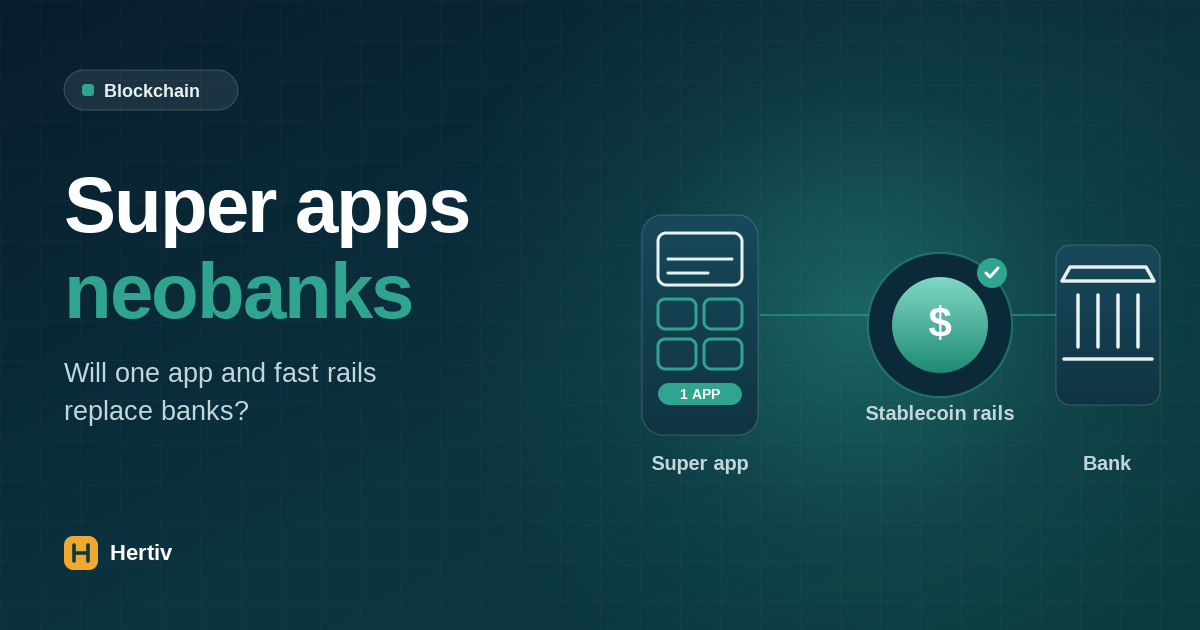
Super apps and crypto neobanks will grow fast, but neither is likely to replace traditional banks outright. Super apps win where one app already owns daily habits, and crypto neobanks win where cross-border payments are slow and costly. The likely outcome is a mix: banks adopt the new rails, and the new apps adopt bank licences and protections.
What are super apps and crypto neobanks?
A super app is a single app that bundles many everyday services — payments, messaging, shopping, food delivery and transport — behind one account and one wallet. A crypto neobank is a digital-only bank that holds customer balances in stablecoins and moves money over a blockchain instead of card and correspondent banking rails.
The two ideas overlap but are not the same. A super app wins by keeping users inside one place for many jobs, while a crypto neobank wins by making money move faster and cheaper across borders. When the two combine, one app can hold your money, pay your bills, book your travel and send funds abroad without a branch or a card network in the middle.
Both models depend on trust. A super app needs users to trust it with daily spending, and a crypto neobank needs users to trust stablecoins, key custody and the app's own controls. That trust is the real contest, not the technology alone.
Why do super apps and crypto neobanks look hard to beat?
Super apps and crypto neobanks look hard to beat because they cut out steps that traditional banks cannot remove: branches, card networks and slow settlement. Each model removes a different cost, and together they remove most of the friction in everyday money.
Three forces favour them. First, distribution: an app that people already open daily can add a payment or savings feature without winning a new customer. Second, cost: stablecoin rails settle in minutes with small fees, so cross-border transfers and merchant payments get cheaper. Third, data: one app sees spending, travel and shopping, so it can offer credit or rewards that a single-purpose bank cannot match.
None of this guarantees dominance. Banks still hold the licences, the deposit guarantees and the relationships with regulators that new entrants need. The question is whether the new models can earn the same trust while keeping their speed and cost edge.
What super apps already do well
Super apps already do well in markets where one app became the default for daily life. The pattern is the same in each case: start with one high-frequency job, then add services that share the same wallet and identity.
| Service | What the user does | Why it sticks |
|---|---|---|
| Payments | Pays friends, bills and shops | Used every day |
| Messaging | Chats and shares inside the app | Friends are already there |
| Shopping | Buys goods without leaving | Wallet is already loaded |
| Transport | Books rides and tickets | One account, one payment |
| Savings and credit | Saves and borrows small amounts | Built on spending history |
The wallet is the centre of the model. Once a user keeps a balance inside the app, each new service becomes a small step instead of a new account. That is why super apps expand into lending and insurance once payments are established.
What still holds crypto neobanks back?
Crypto neobanks still face four gaps that super apps largely solved years ago. Regulation is first: holding customer funds, offering cards and converting crypto to local currency each need licences that differ by country.
Trust is second. Most people do not want to manage private keys, and a lost key or a hacked account can mean lost funds with no branch to visit. Custody design, recovery options and clear protection matter more than any feature list. A blockchain neobank still has to answer the same question every bank answers: what happens when something goes wrong.
The third gap is the on-ramp and off-ramp: getting local currency in and out still depends on banks and payment processors. The fourth is price stability: stablecoins remove most volatility, but users still ask who backs the coin and what happens if the issuer fails. The non-custodial crypto neobanking trends show teams working on each of these gaps, but none of them is solved everywhere yet.
Super apps, crypto neobanks and traditional banks compared
The three models compete on different strengths, and the table below shows where each one leads. No model wins on every row, which is why the likely outcome is a mix rather than a single winner.
| Feature | Super app | Crypto neobank | Traditional bank |
|---|---|---|---|
| Daily use | Strongest | Growing | Weakest |
| Cross-border cost | Medium | Lowest | Highest |
| Deposit protection | Varies by country | Varies by licence | Strongest |
| Range of services | Widest | Narrow | Wide |
| Speed to launch a feature | Fastest | Fast | Slowest |
The interesting row is the last one. A super app can ship a new feature to millions of users in weeks, while a bank may need months of approval. That speed is why banks now buy, copy or partner with the new models instead of ignoring them.
Example (hypothetical): sending money home each month
Example (hypothetical): a worker sends $200 home to family 12 times a year. Through a traditional bank, each transfer costs $12 in fees and takes three days, so the year costs $144 in fees. Through a crypto neobank, each transfer costs $1.50 and arrives in minutes, so the year costs $18. The saving is $126 a year, plus the money arrives days earlier each time.
The saving only holds if the family can spend the stablecoins or convert them cheaply. If the local cash-out costs $5 per transfer, the yearly cost rises to $78 and the saving falls to $66. That is why the off-ramp, not the transfer itself, decides whether the model wins in practice. See stablecoin payments for business for how the rails work behind the transfer.
What are the common mistakes?
The most common mistakes are assuming the technology alone wins, ignoring licences, and treating all users as if they want the same thing.
- Assuming one model fits every country. Rules, habits and cash use differ, and a model that wins in one market can fail in the next.
- Skipping licences and compliance. Holding customer funds without the right licence can shut a product down overnight.
- Treating key custody as a detail. If users lose access to their money, no feature list will bring them back.
- Copying a super app without the daily-use habit. A bundle of services only works if users already open the app every day.
- Ignoring cash-out costs. Cheap transfers mean little if converting to local currency is slow or costly.
Key takeaways
- A super app wins by owning daily habits; a crypto neobank wins by making money move faster and cheaper
- Neither model has solved trust, licences and cash-out yet, and those gaps decide who wins
- Super apps expand from payments into lending once the wallet is loaded
- Stablecoin rails cut cross-border cost, but the off-ramp decides the real saving
- The likely outcome is a mix: banks adopt the new rails and new apps adopt bank protections
Frequently asked questions
Will super apps replace banks completely?
No. Super apps are strong on daily use and distribution, but they still need licences, deposit protection and banking partnerships to hold customer money safely. Banks are adopting the same features, so the contest is about who earns trust fastest, not about one model replacing the other.
Are crypto neobanks safe to use?
It depends on the provider. Check whether it holds a licence, how customer funds are kept, what happens if you lose access, and how you convert back to local currency. A licensed provider with clear custody and recovery is very different from an unlicensed app.
Why are stablecoins central to crypto neobanks?
Stablecoins keep balances steady in value while moving on fast blockchain rails, so a neobank can offer quick transfers and low fees without exposing users to crypto price swings. The coin's backing and the issuer's reserves are what users should check.
Do super apps work in every country?
No. Super apps work best where one app already owns messaging or payments and where regulators allow bundled services. In markets with strong card habits and strict banking rules, growth is slower and partnerships with banks matter more.
What should a team check before building a crypto neobank?
Start with licences, custody design, fraud checks and the off-ramp to local currency. The app and the rails are the easy part; the hard part is the regulatory and operational setup that lets customers trust the product with their money.
Will banks and neobanks merge into one model?
That is the most likely path. Banks are adding stablecoin rails and app-first features, while neobanks are seeking licences and deposit protection. The winner may be a hybrid: fast rails and a familiar app, backed by a regulated balance sheet.


