Why Traders Are Moving to Hybrid Crypto Exchanges
Traders are moving to hybrid exchanges for self-custody plus centralised speed. Here is what they gain, what they give up and when the move pays off.
On this page
Short answer
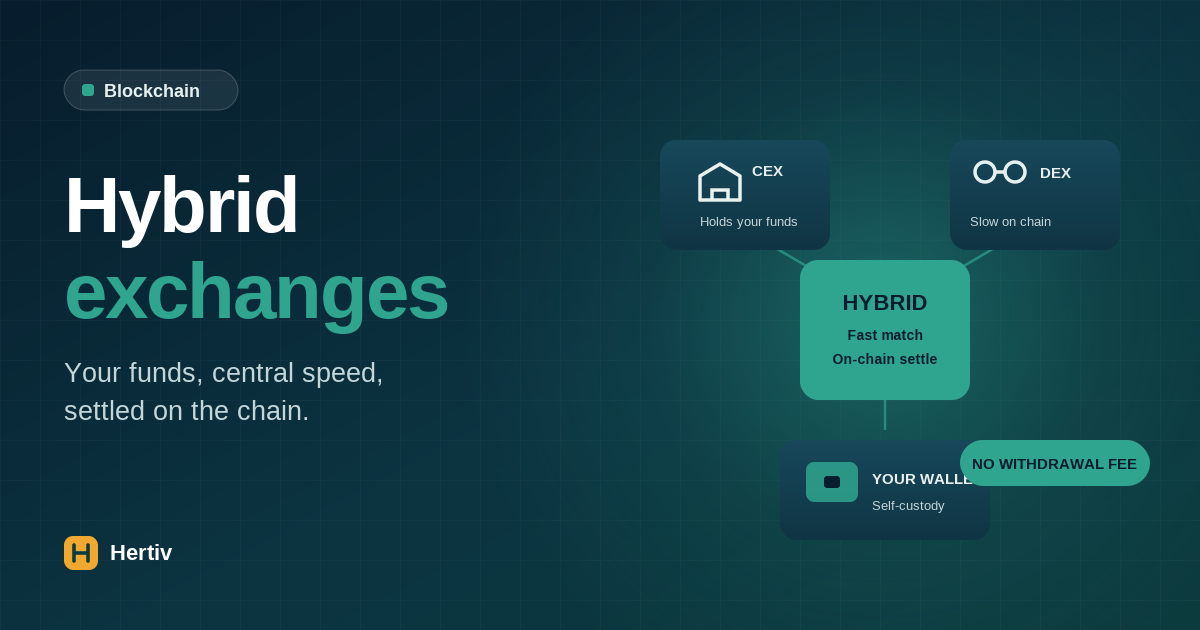
Traders are moving to hybrid crypto exchanges because they want the speed and deep order books of a centralised exchange without handing their funds to a third party. A hybrid matches orders off the chain for speed and settles them on the chain, so the trader keeps control of the funds while trading at centralised speed.
What is a hybrid crypto exchange?
A hybrid crypto exchange is a trading platform that combines the order book and speed of a centralised exchange with the self-custody of a decentralised one. Traders keep control of their funds in their own wallets, while orders are matched on a fast central engine instead of on the chain.
The split is the point. On a centralised exchange, the platform holds the funds and matches the orders. On a decentralised exchange, a smart contract holds the funds and matches the orders. A hybrid splits the two jobs: matching happens off the chain for speed, and settlement happens on the chain, so the trader's funds stay in their own wallet until a trade is agreed.
| Feature | Centralised | Hybrid | Decentralised |
|---|---|---|---|
| Who holds funds | The exchange | The trader's wallet | A smart contract |
| Order matching | Fast, off chain | Fast, off chain | Slow, on chain |
| Trading speed | High | High | Lower |
| Fees | Trading and withdrawal | Trading, lower withdrawal | Trading and gas |
| Fiat on-ramp | Yes | Often, through a partner | Rarely |
The model is still young, and the details differ between platforms, so the label covers a range of designs. For the basics, see what hybrid crypto exchange development is.
Why are traders moving to hybrid exchanges?
Traders are moving to hybrid exchanges for one main reason: they want the speed and depth of a centralised exchange without handing their funds to a third party. After several large centralised exchanges froze withdrawals or collapsed, many traders decided that holding their own funds was worth a change of platform.
The second reason is cost. A hybrid settles trades on the chain, so the trader pays the trading fee but not the withdrawal fee a centralised exchange charges to move funds out. For a trader who moves funds often, that saving adds up, and the gas cost of settlement is usually smaller than the withdrawal fee it replaces.
The third reason is access. A hybrid can list tokens quickly, like a decentralised exchange, while still offering the order types, charts and speed that active traders expect from a centralised one. A trader who wants a new token and a limit order no longer has to choose between the two.
None of this means centralised exchanges are finished. They still hold the deepest order books and the easiest fiat on-ramps, and many traders keep an account there alongside a hybrid one. The move is about splitting risk, not about abandoning one model for another.
What do traders get that a centralised exchange does not offer?
Traders on a hybrid exchange get self-custody, which a centralised exchange does not offer. On a centralised exchange, the funds sit in the platform's wallets, and the trader holds a balance on the platform's books. If the platform freezes withdrawals, the trader cannot move the funds, however good their trading was.
On a hybrid, the funds stay in the trader's own wallet until a trade is agreed, and the trade is settled on the chain. The platform cannot lend the funds out, freeze them or lose them in its own failure, because it never holds them. That is the feature traders point to first when they explain the move.
They also get transparency. A hybrid settles on the chain, so the trade is visible and can be checked, while a centralised exchange settles in its own books and the trader must trust its reporting. For a trader who has watched a platform fail, that difference is hard to give up.
The trade-off is that self-custody puts the responsibility on the trader. Lose the wallet keys and the funds are gone, with no support desk to restore them. A hybrid removes the platform as a risk and replaces it with the trader's own key management.
What do traders get that a decentralised exchange does not offer?
Traders on a hybrid exchange get speed and depth, which a decentralised exchange does not offer. A decentralised exchange matches orders on the chain, so every order and every change to it waits for a block, and the cost of each action is a gas fee. Active traders find that slow and expensive.
A hybrid matches orders off the chain, so placing, changing and cancelling an order is instant and free, and the chain is used only to settle the trades that actually happen. That makes the trading feel like a centralised exchange, with the same order types and the same depth, while the settlement stays on the chain.
They also get a deeper order book. Because market makers can quote and cancel without paying gas on every change, they offer tighter prices and larger size than they can on a purely on-chain book. A trader who moves size notices the difference in the price they actually get.
Some hybrids also offer a fiat on-ramp through a partner, so a trader can move money in from a bank account without first buying crypto elsewhere. That is rare on a decentralised exchange, and it is one of the reasons new traders find hybrids easier to start on.
What are the trade-offs?
The trade-offs of a hybrid exchange are complexity, youth and the fact that some risk stays. The model is newer than both centralised and decentralised exchanges, so there are fewer platforms, fewer track records and fewer independent audits to check.
The matching engine is centralised, which means the platform can see the orders and could, in theory, favour some traders over others. A hybrid removes custody risk but not all trust: the trader still trusts the engine to match fairly and the team to run it honestly. A fully on-chain exchange does not ask for that trust, but it pays for it in speed.
Fees are mixed. Trading fees are usually lower than on a centralised exchange, but the trader pays gas on settlement, and on a busy chain that cost can rise sharply. A trader who settles many small trades can end up paying more in gas than they saved in trading fees.
Liquidity is the other limit. A new hybrid has a thinner order book than a large centralised exchange, so a large order can move the price more. Traders who move size check the depth before they commit, and many keep a centralised account for the trades that need the deepest book.
Example (hypothetical): a trader moving monthly volume
Example (hypothetical): a trader moves $20,000 of volume a month and makes 40 trades, so each trade averages $500. On the centralised exchange they used, the trading fee was 0.2% and the monthly withdrawal fee was $25, so the monthly cost was $20,000 x 0.2% = $40 in trading fees plus $25 to withdraw, which is $65 a month.
On a hybrid exchange the trading fee is 0.15%, so the trading fees are $20,000 x 0.15% = $30 a month. Settlement costs gas, which the trader assumes at $0.50 per trade, so 40 trades cost 40 x $0.50 = $20 a month. There is no withdrawal fee, because the funds never leave the trader's wallet.
The hybrid month costs $30 + $20 = $50, against $65 on the centralised exchange, so the trader saves $15 a month, which is $180 a year. The saving is small at this volume, and it grows with volume: at $100,000 a month the same maths gives $150 + $100 = $250 against $200 + $25 = $225, so the hybrid costs more.
The arithmetic shows the point: the saving depends on volume, fee and gas, and it flips at some point. A trader should run these numbers for their own volume before moving, and check the fee and the gas cost on the day, because both move.
What are the common mistakes?
The most common mistakes with hybrid exchanges are assuming the platform holds no risk, ignoring the gas cost of settlement and moving everything at once.
- Treating a hybrid as fully trustless when the matching engine is centralised
- Forgetting the gas cost of settlement when comparing fees
- Moving all funds to a new platform before testing it with a small trade
- Keeping the wallet keys in one place with no backup
- Trading a thin order book with a large order and moving the price
- Skipping the audit and the team background of a new platform
Building one is a different question from trading on one. The how to build a hybrid crypto exchange guide covers the parts and the costs.
The why build a hybrid exchange guide covers the business case for launching one.
Key takeaways
- A hybrid matches orders off the chain for speed and settles them on the chain, so funds stay in the trader's wallet.
- The main gain over a centralised exchange is self-custody: the platform cannot freeze, lend or lose the funds.
- The main gain over a decentralised exchange is speed and depth, since orders are matched off the chain.
- The matching engine is still centralised, so some trust in the platform remains.
- Whether the move saves money depends on volume, trading fee and gas, so run your own numbers first.
Frequently asked questions
What is a hybrid crypto exchange?
It is a trading platform that matches orders off the chain, like a centralised exchange, and settles them on the chain, like a decentralised one. Traders keep their funds in their own wallets, while the matching is fast and free.
Why are traders leaving centralised exchanges?
The main reason is custody: on a centralised exchange the platform holds the funds and can freeze withdrawals. After several large platforms froze withdrawals or collapsed, many traders decided that holding their own funds was worth changing platforms.
Are hybrid exchanges safer than decentralised exchanges?
They are safer in some ways and less safe in others. A hybrid removes custody risk, but its matching engine is centralised, so the trader trusts the platform to match fairly. A fully on-chain exchange asks for no such trust but is slower and more expensive to trade on.
Do hybrid exchanges cost less to trade on?
It depends on volume. Trading fees are usually lower than on a centralised exchange, but the trader pays gas on settlement, and on a busy chain that cost can rise sharply. Run the numbers for your own volume before you move.
Can I use fiat money on a hybrid exchange?
Some hybrids offer a fiat on-ramp through a partner, so you can move money in from a bank account. It is not universal, so check whether the platform you are considering offers it and what the partner charges.
Should I move all my trading to a hybrid exchange?
Most traders do not move everything at once. Test the platform with a small trade, check the order depth and the fees at your volume, and keep a centralised account for the trades that need the deepest book.


