Why Build in Web3? Reasons Teams Choose It
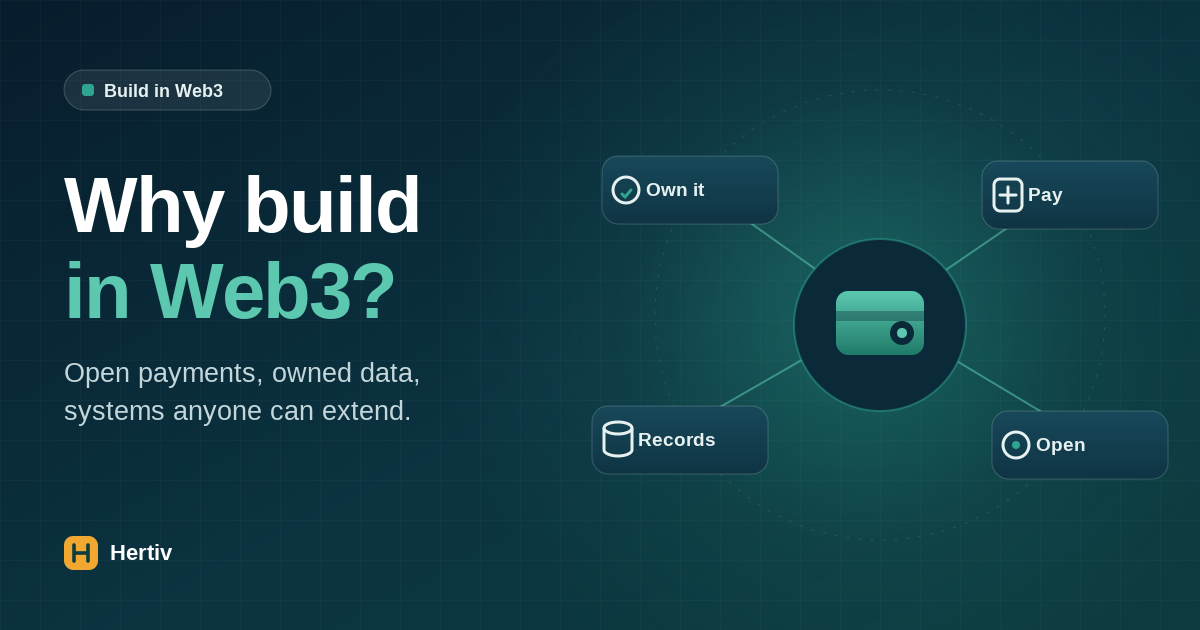
Teams build in Web3 for open payments, user-owned data and systems anyone can build on. Here are the reasons, when they apply, and the risks to weigh first.
On this page
Short answer
Teams build in Web3 when they want users to own their data and assets, payments that work across borders, and open systems other builders can extend. Web3 also suits products where trust comes from public, checkable records rather than one company's promise. It is a poor fit when the product needs private data or fast customer support, so the choice depends on what the product must do.
What does it mean to build in Web3?
Building in Web3 means building an app or service on open blockchain networks, where users hold their own accounts and assets, data and payments move without one company in the middle, and other builders can extend what you made. A user signs in with a wallet they control, pays with a digital asset, and keeps a record they can check themselves.
Web3 is not one product or one network. It is a set of open tools: blockchains that record ownership, smart contracts that run rules automatically, wallets that hold accounts and assets, and tokens that can stand for money, membership or a share of something real.
The difference from a normal web app is who holds the keys. In a normal app, the company holds the accounts, the data and the payment rails. In Web3, the user holds the account, the network holds the record, and the company builds the experience on top. For the basics of the networks underneath, what Web3 is explains how the pieces fit together.
Why do teams choose to build in Web3?
Teams choose Web3 for a small set of reasons, and each one only applies to some products. A team that picks Web3 for a reason that does not match its product will pay the cost of the technology without getting the benefit.
| Reason | What it gives you | Example product |
|---|---|---|
| User-owned data and assets | Users keep what they earn | Game items and memberships |
| Open payments | Payments across borders | Creator payouts and tips |
| Public, checkable records | Trust without one company | Supply and ownership records |
| Open systems | Others can build on your work | Shared marketplaces |
| New business models | Fees shared with users | Community-run platforms |
| Global reach | Anyone with a wallet can join | Borderless savings and gifts |
Ownership is the reason most teams give first. When users own their game items, their membership or their content, they can take it with them instead of losing it if the app closes.
Payments are the second reason: a creator can be paid by anyone, anywhere, without waiting for a bank to approve the transfer. Public records are the third: when ownership and payments are on a public record, anyone can check them instead of trusting one company's word.
When does building in Web3 make sense?
Building in Web3 makes sense when the product needs one of the reasons above and cannot get it from a normal database. A marketplace where users trade items they own, a payment app for people without bank access, or a record that several companies must trust are all good fits, because the open record is the point of the product.
It makes less sense when the product is a normal app with a Web3 label added. A to-do list, a food delivery app or a company dashboard gains nothing from a blockchain, and the added cost, the wallet step and the slower transactions will make it worse than the normal version.
A simple test helps: if you removed the blockchain and the product still worked the same way, you probably do not need Web3. If removing it broke the ownership, the payments or the trust the product promises, then Web3 is doing real work. For teams still deciding, how to launch a Web3 app covers the planning steps before any building starts.
How do you start building in Web3?
You start building in Web3 by proving the idea with the smallest version that shows the ownership or payment working, then growing from there. A Web3 project that starts with a full platform usually spends months on infrastructure before anyone can use it.
- Name the one Web3 job. Write down the single thing the blockchain must do, such as holding membership or moving a payment.
- Pick the network and the wallet. Choose a network your users can already reach, and a wallet they can install in minutes.
- Build the smallest version. Build the one job end to end, with a simple screen and a clear result.
- Test with real users. Ask five users to sign up, pay and check their record, and watch where they get stuck.
- Check the rules. Ask a legal adviser which rules apply in your market before you take real money.
- Decide what grows next. Add the next feature only after the first one works for real users.
Keep the team small at the start: one person who owns the product, one engineer who knows smart contracts, and one designer who can make the wallet step feel simple. The wallet step is where most users drop off, so it deserves more design time than the smart contract itself. For the build itself, blockchain development covers how a Web3 product is designed and built.
Example (hypothetical): a membership app for a small community
Example (hypothetical): a running club with 200 members wants a membership app where each member holds a digital membership card they can show at events. The club builds a Web3 app where the card is a token in each member's wallet, and the club checks it at the door.
The build takes 8 weeks and costs a hypothetical 40,000 dollars: 2 weeks for design, 4 weeks for the smart contract and the app, and 2 weeks for testing. The club charges 10 dollars a year for membership, so 200 members bring in 2,000 dollars a year, which does not cover the build cost in the first year.
The club still builds it, because the point is not the first-year income. Members keep their cards even if the club changes its app, and the club can add event tickets and discounts to the same card later. The lesson is that a Web3 build is worth it when the ownership matters to the users, not when it is the cheapest way to build the same thing.
What are the risks and costs?
Web3 adds risks that a normal web app does not have. Smart contracts cannot be changed easily once they are live, so a bug in the contract can be expensive to fix. Wallet steps confuse new users, and a user who loses their wallet key can lose access to their assets. Rules for tokens and payments also differ by market, and they change often.
Costs come in three parts: the build, the network fees and the ongoing care. The build is the largest cost, and it needs an engineer who knows smart contracts, not only web development.
Network fees depend on the chain you choose and on how busy it is, so test on a small scale before you commit to a chain. Ongoing care means watching the contract, answering users who lose access, and updating the app as wallets change.
Budget for a security check before launch. A smart contract review by a specialist is not cheap, but it is cheaper than a bug found by an attacker. Never launch a contract that handles real money without that review, and never promise users a return on a token, because that changes which rules apply to your product.
What are the common mistakes?
The most common mistakes are adding Web3 to a product that does not need it, skipping the security check, and making the wallet step too hard.
- Web3 for its own sake. Adding a blockchain to a normal app adds cost and friction without adding value.
- Skipping the security check. Launching a smart contract without a review risks a bug that cannot be fixed cheaply.
- A hard wallet step. If users cannot set up a wallet in minutes, most of them will leave before they see the product.
- No legal check. Tokens and payments attract rules that differ by market, and ignoring them can stop a launch.
- Promising returns. Telling users a token will gain value changes the rules that apply and invites trouble.
- Building too much first. A full platform built before anyone uses it will spend months on features nobody asked for.
Key takeaways
- Web3 fits products where ownership, open payments or public trust matter
- If removing the blockchain changes nothing, you do not need it
- Start with one Web3 job, tested by real users
- The wallet step is where most users drop off, so design it carefully
- Get a security review before any contract handles real money
- Check the legal rules in your market before you launch
Frequently asked questions
What is Web3 in simple terms?
Web3 is the name for apps built on open blockchain networks, where users hold their own accounts and assets instead of a company holding them. Wallets, smart contracts and tokens are the main building blocks.
Why would a business build in Web3?
A business builds in Web3 when its product needs user-owned assets, payments across borders, or public records that several parties can trust. If none of those matter, a normal web app is usually cheaper and easier.
Is Web3 only for crypto and finance?
No. Web3 is also used for game items, memberships, creator payouts, supply records and community platforms. Finance was the first large use, but ownership and open payments apply to many other products.
How much does it cost to build in Web3?
It depends on the product, the network and the team, and costs vary widely. The build needs a smart contract engineer, plus a security review before launch. Ask for quotes based on your real scope, not a list price.
Do users need a wallet to use a Web3 app?
Usually yes, because the wallet holds the user's account and assets. Some apps hide the wallet step behind a normal login, but the user still needs a way to hold and check what they own.
What is the biggest risk of building in Web3?
The biggest risk is a bug in a smart contract that handles real money, because contracts are hard to change once live. A security review before launch and a small first release are the two best ways to keep that risk down.


