Who Can Validate Your AI Idea Before You Invest?
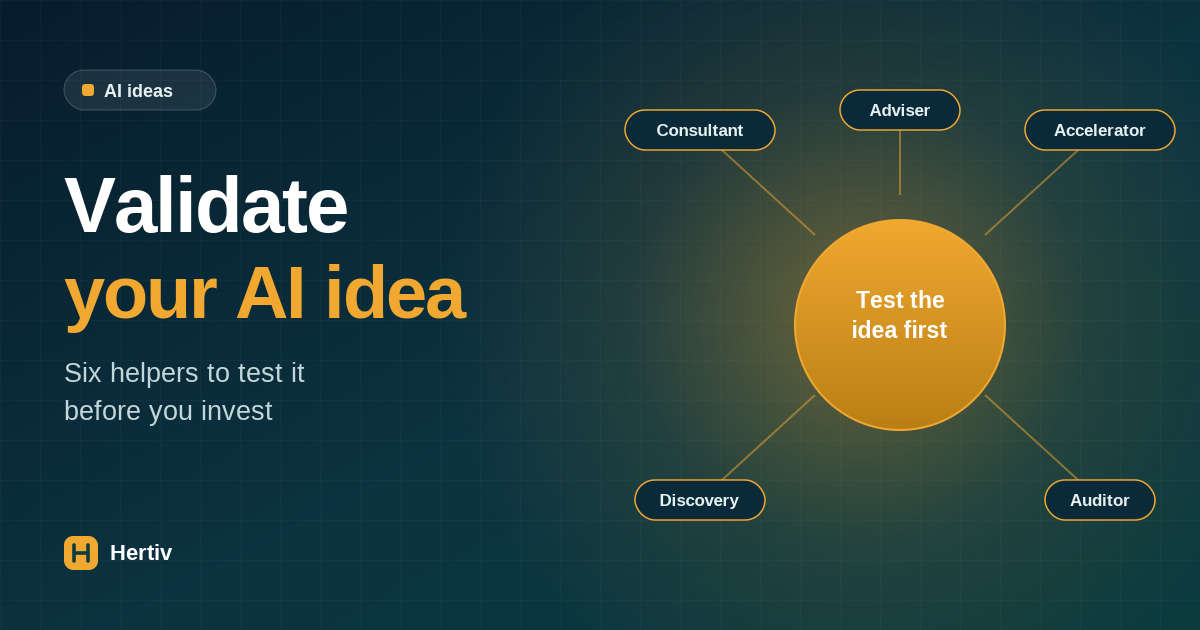
Six kinds of help can test an AI idea before you spend on building it: consultants, discovery teams, accelerators, advisers, auditors and researchers.
On this page
Short answer
An AI idea is worth testing before you invest in building it, and six kinds of help can do the testing: an AI consulting firm, a product discovery team, an accelerator programme, a technical adviser, an AI audit service and a user research team. Each one checks a different risk, from whether the model works to whether anyone will pay for it.
Who can help validate an AI idea before you invest?
Before you spend on building an AI product, check whether the idea holds up: whether the model can do the job, whether the data exists, and whether anyone will pay for it. The six kinds of help below each test a different part of that question, and most founders use two or three of them in sequence.
An AI consulting firm tests the technical side. A product discovery team tests demand. An accelerator tests the business model with mentors and a deadline. The right mix depends on what you already know: if you have users but no model, start technical; if you have a model but no users, start with discovery. The table below compares the six options.
| Helper | Main check | Best for | Typical output |
|---|---|---|---|
| AI consulting firm | Can the model do the job? | Technical feasibility | A pilot and a build plan |
| Product discovery team | Will anyone use it? | Demand and pricing | Interview notes and a test offer |
| Accelerator programme | Does the business work? | Early-stage founders | Mentoring and a demo day |
| Technical adviser | Is the plan sound? | Second opinion on scope | Written review and risks |
| AI audit service | Is it safe and legal? | Regulated data and bias | Risk report and fixes |
| User research team | Do users understand it? | Usability and trust | Test sessions and findings |
The list is alphabetical, not ranked. The best helper is the one that tests your biggest unknown first, not the one with the longest client list. Prices vary widely, so check the vendor site for current fees before you compare costs.
1. AI consulting firm: best for testing technical feasibility
1. AI consulting firm: best for testing technical feasibility
An AI consulting firm builds a small pilot on your own data and measures whether the model answers well enough to be useful. It will tell you what data you need, which model fits, and what the build would cost, usually after a few weeks of work on a narrow slice of the problem.
This is the right first step when your main doubt is technical: you have users and a clear job, but you are not sure the model can do it. Ask for a pilot that uses your real documents and your real questions, and agree in advance what "good enough" means. You can link this step to broader AI consulting when you are ready to plan the full build.
Pros:
- Tests the model on your own data, not a demo set
- Produces a costed build plan you can act on
- Spots data gaps before you commit
Cons:
- Costs more than a light-touch review
- Takes weeks, not days
- See vendor site for pricing
2. Product discovery team: best for testing demand
2. Product discovery team: best for testing demand
A product discovery team interviews the people you hope will pay, then tests a simple offer: a landing page, a paid pilot, or a manual version of the service. It answers the question a model cannot answer on its own, which is whether anyone cares enough to change how they work today.
This is the right first step when the technology looks possible but the demand is unproven. A good discovery team will push you to talk to buyers, not just users, and to test price early. Ten interviews that end with a signed pilot say more than a hundred polite conversations.
Pros:
- Tests willingness to pay, not just interest
- Fast: results in days or a few weeks
- Finds the wording buyers actually use
Cons:
- Does not test whether the model works
- Small samples can mislead
- Needs access to real buyers
3. Accelerator programme: best for early-stage founders
3. Accelerator programme: best for early-stage founders
An accelerator programme gives a small group of founders mentoring, a fixed deadline and a demo day in front of investors. Mentors challenge the idea each week, and the programme forces you to test assumptions on a schedule instead of polishing the idea in private.
This fits founders who are early, full-time and open to coaching. The trade-off is time and equity: most programmes take a share of the company, and the schedule is intense. Apply only if you can give the programme your full attention for its full length.
Pros:
- Weekly pressure to test, not just plan
- Mentors who have seen similar ideas fail
- Investor introductions at demo day
Cons:
- Usually takes equity in your company
- Demands full-time focus for months
- Competitive to get into
4. Technical adviser: best for a second opinion on scope
4. Technical adviser: best for a second opinion on scope
A technical adviser is an experienced engineer or architect who reviews your plan, your data and your vendor quotes, then tells you where the plan is weak. The review usually takes a few days and ends with a written list of risks and what to change before you sign anything.
This is the cheapest useful check when you already have a plan or a quote and want someone independent to read it. Choose an adviser who has shipped AI products, not only advised on them, and ask them to name the three biggest risks in writing. A review that finds nothing is a warning sign, not a pass.
Pros:
- Cheap and fast compared with a pilot
- Independent view of vendor quotes
- Finds scope gaps before contracts
Cons:
- Does not build or test anything
- Quality depends on the adviser
- Needs your real documents to help
5. AI audit service: best for safety and legal checks
5. AI audit service: best for safety and legal checks
An AI audit service checks a model and its data for bias, privacy risk, security gaps and legal exposure. It tests the system with edge cases, reviews how data is stored and logged, and reports what must change before the product can be used with real customers.
This matters most when the idea touches personal data, health, finance or hiring, where a mistake can cost far more than the build. Run the audit on the pilot, not after launch, because fixes are cheaper while the system is still small. For a related view, the guide to testing AI models shows what a thorough test covers.
Pros:
- Finds bias and privacy risks early
- Produces a report you can show buyers
- Covers rules a builder may miss
Cons:
- Does not test demand or pricing
- Adds time before launch
- See vendor site for pricing
6. User research team: best for usability and trust
6. User research team: best for usability and trust
A user research team watches real people try the AI feature and records where they hesitate, misunderstand the answer or stop trusting it. The team runs short test sessions, then reports the exact moments where the product confused people and what to change.
This is the right check when the model works but people do not use it as expected. AI answers are often plausible but wrong in small ways, and users need to know when to trust the output and when to check it. Five watched sessions usually find the biggest problems.
Pros:
- Shows real behaviour, not opinions
- Finds trust and wording problems fast
- Cheap compared with rebuilding
Cons:
- Does not test the model itself
- Needs real users to be useful
- Findings need a team to act on them
How to choose who validates your idea
Start from your biggest unknown, not from the helper with the best website. If you are unsure the model can do the job, book the consulting firm. If you are unsure anyone will pay, book the discovery team. If you are unsure about the rules, book the audit. One focused check beats three vague ones.
- Write down the one claim your idea depends on, in one sentence.
- Pick the helper whose main check matches that claim.
- Agree in advance what result would make you stop, change or continue.
- Run the check on real data and real users, not on slides.
- Act on the result: change the idea, narrow the scope, or stop and keep the money.
Keep the validation small and written down. A short report you can re-read beats a long meeting you cannot remember, and it gives the next helper a clear starting point.
Common mistakes
The most common mistake is validating the idea with friends and colleagues, who are polite by default. Strangers who would have to pay are the only honest test, and they are the hardest to find, which is why the discovery work matters most.
Another mistake is testing a demo instead of the real job: a model that summarises a sample document says little about a model that must answer a thousand real questions a day. Test the hardest version of the job, not the easiest, and set the pass mark before you see the results.
Key takeaways
- Test the biggest unknown first
- Use two or three helpers in sequence, not all six at once
- Agree the pass mark before you run the check
- Test on real data and real buyers, not on demos
- Act on the result: change, narrow or stop
Frequently asked questions
How much does it cost to validate an AI idea?
Costs vary from a few days of an adviser's time to a multi-week pilot from a consulting firm. Start with the cheapest check that tests your biggest unknown, and check the vendor site for current fees before you commit to a pilot.
Can I validate an AI idea without a technical team?
Yes. A discovery team and a user research team need no technical staff from you, and an adviser can review a vendor's plan on your behalf. You only need a technical team when you move from validation to building.
How long does validation usually take?
A discovery sprint takes one to three weeks, an adviser review takes a few days, and a technical pilot takes three to six weeks. An accelerator takes months, so use it only when you are ready to commit full-time.
What should a validation report include?
It should name the claim that was tested, the data and users used, the result in plain numbers, and the risks that remain. If a report only says the idea is promising, it has not tested anything.
Should I validate before talking to investors?
Yes. Investors ask the same questions a good validation answers: does it work, will anyone pay, and what are the risks. A short written report makes those conversations shorter and more honest.
Is an accelerator the same as validation?
No. An accelerator includes validation, but it also demands months of full-time work and usually takes equity. Use a discovery team or a pilot first if you only need the answer to one question.


