White Label Tokenization Partners: How to Choose One
A white label tokenization partner builds a token platform under your brand, from smart contracts to the investor dashboard. Here is how to pick one.
On this page
Short answer
A white label tokenization development partner is a company that builds a tokenization platform you sell under your own brand. The partner writes the smart contracts, builds the investor dashboard and handles the technical parts, while your business owns the brand, the customers and the assets. This guide explains what to check before you sign.
What is a white label tokenization development partner?
A white label tokenization development partner is a specialist firm that builds a platform for issuing and managing digital tokens backed by real assets, such as property, funds or bonds, and brands it as yours. White label means the partner's name stays off the product: your logo, your colours and your domain are what investors see.
Tokenization turns ownership of an asset into tokens on a blockchain, so shares in a property or a fund can be bought, sold and tracked in smaller pieces. Building that system from scratch takes a blockchain team, a compliance review and months of work, which is why many businesses hire a partner instead.
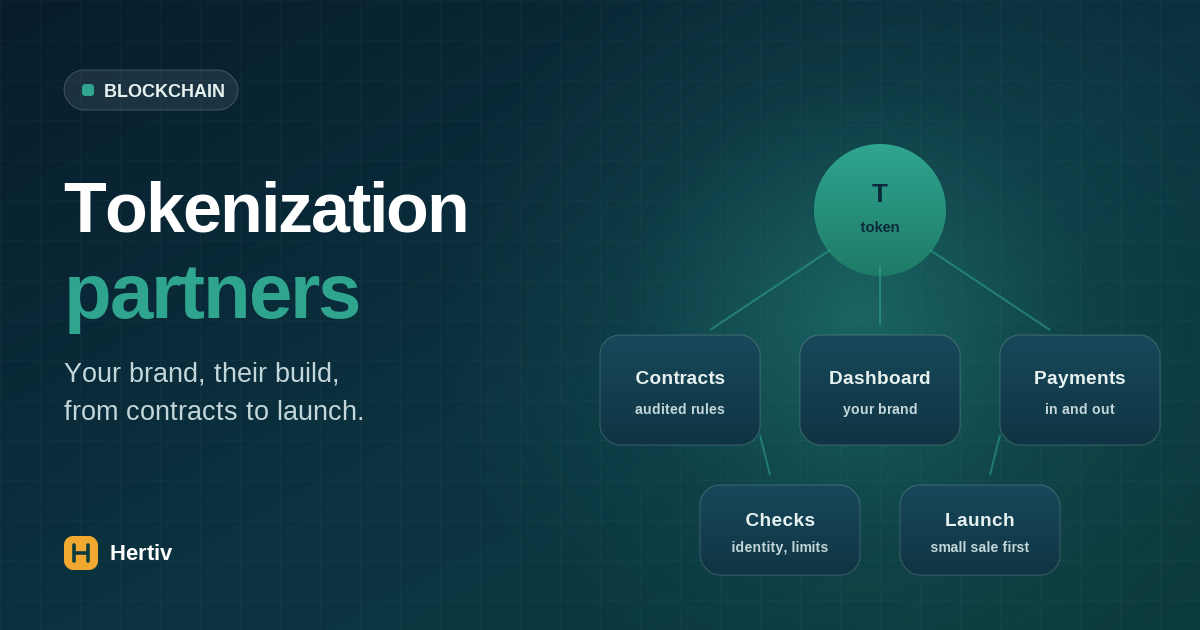
| What the partner builds | What it does |
|---|---|
| Smart contracts | Issue tokens, enforce transfer rules, pay distributions |
| Investor dashboard | Onboarding, holdings, documents and statements |
| Admin panel | Manage offerings, investors and compliance checks |
| Payment rails | Take funds in and pay investors out |
| Compliance tooling | Identity checks, limits and record keeping |
The sections below explain what a partner should deliver, what to check before signing, and how the first project usually runs. Fees vary widely by scope, so ask for a written quote and check the vendor site for current plans rather than trusting a list price.
What does a tokenization partner actually build?
A partner builds the whole platform, not just the smart contracts. The investor-facing side covers sign-up, identity checks, buying tokens, viewing holdings and receiving statements. The admin side covers creating offerings, setting transfer rules, managing investors and exporting records for audit.
The smart contracts are the core. They define how many tokens exist, who may hold them, how transfers are approved and how distributions are paid. A good partner writes these contracts so the rules can be audited, and has them reviewed by an independent auditor before launch.
Partners also connect the platform to the outside world: payment providers for taking funds, identity services for checks, and custodians for holding assets. These connections take time to arrange, so ask how many the partner has built before and how long each one took.
What should you check before signing?
Check the partner's past work first. Ask for two or three live platforms they built, and look at them as an investor would: sign up, read the documents and try the dashboard. A partner that cannot show live work is a risk, however good the sales call sounds.
Check the compliance approach next. Token sales touch securities rules in most markets, and the rules differ by country. A serious partner will ask about your market and your lawyers early, and will refuse work that does not fit the rules. A partner that waves the rules away is a warning sign.
Check who owns the code and the contracts. You should own the smart contracts and the platform code, or hold a licence that survives if the partner closes. Put ownership, source code access and the right to move hosts in the contract before work starts.
How do white label tokenization projects charge?
Most partners charge in two parts: a build fee for the platform and a running fee for hosting, support and updates. The build fee depends on the scope: a simple token sale with one asset costs far less than a platform with many assets, secondary trading and investor reporting.
Some partners also charge a share of the funds raised or a fee per transaction. Ask for the full fee table in writing, including what happens if the project grows, and compare the total cost of the first year, not only the build fee.
Do not accept a price without a scope. A quote that lists features without saying what is included will grow as the project goes on. Ask for a written scope with a feature list, a timeline and the fees for each phase, and check the vendor site for current plans.
Example (hypothetical): a property fund token sale
Example (hypothetical): a property fund wants to sell tokens worth $10 million in total, in pieces of $100 each. That means 100,000 tokens, since 10,000,000 divided by 100 equals 100,000. The partner builds the platform, the contracts and the investor dashboard for the sale.
The sale runs for six weeks and sells 80,000 of the 100,000 tokens, which is $8 million. The partner's fee is 2 percent of funds raised, so the fee is 2 percent of $8 million, which is $160,000, and the fund keeps $7,840,000 before other costs.
The fund then pays a quarterly distribution of $150,000 across the 80,000 sold tokens, which is $150,000 divided by 80,000, or $1.88 per token per quarter. The platform shows each investor their share, and the contracts pay it automatically, which is the point of tokenizing in the first place.
How to run the first project in five steps
Running the first project well matters more than picking the perfect partner. A clear sequence keeps the legal, technical and commercial work in the right order.
- Confirm the legal shape: work with your lawyers to confirm the token type, the market and the investor rules before any code is written.
- Write the scope: list the assets, the investor journey, the payment methods and the reports, and get a written quote against that scope.
- Test the contracts: ask for an independent audit of the smart contracts and fix every finding before launch.
- Run a small sale first: open the platform to a small group of investors, check the full journey, and fix what breaks.
- Launch and watch: open the sale, monitor the dashboard daily, and keep the partner on support for the first month.
Keep the first sale small. A small sale that works end to end teaches more than a large sale that stalls, and it gives investors a reason to trust the next one.
Common mistakes when hiring a tokenization partner
The most common mistake is choosing on price alone. The cheapest partner often leaves out the audit, the admin panel or the support, and those gaps cost more later than the saving. Compare the full scope and the first-year total, not the headline fee.
Another mistake is starting the build before the legal work. A platform built around the wrong token type or the wrong market has to be rebuilt, and that rebuild costs more than the first build. Settle the legal shape first, even if it feels slow.
A third mistake is ignoring the exit. If the partner closes or the relationship ends, you need the code, the contracts and the data to keep running. Put ownership and handover in the contract on day one, and test that you can run the platform without the partner.
Key takeaways
- A white label partner builds the token platform under your brand.
- Check live past work, the compliance approach and code ownership first.
- Settle the legal shape before any code is written, and audit the contracts.
- Run a small sale first, and compare the full first-year cost, not the build fee.
Frequently asked questions
What is white label tokenization?
White label tokenization is a platform for issuing asset-backed tokens that a business sells under its own brand. A development partner builds the platform, including smart contracts and the investor dashboard, while the business owns the brand and the customers.
How much does a white label tokenization platform cost?
The cost depends on the scope: a simple token sale costs far less than a platform with many assets, trading and reporting. Partners usually charge a build fee plus a running fee, so ask for a written quote and check the vendor site for current plans.
Do I need a lawyer for a token sale?
Yes. Token sales touch securities rules that differ by country, and the token type, the market and the investor rules must be settled before launch. A good partner will ask about your lawyers early and will not start the build without that work.
What is the difference between a platform and a partner?
A platform is the software that issues and manages tokens, while a partner is the company that builds and runs it for you. Some businesses buy a ready-made platform, while others hire a partner to build one to their own scope.
Can investors trade the tokens afterwards?
That depends on the rules of your market and the design of the platform. Some tokens can be traded on a secondary market, while others can only be transferred with approval. Ask your partner and your lawyers what the rules allow before you promise trading to investors.
Who owns the smart contracts?
You should own them, or hold a licence that survives if the partner closes. Put ownership, source code access and the right to move hosts in the contract before work starts, so the platform can keep running without the partner.


