White Label Real Estate Tokenization: How It Works
White label real estate tokenization lets a firm offer tokenised property under its own brand, without building the platform. Here is what it includes.
On this page
Short answer
White label real estate tokenization is a ready-made tokenization platform that a property firm rebrands as its own, so investors buy tokens in a property through the firm's website and app instead of a third-party marketplace. The provider runs the technology, token issuance, investor checks and payment rails, while the firm keeps its brand, its investors and its fee structure.
What is white label real estate tokenization?
White label real estate tokenization is a ready-made platform that lets a property firm sell digital tokens in a building or a fund under its own brand. A token is a digital record on a blockchain that represents a share of a property, and the platform handles issuing the tokens, checking investors and recording who owns what.
The "white label" part means the technology is built by a specialist provider and the property firm puts its own name, logo and colours on it. Investors see the firm's brand, not the provider's. The firm also sets its own minimum investment, fees and offering terms, within the rules that apply in its market.
This is different from listing a property on a public token marketplace. On a marketplace, the property sits next to other sellers' offers and the marketplace sets the rules. With a white label platform, the firm controls the investor experience end to end, from the first page an investor sees to the payout statements they receive.
What does a white label platform include?
A white label real estate tokenization platform usually includes five parts: token issuance, investor onboarding, a way to buy and sell, payout handling and reporting. Each part matters, because a missing piece usually means extra manual work or a second tool.
| Platform part | What it does | Why it matters |
|---|---|---|
| Token issuance | Creates tokens for a property or fund | Defines what each token represents |
| Investor onboarding | Identity checks and suitability forms | Keeps the offer inside the rules |
| Buying and selling | Primary sale and, where allowed, resale | Investors need a way in and a way out |
| Payouts | Rent and sale proceeds paid per token | Investors expect regular, correct payments |
| Reporting | Holdings, statements and tax records | Builds trust and saves admin time |
Some platforms also include a wallet, so investors hold their tokens in an account on the platform instead of managing a separate crypto wallet. That choice matters for the audience: first-time property investors usually prefer a simple account, while experienced crypto investors may want to hold tokens themselves.
Before signing, a firm should check which of these parts are included in the base price and which are add-ons. A platform that looks cheap can become expensive once onboarding, custody and payout tools are added.
How does a white label platform work?
A white label platform works by connecting four groups: the property owner, the investors, the compliance checks and the blockchain record. The owner lists a property or a fund, the platform creates the tokens, investors pass the checks and buy, and the blockchain records the ownership.
- Structure the offer. Decide what is being tokenised, such as one building or a fund of several properties, and how many tokens the offer will have.
- Set the rules. Agree the minimum investment, who may invest, and what rights a token gives, such as income, voting or nothing beyond ownership.
- Brand the platform. Add the firm's name, logo, colours and domain, so investors see one brand from start to finish.
- Onboard investors. Collect identity documents and run the checks the local rules require before anyone can buy.
- Run the sale. Investors buy tokens with bank transfer or card, and the platform records each purchase.
- Pay out income. Rent and sale proceeds are split per token and paid to holders on a fixed schedule.
The blockchain part is only one piece of the system. Most of the work is ordinary business process: documents, checks, payments and reporting. A firm that treats the platform as a finished product and ignores those processes will struggle, because investors judge the offer by the statements and payments they receive, not by the technology underneath.
Who uses white label real estate tokenization?
White label real estate tokenization is used by property developers, fund managers, brokers and property platforms that want to offer fractional ownership without building the technology. It suits firms that already have investors or buyers and want to give them a smaller entry ticket.
Developers use it to raise money for a project from many small investors instead of a few large ones. Fund managers use it to open a fund to investors who could not meet a high minimum. Brokers use it to add an investment product alongside their sales business.
It is a poor fit for a firm with no audience and no property pipeline. The platform does not find investors or properties; it only makes the sale and the record-keeping easier. A firm still needs a property worth tokenising, a legal structure and a plan to reach investors.
Teams that already tokenize real estate with their own systems sometimes keep that work in-house instead, because they have the team and the volume to justify it.
What does a white label platform cost?
A white label real estate tokenization platform usually costs a setup fee plus a monthly fee and a share of each transaction or of the assets on the platform. The exact split varies by provider, so firms should ask for the full fee schedule before comparing offers, and check the vendor site for current pricing.
The main cost drivers are the number of properties, the number of investors, the compliance checks required and whether the provider handles custody and payouts. A single-property offer with a few dozen investors costs far less to run than a fund with thousands of holders and monthly payouts.
There are also costs outside the platform: legal advice, property valuation, audit and the time the firm's own team spends on investor support. A realistic budget includes all of these, not just the platform fee. A firm that budgets only for the software usually discovers the rest too late.
Example (hypothetical): tokenising a $12M property fund
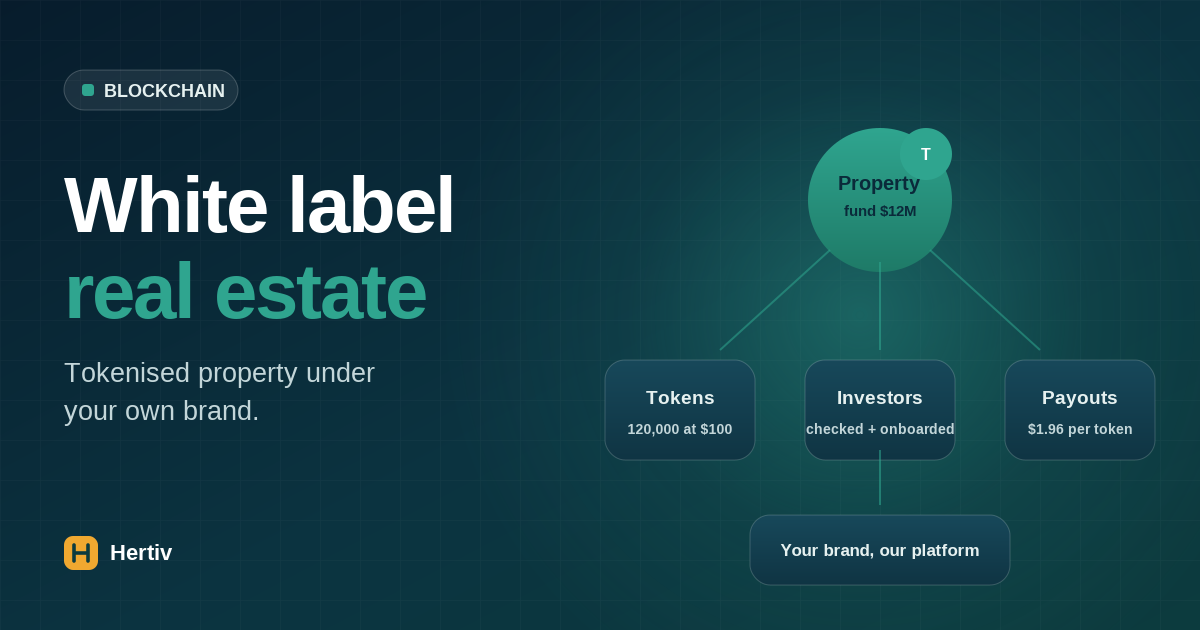
Example (hypothetical): a fund manager tokenises a property fund worth $12,000,000 and issues tokens at $100 each. The fund therefore has 120,000 tokens, since $12,000,000 divided by $100 equals 120,000.
The fund earns $240,000 of net rent income in a quarter. Paid out evenly, that is $2.00 per token, since $240,000 divided by 120,000 equals $2.00. The platform charges a 2% payout fee, which is $4,800, since 2% of $240,000 equals $4,800.
After the fee, $235,200 reaches investors, which is $1.96 per token, since $235,200 divided by 120,000 equals $1.96. An investor holding 500 tokens receives $980 that quarter, since 500 times $1.96 equals $980. The arithmetic is simple, but it shows why fees and token price must be agreed before the sale, not after.
Common mistakes
The most common mistake is choosing a platform before the legal structure is settled. Token terms, investor eligibility and payout rules depend on the legal setup, and a platform chosen first often has to be reconfigured or replaced.
- Skipping the compliance check. Assuming the provider handles all legal duties, when the firm remains responsible for its own offer.
- Hiding the fees. Investors who discover platform fees in their first statement rarely invest again.
- No plan for resale. Tokens that cannot be sold leave investors stuck, even if the property performs well.
- Weak reporting. Late or unclear statements destroy trust faster than any technical problem.
- Treating the launch as the finish. Payouts, support and reporting are ongoing work, not a one-time setup.
The firms that do well treat the platform as a tool and the offer as a business. They test the full investor journey before launch, from the first page to the first payout, and they fix the rough edges while the audience is still small.
Key takeaways
- White label means the firm keeps its brand while a provider runs the technology
- Five parts matter: issuance, onboarding, trading, payouts and reporting
- Fees, token price and payout terms must be agreed before the sale
- Resale options and clear statements matter as much as the sale itself
- The platform does not find investors; the firm still needs an audience
Frequently asked questions
Is white label real estate tokenization legal?
That depends on the country and the structure of the offer, and the rules differ by market. In most places, tokenised property is treated as a security or a regulated investment, so the firm needs legal advice before the sale. A platform provider can supply the technology, but it does not remove the firm's legal duties.
What is the difference between white label and a marketplace?
A marketplace lists many sellers' properties under the marketplace brand, while a white label platform runs under the firm's own brand with its own terms. Marketplaces bring their own audience, while white label platforms suit firms that already have investors and want full control of the experience.
How small can the minimum investment be?
That depends on the offer structure and the local rules, and some markets set minimums for certain investor types. In practice, white label platforms often support minimums of a few hundred dollars, which is far below the minimum for a direct property purchase. The firm sets the minimum with its legal adviser.
Do investors need a crypto wallet?
Not always. Many white label platforms hold tokens in a custodial account, so investors log in with an email and password like any other investment account. Some platforms let experienced investors move tokens to their own wallet. The firm should decide which option fits its audience before launch.
Can investors sell their tokens?
Only if the offer includes a resale route and the local rules allow it. Some platforms run a secondary market, some arrange buybacks, and some offer no resale at all. Investors should be told clearly, before they buy, whether and how they can exit.
What should a firm check before choosing a provider?
Check which platform parts are included, the full fee schedule, how payouts and reporting work, and what happens to investor records if the provider stops trading. Ask for a demo of the full investor journey, and speak to a firm already using the platform.


