White Label NFT GIFs Marketplace: How It Works
A white label NFT GIFs marketplace lets a brand sell looping animations as NFTs under its own name, without building minting, payments and wallets from scratch.
On this page
Short answer
A white label NFT GIFs marketplace is a ready-made platform that a brand can rebrand and run as its own store for selling short looping animations as NFTs. It handles minting, listings, payments, royalties and wallets, while the brand keeps its own name, design and audience. The buyer gets a verifiable digital item; the seller keeps the storefront.
What is a white label NFT GIFs marketplace?
A white label NFT GIFs marketplace is a ready-made storefront for selling short looping animations as NFTs, built by one company and run under another company's name and design. The brand does not write the smart contracts, the minting flow or the payment pages; it configures a product that already works and adds its own logo, colours, domain and fee rules.
A GIF is a short looping animation, usually a few seconds long, used as a reaction, a sticker or a piece of collectible art. Turning it into an NFT gives each copy a public record of ownership and a fixed supply. A buyer can prove they own a specific edition, and the creator can earn a royalty each time it changes hands.
The 'white label' part matters because building this from scratch means smart contract development, wallet integration, file storage, payments and moderation. A white label product bundles those parts so a brand can open a store in weeks instead of months, and focus on the artists and the audience instead of the plumbing.
How does a white label GIFs marketplace work?
A white label GIFs marketplace works by turning a creator's animation file into a token, listing it for sale, and recording each purchase on a blockchain. The buyer pays with a wallet or a card, and the token moves to their wallet once the payment clears.
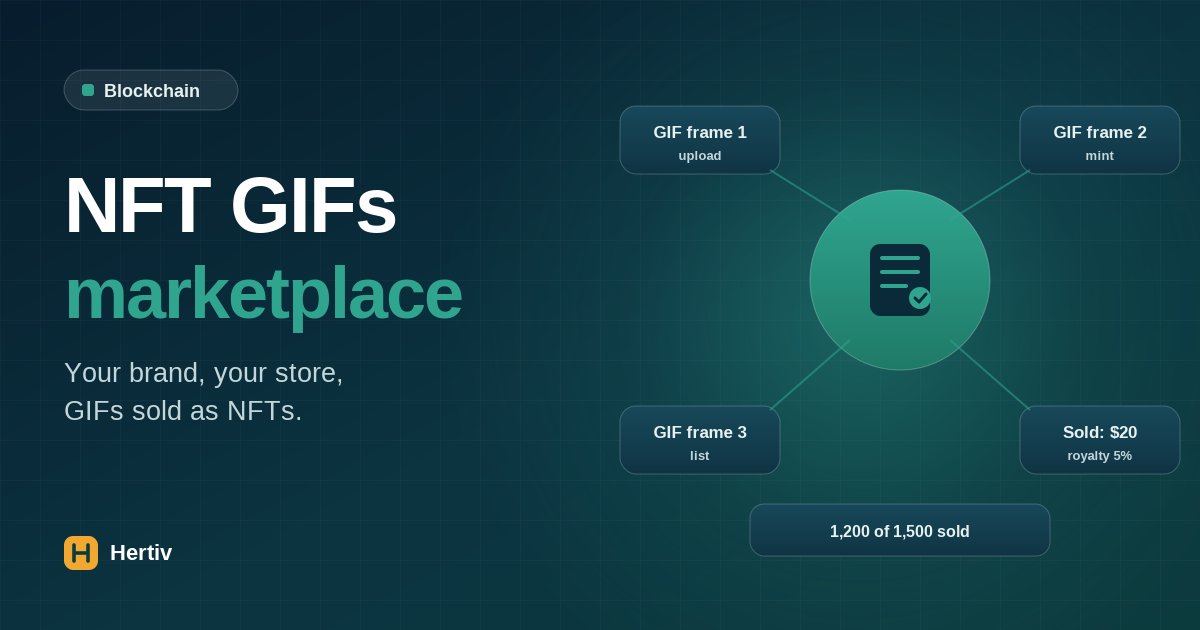
The usual flow looks like this:
- Upload. The creator uploads the GIF, adds a title, a description and the number of editions.
- Mint. The platform creates a token for each edition and stores the file and its details.
- List. The GIF appears on the storefront at a fixed price, or in an auction with a time limit.
- Buy. A buyer connects a wallet or pays by card, and the token is sent to them.
- Resell. The buyer can list the token again, and the original creator earns a royalty on the resale.
Behind the scenes, the platform keeps the GIF file in storage, tracks ownership on the chain, and pays out the seller and the royalty automatically. The buyer never needs to understand the chain; they see a store, a price and a purchase button.
What does a white label GIFs marketplace include?
A white label GIFs marketplace includes the parts a brand needs to run a store: minting, listings, payments, wallets, royalties and moderation. The exact parts vary by vendor, so check the list before signing anything.
| Part | What it does | Why it matters |
|---|---|---|
| Minting | Creates tokens from uploaded GIFs | Sets supply and ownership |
| Storefront | Shows GIFs under your brand | Buyers trust a familiar name |
| Payments | Takes wallet and card payments | More buyers can complete a purchase |
| Royalties | Pays creators on each resale | Keeps artists on the platform |
| Wallets | Holds and shows owned GIFs | Buyers need somewhere to keep them |
| Moderation | Reviews uploads before listing | Stops copied or harmful content |
Some vendors also offer auctions, timed drops, bundles and a mobile app. Those are useful, but they are not the core of the product. A store that mints reliably, pays out correctly and loads fast will serve a brand better than one with many features and a fragile checkout.
Who uses a white label GIFs marketplace?
A white label GIFs marketplace is used by brands, creators and communities that already have an audience for short animations and want a store of their own. The common thread is an existing fan base: the platform provides the store, and the brand provides the buyers.
Typical users include:
- Sticker and GIF artists. They sell limited editions of their most popular animations directly to fans.
- Entertainment brands. A show, a game or a sports team sells reaction GIFs tied to its characters and moments.
- Online communities. A chat group or a fan club sells member-only GIF packs as collectibles.
- Marketing teams. A brand runs a limited drop as a campaign, with each GIF carrying a perk such as early access.
A white label store makes sense when the brand's name is the draw. If nobody knows the brand, a large public marketplace will bring more buyers. The white label route suits teams that already have traffic and want to keep the revenue and the customer relationship.
What should you check before you launch?
You should check five things before launching a white label GIFs marketplace: the chain and fees, the file storage, the payment options, the royalty rules and the moderation tools. Each one affects how much the store earns and how buyers experience it.
- Chain and fees. Ask which chain the platform uses and what a mint and a purchase cost in network fees. High fees kill low-price GIF sales.
- File storage. Confirm the GIF files are stored in a way that survives the vendor going away, not only on the vendor's own server.
- Payments. Check whether buyers can pay by card as well as by wallet. Card checkout brings in buyers who do not own crypto.
- Royalties. Confirm the royalty percentage, who sets it, and whether it is enforced on resales inside and outside the store.
- Moderation. Ask how uploads are reviewed, how takedowns work, and who is responsible when a GIF is copied from another artist.
Fees for a white label platform are set by the vendor, so ask for the pricing page or a written quote and write 'see vendor site' in any public copy until you have it. The launch cost, the monthly fee and the share of each sale should all be clear before the first drop.
Example (hypothetical): a sticker artist collective opens a GIF store
Example (hypothetical): a collective of six sticker artists has 40,000 followers and wants to sell limited-edition reaction GIFs under its own name. It picks a white label platform, adds its logo and colours, and lists 1,500 GIFs at $20 each.
The first drop sells 1,200 of the 1,500 editions in a week. That is 1,200 x $20 = $24,000 in sales. The platform takes a 2.5% fee, which is $24,000 x 0.025 = $600, leaving $23,400 for the collective before the artists split it.
Over the next month, 200 of those GIFs are resold at an average of $60. The collective set a 5% royalty, so each resale pays $60 x 0.05 = $3 to the original artist, or $600 across the 200 resales. The royalty is small per sale, but it keeps paying as long as the GIFs keep changing hands.
The lesson is not the size of the numbers. It is that the collective knew its fee, its royalty and its storage before launch, so the payout math was never a surprise.
What are the common mistakes?
The most common mistakes with a white label NFT GIFs marketplace are picking a chain with high fees, skipping moderation, and promising buyers things the platform cannot do.
- High-fee chains. If minting and buying cost more than the GIF itself, low-price drops fail.
- No moderation. Copied GIFs and spam listings damage trust fast, and the brand takes the blame.
- Weak storage. If the GIF file lives only on the vendor's server, buyers own a token that points to nothing when the vendor closes.
- Unclear royalties. Creators leave when they find out the royalty is not enforced on resales outside the store.
- Card checkout missing. Requiring a crypto wallet cuts out most casual buyers.
- Overpromising perks. Do not tie a GIF to a reward, such as event access, unless the team can deliver it.
Key takeaways
- A white label GIFs marketplace is a rebrandable store for selling looping animations as NFTs
- Minting, listings, payments, royalties and wallets come with the platform; the brand adds its name and audience
- Check the chain fees, file storage, card payments, royalty enforcement and moderation before launch
- Card checkout matters: most casual buyers do not own a crypto wallet
- Keep promises tied to a GIF small and deliverable, or buyers lose trust
Frequently asked questions
What is a white label NFT marketplace?
A white label NFT marketplace is a ready-made trading platform that a company rebrands and runs as its own. It provides the minting, listing, payment and wallet features, while the company supplies the name, design and audience. A GIFs marketplace is a version of this focused on short looping animations.
Do buyers need a crypto wallet to buy a GIF NFT?
It depends on the platform. Many white label stores accept card payments through a custodian, so a buyer can purchase without owning crypto. Check the checkout options before launch, because wallet-only checkout excludes most casual buyers.
How do creators earn from a GIF NFT after the first sale?
Creators earn a royalty on each resale, set as a percentage of the resale price when the GIF is minted. A 5% royalty on a $60 resale pays $3 to the original creator. The royalty is only as reliable as the platform that enforces it.
Which blockchain should a GIFs marketplace use?
Choose a chain where minting and buying cost a small fraction of the GIF price, since GIFs usually sell at low prices. Also check that the chain has wallets your buyers already use and that the platform can move to another chain later if fees rise.
What happens to a GIF if the platform closes?
It depends on where the file is stored. If the GIF file is stored on decentralised storage or a public host, the token still points to a live file. If it lives only on the vendor's server, the token may point to nothing. Ask where files are stored before signing.
Can a white label GIFs marketplace sell other NFT types too?
Most can. The same minting and listing flow works for images, audio clips and short video. A GIFs store can expand into those formats later without changing the platform, as long as the file sizes and formats are supported.


