What Makes a SaaS Company Grow? The Drivers That Matter
A SaaS company grows when it keeps customers, wins new ones and earns more from each account. Learn which drivers matter and how to measure them.
On this page
Short answer
A SaaS company grows when it keeps the customers it has, wins new ones at a cost it can afford, and earns more from each account over time. Retention is the foundation: without it, every new sale only replaces a customer who left.
What makes a SaaS company grow?
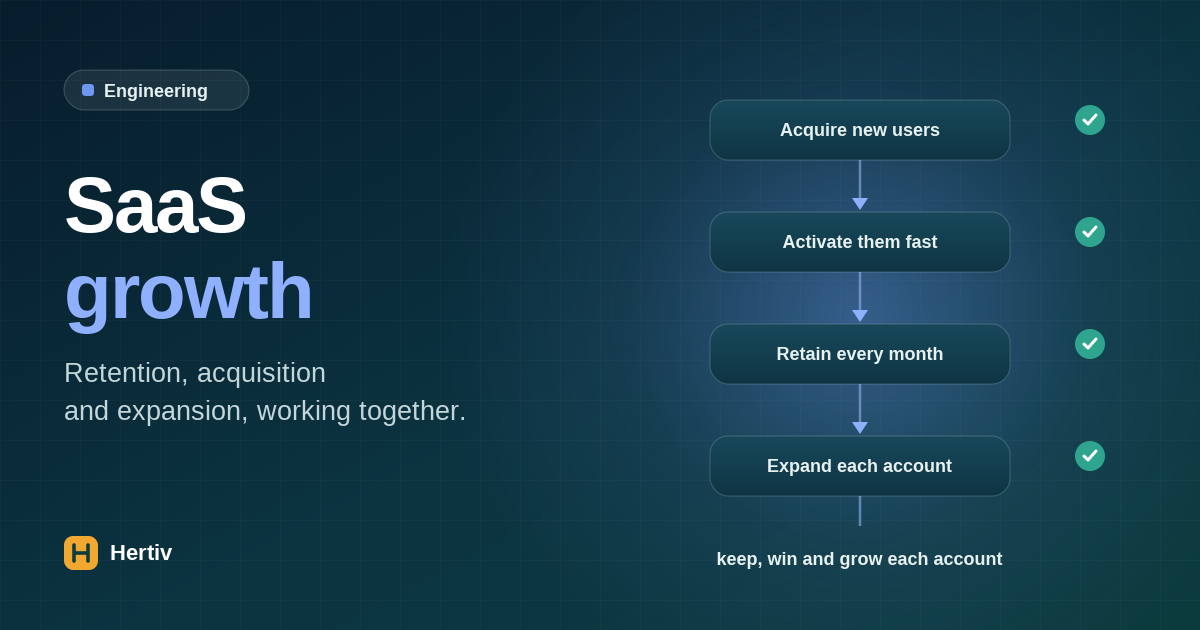
A SaaS company grows when it keeps the customers it has, wins new ones at a cost it can afford, and earns more from each account over time. Those three forces, retention, acquisition and expansion, decide whether monthly revenue rises or stalls.
Growth in SaaS is not one number. It is the result of a simple equation: new customers plus expansion revenue, minus customers who leave and accounts that shrink. A company can sign many new customers and still shrink if churn is high, and it can grow steadily with modest sales if customers stay and spend more.
The five drivers that matter most:
| Driver | What it means | Why it matters |
|---|---|---|
| Retention | Customers stay and renew | Growth compounds instead of leaking away |
| Acquisition | New customers arrive at a workable cost | Feeds the top of the funnel |
| Expansion | Accounts spend more over time | Revenue grows without new logos |
| Pricing | Plans match the value delivered | Captures value already created |
| Product | The product solves a real, repeated job | Makes the other four possible |
None of these drivers works alone. A strong product with weak onboarding will not retain users, and cheap acquisition with high churn only burns cash. Growth comes from all five moving together, which is why the strongest SaaS teams measure each one separately. The product itself is the starting point, and how to build a SaaS product covers the build side of that work.
How does retention drive SaaS growth?
Retention drives SaaS growth because a customer who stays pays every month, while a customer who leaves must be replaced before the company can grow at all. Retention is the multiplier on every other effort.
Consider two companies with the same sales. One keeps 95 percent of its customers each year, the other keeps 80 percent. After a year, the first company still has nearly all of its base plus its new sales, while the second must replace a fifth of its base just to stand still. The gap widens every year, because the retained base keeps compounding.
Retention is usually measured as logo retention, the share of customers who stay, and revenue retention, the share of revenue that stays after churn and expansion. Revenue retention above 100 percent means the existing base is growing on its own, which is the strongest signal a SaaS company can show.
What keeps customers is rarely a single feature. It is a product that solves a repeated job, onboarding that gets users to value quickly, support that answers fast, and a price that feels fair for the result. Teams that watch usage data can see which accounts are drifting and act before they cancel.
Retention also shapes costs. Keeping a customer is generally far cheaper than winning a new one, so a company with strong retention can spend less on sales and still grow. That is why investors and buyers look at retention first when they judge a SaaS business.
How do pricing and packaging help a SaaS company grow?
Pricing and packaging help a SaaS company grow by matching what customers pay to the value they get, so the company captures more of the value it already creates. Many SaaS companies undercharge for years without realising it.
The most common pattern is tiered pricing: a starter plan for small teams, a growth plan with more users or usage, and an enterprise plan with security, support and custom terms. Each tier should map to a clear jump in value, such as more seats, higher limits or advanced features, so upgrading feels like a fair trade rather than a penalty.
Usage-based pricing fits products where value scales with use, such as messages sent, records processed or storage consumed. It lets small customers start cheap and lets heavy users pay more as they grow. The risk is unpredictable bills, so most teams combine a base fee with usage on top.
Annual billing is a quiet growth lever. A customer who pays yearly is committed for twelve months, which improves cash flow and reduces churn. Offering a modest discount for annual payment, such as two months free, often pays for itself in retention.
Price changes should be tested on new customers first and communicated to existing ones with notice and a clear reason. A sudden, unexplained increase drives cancellations that a gradual, explained one does not. Pricing is part of the product, and SaaS product development cost is worth understanding before setting prices that must cover the build.
What role does the product itself play in growth?
The product itself plays the central role in SaaS growth, because no amount of marketing can save a product that users do not return to. Growth starts when users reach a result they care about, quickly and repeatedly.
The first test is activation: does a new user reach the core result within the first session or two? A project tool whose first project takes an hour to set up will lose users that a tool with a five-minute setup keeps. Teams that measure time-to-value and shorten it usually see retention rise.
The second test is whether the product fits into a daily or weekly habit. Products that solve a one-off job grow by finding new users constantly, while products that become part of a workflow grow through the same users coming back. Features that save time every week, automate a chore or make a report easier are the ones that keep people paying.
The third test is whether users can succeed without help. Clear empty states, in-product guidance and sensible defaults reduce the support load and let small teams serve many customers. When users need a call to do basic tasks, growth stalls because every new customer adds support cost.
Product-led growth, where the product itself brings in new users through sharing, invites or a free tier, works best when the product is genuinely useful to try. A free tier that shows real value converts better than one that hides everything behind a paywall.
How should a SaaS company win new customers?
A SaaS company should win new customers by finding the channels where its buyers already look for answers, and by proving value before asking for payment. Spraying money across every channel is the fastest way to burn a budget.
Most SaaS companies grow through a mix of three channels. Search and content bring buyers who are already looking for a solution, and they compound over time as articles and guides rank. Partnerships and integrations bring buyers who already trust another product in the stack. Referrals and word of mouth bring the cheapest customers of all, because a recommendation from a peer carries more weight than any advertisement.
Paid advertising works when the numbers work: the cost of winning a customer must be clearly lower than the revenue that customer will bring over their lifetime. A team should know its customer acquisition cost and its average customer lifetime value before scaling ad spend, and should stop any channel where the ratio does not work.
Sales matters most for higher-priced plans. A short trial, a clear demo and a fast answer to pricing questions convert better than a long sales process. For lower-priced plans, self-service signup with a good trial usually beats a sales call.
Whatever the channel, the message should name the job the product does and the result it delivers, not the list of features. Buyers compare outcomes, and the product that explains its outcome most clearly usually wins the trial. If you are planning the build behind that growth, SaaS development covers the product side.
Example: a 200-customer SaaS company grows in a year
Example (hypothetical): a small SaaS company sells a scheduling tool at 100 dollars a month and starts the year with 200 customers, which is 20,000 dollars of monthly recurring revenue.
Over the year it loses 5 percent of its customers each month to churn, which is 10 customers a month, or 120 over the year. It also wins 20 new customers a month, or 240 over the year. Starting from 200, minus 120 lost, plus 240 gained, it ends the year with 320 customers.
At 100 dollars a month, 320 customers is 32,000 dollars of monthly recurring revenue, up from 20,000 dollars. That is growth of 60 percent, driven by winning twice as many customers as it loses.
Then the company adds an upgrade: 30 of its customers move from the 100 dollar plan to a 140 dollar plan. That adds 30 times 40 dollars, or 1,200 dollars a month, taking monthly revenue to 33,200 dollars. The upgrade alone adds 6 percent to revenue without a single new customer, which shows why expansion matters as much as acquisition.
What are the common mistakes?
The most common SaaS growth mistakes are chasing new customers while ignoring churn, pricing by guesswork, and scaling sales before the product is ready.
- Ignoring churn while celebrating signups. A growing signup chart hides a shrinking base if customers leave as fast as they arrive. Watch net revenue retention, not just new logos.
- Pricing by copying competitors. A rival's price reflects their costs and customers, not yours. Price on the value your product delivers to your own users.
- Scaling sales before retention is proven. Spending on ads when half of new users leave in the first month wastes the budget. Fix onboarding and activation first.
- Adding features instead of fixing the core job. A long feature list does not help if the main workflow is slow or confusing. Improve the job users pay for before adding new ones.
- Measuring vanity numbers. Signups, page views and free users are not growth. Paying customers, retained revenue and expansion revenue are the numbers that matter.
Key takeaways
- Growth is retention plus acquisition plus expansion, minus churn
- Retention compounds: keeping customers is cheaper than replacing them
- Tiered pricing and annual billing capture value the product already creates
- Activation speed and a repeated core job decide whether users stay
- Expansion revenue, such as plan upgrades, grows revenue without new customers
Frequently asked questions
What is a good churn rate for a SaaS company?
It depends on the market and the price point. Small-business products often see monthly churn of 3 to 5 percent, while enterprise products aim for annual churn below 10 percent. What matters most is the trend: churn falling month by month is a healthy sign, whatever the starting point.
How fast should a SaaS company grow?
There is no single right speed. Early-stage companies often aim to double revenue each year, while larger companies grow more slowly in percentage terms but add more revenue in absolute terms. Sustainable growth with strong retention is worth more than fast growth built on churn.
What is net revenue retention?
Net revenue retention measures how much revenue stays after churn, contraction and expansion. Above 100 percent means the existing customer base is growing on its own. It is one of the most watched numbers in SaaS because it shows whether customers find more value over time.
Should a SaaS company offer a free tier?
A free tier works when the product shows real value quickly and the free plan naturally leads to a paid one, for example through usage limits or team size. It fails when the free plan gives away the whole product or attracts users who will never pay. Test it on a small group first.
How much should a SaaS company spend to win a customer?
A common guide is that the lifetime value of a customer should be at least three times the cost of winning them. Below that, growth burns cash faster than it creates value. The exact ratio depends on margins, payback time and how long customers stay.
Does pricing really change SaaS growth?
Yes. Pricing is often the fastest growth lever because it applies to every customer at once. A 10 percent price rise on a product customers already value adds revenue immediately, while a badly judged rise drives cancellations. Test changes on new customers before touching existing plans.


