How Much Does It Cost to Build a SaaS Product?
The cost of building a SaaS product depends on scope, team and integrations. Here is what drives the price, and how to budget for a first version.
On this page
Short answer
The cost of building a SaaS product is the total spend to design, build, test and launch a working subscription product, plus the running costs that follow. A small first version with one core workflow usually costs far less than a full platform, because scope, integrations and team rates drive the price more than the technology choice.
What does it cost to build a SaaS product?
The cost of building a SaaS product is the money a team spends to take a subscription product from an idea to a working service that customers can pay for. It covers product design, software development, testing, hosting, and the tools the team uses along the way.
There is no single price, because SaaS products differ so much. A simple tool with one workflow, a login and a payment page is a small build. A platform with teams, roles, reporting, billing rules and third-party integrations is a large one. The honest way to price a build is to price the scope, not the category.
Most first versions land in a range that surprises founders in both directions. A tight first version can be built by a small team in a few months. A broad first version with many features can take a year and cost several times more, often without proving the idea any faster. For the shape of a first version, what an MVP is explains how to cut scope to the part that proves value.
What drives the cost of a SaaS product?
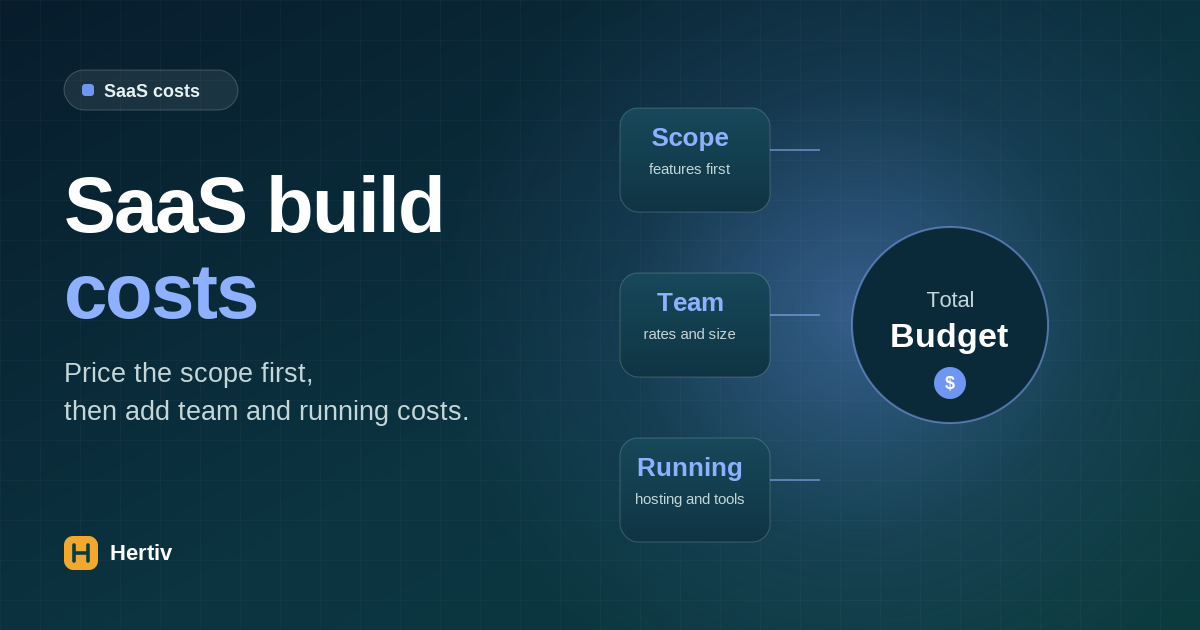
The cost of a SaaS product is driven by scope, team, integrations and compliance, and each one can be sized up or down before work starts. The table below shows the main drivers and how they move the price.
| Cost driver | What it covers | How it moves the price |
|---|---|---|
| Scope | Features, screens and workflows | More features means more design, code and tests |
| Team | Designers, developers, testers | Rates and team size set the monthly burn |
| Integrations | Payments, email, CRM, analytics | Each one adds build time and upkeep |
| Data and security | Roles, permissions, backups | More rules mean more design and review |
| Compliance | Privacy rules and audits | Regulated data adds review and paperwork |
| Running costs | Hosting, tools and support | Grow with users, so they follow launch |
Scope is the lever with the most power. Cutting one workflow from the first version often saves more than negotiating a lower rate, because it removes design, code, tests and support for that workflow in one move.
What should the first version include?
The first version of a SaaS product should include one core workflow that a paying customer can finish, plus login, billing and the minimum admin a team needs to run it.
Start with the job the customer pays for. If the product is an invoicing tool, the first version must create, send and track an invoice, and take payment. Reporting, templates, team roles and integrations can wait until customers ask for them. A first version that does one job well proves the idea faster than a wide one that does five jobs badly.
Keep the parts that are not the product as simple as possible. Use a ready-made payment service, a ready-made email service and a simple hosting setup. Building your own billing or email system is a project in itself, and it adds nothing the customer can see. The goal of a first version is learning, not building infrastructure.
How do team choices change the price?
Team choices change the price of a SaaS build because rates, speed and management overhead differ between hiring in-house, working with an agency, and hiring freelancers.
An in-house team gives the most control and the most continuity, but it is the slowest to assemble and carries salaries, benefits and management. An agency can start fast and brings a full team, but it charges a higher rate and needs a clear brief. Freelancers cost less per hour, but coordinating several of them takes time, and the product can stall if one person leaves.
Many small SaaS builds use a mix: a small in-house product owner, an agency or a senior contractor for the build, and freelancers for design or testing. The mix matters less than having one person who owns the scope and can say no to extra features. For a comparison of hiring models, how to develop a SaaS application covers the build side in more depth.
Example (hypothetical): a small team builds a billing SaaS
Example (hypothetical): a two-person startup plans a billing SaaS for small service firms. The first version covers invoices, payments and reminders, with login and a simple dashboard.
The team hires two developers and one designer for four months. The developers cost $6,000 each per month, which is $48,000. The designer costs $5,000 per month, which is $20,000. Testing and a small amount of help from a part-time tester adds $6,000. Design and build together come to $74,000.
Running costs in the first year are small: hosting $300 a month, a payment service that takes a share of each payment, and email and analytics tools at $200 a month. That is $6,000 for the year, plus payment fees. The total first-year spend is about $80,000 before payment fees, and the team can see exactly which part is build and which part is running cost.
What are the common mistakes?
The most common mistakes when costing a SaaS product are pricing the idea instead of the scope, building features nobody asked for, and forgetting the costs that start after launch.
- Pricing a wish list. A list of fifty features is not a first version. Price the five that prove the idea, and keep the rest for later.
- Building your own billing. Payment rules, taxes and failed payments are a product of their own. Use a payment service first.
- Ignoring running costs. Hosting, support, tools and fixes continue after launch. Budget for them from month one.
- No reserve. Estimates are wrong more often than right. A reserve of 15 to 20 percent keeps a surprise from stopping the build.
- Skipping testing. A billing bug or a lost invoice costs more in refunds and trust than the testing would have cost.
The same discipline applies to the build itself: a small team that ships a narrow product and learns from real users will spend less than a large team that builds in private for a year.
How do you set a realistic SaaS budget?
You set a realistic SaaS budget by pricing the first version feature by feature, adding running costs and a reserve, then checking the total against the money you actually have.
- List the first version only. Write down the workflows, screens and integrations the first version must have, and nothing else.
- Price each workflow. Ask for an estimate per workflow, in hours, so you can see which ones cost the most and cut the expensive ones first.
- Add the team cost. Multiply the hours by the team rate, and add design, testing and a small amount of project time.
- Add running costs. Hosting, payment fees, email, analytics and support for the first year, even if they look small.
- Add a reserve. Add 15 to 20 percent for surprises, and treat it as spent, not as spare money.
- Check the total against cash. If the total is more than you have, cut scope before you cut quality. For the costing angle on a smaller first build, how much an MVP costs gives a useful comparison.
A budget built this way is easy to defend and easy to change. When a new feature is proposed, you can price it the same way and decide whether it is worth the money, instead of guessing.
Key takeaways
- A SaaS product is priced by scope, team, integrations and running costs, not by category
- The first version should do one core job well, with login and billing, and little else
- Scope is the strongest cost lever: cutting one workflow saves design, code, tests and support
- Budget for running costs and a 15 to 20 percent reserve from the start
- Price each workflow in hours so you can see what to cut when the total is too high
Frequently asked questions
How much does a simple SaaS product cost to build?
It depends on scope and team rates, but a small first version with one core workflow, login and billing is usually a build of a few months by a small team. The example in this article puts that at about $80,000 in the first year, before payment fees. A broad platform with many features and integrations costs several times more.
What costs the most in a SaaS build?
Scope usually costs the most, because every feature adds design, code, tests and support. Team rates come next, and integrations add more than founders expect, since each one needs setup, error handling and upkeep. Cutting scope is the fastest way to cut cost.
Should I build my own billing system?
No, not for a first version. Payment services handle cards, taxes, failed payments and refunds, and building that yourself is a separate project. Use a ready-made payment service first and revisit the decision only when billing becomes a real cost or a real limit.
How long does it take to build a first SaaS version?
A narrow first version usually takes three to six months with a small team. A broad one can take a year or more. The timeline follows the scope, so a team that cuts features also cuts months, and ships sooner to real users.
What are the running costs after launch?
Hosting, payment fees, email, analytics and support are the main running costs. Hosting and tools are usually a few hundred dollars a month for a small product, while payment fees grow with revenue. Budget for them from month one so launch does not bring a surprise.
Do I need a designer for a SaaS product?
Yes, for the first version at least. A designer makes the core workflow clear and easy to finish, which is what turns a trial into a paying customer. A product with a confusing first screen loses users before they see what it can do.


