What Is Substrate, and How Do You Build a Chain With It?
Substrate is a Rust framework for building custom blockchains. Learn how its pallets, runtime and consensus fit together, and when a custom chain is worth it.
On this page
Short answer
Substrate is an open-source framework, written in Rust, for building custom blockchains. It gives a team a modular runtime, networking, consensus and governance tooling, so the rules of the chain are written in code instead of being fixed by a base protocol. It is the framework behind Polkadot and many independent app-chains.
What is Substrate?
Substrate is a framework for building blockchains, not a blockchain itself. It provides the parts every chain needs, such as peer-to-peer networking, block production, consensus and storage, and lets a team define the chain's own rules in a modular runtime.
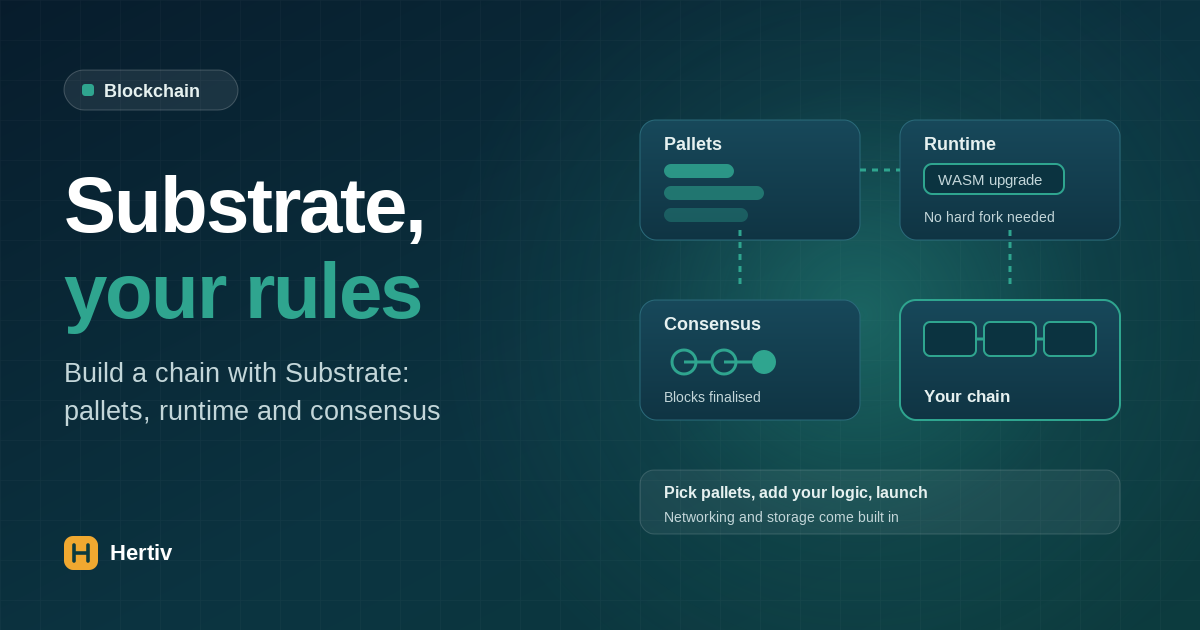
The framework is written in Rust and organised around pallets: small, reusable modules that each handle one job, such as accounts, balances, governance or staking. A team picks the pallets it needs, adds its own, and compiles them into a runtime that defines exactly how its chain behaves.
Substrate is best known as the framework behind Polkadot, where chains built with it can share security through a relay chain. But it is also used on its own, for sovereign chains and private networks that never connect to Polkadot. The framework does not force a particular token, consensus or governance model.
That freedom is the point. On a general-purpose chain, the rules about fees, upgrades and permissions are set by the base protocol. With Substrate, those rules are part of the product, so a team can change them when the product needs it. If you are weighing that choice, a blockchain consulting review usually prices the smart-contract route first and the custom-chain route second.
How does Substrate work?
Substrate works by splitting a blockchain into two parts: the node, which handles networking, storage and block production, and the runtime, which holds the chain's rules. The node is mostly the same for every Substrate chain, while the runtime is what makes each chain different.
The runtime is compiled to WebAssembly, which lets the chain upgrade itself without a hard fork. A runtime upgrade is proposed, voted on if governance requires it, and then applied as a normal transaction, so the network keeps running while its rules change.
Consensus is pluggable. A chain can use Aura for block production with GRANDPA for finality, the combination Polkadot uses, or pick another consensus that fits its needs, such as proof of authority for a private network. The framework supplies the pieces; the team chooses the shape.
Because the runtime is code, it can be tested like any other software. Teams write unit tests for their pallets, run the chain on a local test network, and only then deploy. That testability is one of the practical reasons teams choose a framework over building a chain from scratch.
What are pallets and the runtime?
Pallets are the building blocks of a Substrate runtime. Each pallet is a Rust module that manages one part of the chain's state and logic, such as the balances pallet that tracks token holdings, or the governance pallet that runs votes and referenda.
| Pallet | What it does | When you need it |
|---|---|---|
| Balances | Tracks accounts and token transfers | Almost every chain |
| Staking | Manages validators and rewards | Chains with their own security |
| Governance | Runs proposals, votes and councils | Chains that upgrade by vote |
| Identity | Attaches verified data to accounts | Permissioned or regulated chains |
| Contracts | Runs smart contracts on the chain | Chains that host third-party code |
| Custom pallet | Your own product logic | Rules no standard pallet covers |
The runtime is the set of pallets a chain runs, compiled together. Adding a pallet adds a feature; removing one removes it. A team can also write a custom pallet for logic that is specific to its product, such as a fee rule that depends on the type of transaction, or a registry that only approved accounts can write to.
This modularity is what makes Substrate faster than building a chain from nothing. The networking, consensus and storage are already written and tested, so the team spends its time on the rules that make its chain different, not on the parts every chain shares.
Substrate vs smart contracts: which fits your product?
Substrate and smart contracts solve different problems. A smart contract runs on someone else's chain and inherits its security, wallets and users. A Substrate chain is your own network, with your own rules, your own validators and your own security to arrange.
The contract route is cheaper and faster for most products. You write the contract, test it, audit it and deploy it, and the base chain handles the rest. The chain route costs far more, because you must run validators, build wallets and indexers, and keep the network secure.
A custom chain earns its keep when the product needs rules the base chain cannot offer: custom fee logic, permissioned access, a different governance model, or performance that a shared chain cannot guarantee. If none of those apply, the contract route is usually the better answer, and a smart contract development team can ship it in weeks rather than months.
A useful test is to write down the three rules your product needs that a general-purpose chain does not provide. If the list is empty, build a contract. If the list is long and each rule shapes the product, a Substrate chain may be worth the engineering cost.
How do you build a chain with Substrate?
You build a chain with Substrate by starting from the node template, choosing your pallets, adding your custom logic, and testing on a local network before you deploy.
- Start from the template. Clone the Substrate node template, which gives you a working chain with the standard pallets already wired in.
- Pick the pallets. Keep the pallets your product needs, such as balances and governance, and remove the ones it does not.
- Write the custom pallet. Add the logic that is specific to your product, with unit tests for each rule it enforces.
- Choose consensus and finality. Pick the combination that fits your network, such as Aura and GRANDPA for a public chain or proof of authority for a private one.
- Run a local test network. Start several nodes on your own machines, send transactions, and check that blocks are produced and finalised.
- Test upgrades. Practise a runtime upgrade on the test network, because the first upgrade you do in production should not be the first you ever do.
- Launch with a plan for validators. Decide who runs the validators, how they are paid, and what happens if one goes offline.
Most teams spend more time on the last three steps than on the first four. A chain that compiles is not a chain that runs well, and the testing and launch planning are where a custom chain project usually succeeds or fails. Teams that need help with that part often start with Substrate app-chain development support for the launch phase.
Example (hypothetical): a supply-chain app-chain
Example (hypothetical): a group of food exporters wants a shared chain that records shipments, checks certificates and settles payments between members. A smart contract could record the data, but the group wants its own fee rules and permissioned membership, so it chooses Substrate.
The team starts from the node template and keeps the balances, identity and governance pallets. It writes one custom pallet that records a shipment, links it to a certificate, and releases payment only when the certificate is verified. That pallet is about 400 lines of Rust, plus tests.
On the test network, the team runs 4 validator nodes and sends 1,000 shipment transactions. Each block holds about 50 transactions and finalises in about 12 seconds, so the full test takes 1,000 divided by 50, which is 20 blocks, or about 4 minutes. The numbers are invented to show the arithmetic, not a real benchmark.
The point is that the hard part was not the chain itself, which the template provided, but the custom pallet and the launch plan: who runs the validators, who can join, and how the governance votes work. Those decisions took longer than the code.
What are the common mistakes?
The most common mistakes with Substrate are choosing a custom chain when a contract would do, skipping upgrade testing, and underestimating the work of running a network.
- Building a chain for a contract problem. If the product works as a set of contracts, a custom chain adds cost without adding value.
- Skipping upgrade tests. A runtime upgrade that fails in production can halt the chain, so it must be practised on a test network first.
- Too many custom pallets. Every custom pallet is code to maintain and audit, so use a standard pallet whenever it covers the need.
- No validator plan. A chain with two validators run by one team is not decentralised, and a chain with no paid validators will not stay running.
- Ignoring wallets and indexers. Users need a wallet and an explorer to use the chain, and both are real work that teams forget to budget.
Most of these mistakes come from treating the chain as a coding project rather than a network to operate. The code is the smaller half of the job; running the network is the larger half.
When is Substrate the wrong choice?
Substrate is the wrong choice when the product does not need its own rules. A token, a marketplace, a lending pool or a voting app usually works better as contracts on an existing chain, where the security, wallets and users already exist.
It is also the wrong choice when the team cannot run a network. A chain needs validators, monitoring, upgrades and incident response, and a team that cannot staff those jobs will end up with a chain that stops when something breaks.
Finally, it is the wrong choice when speed matters most. A contract can be tested, audited and live in weeks. A chain takes months to build, test and launch, and the launch is only the start of the operating work. If the product needs to reach users quickly, start with a contract and move to a chain only when the rules demand it.
Key takeaways
- Substrate is a Rust framework for building custom blockchains, not a blockchain itself
- Pallets are reusable modules; the runtime is the set of pallets a chain runs
- The runtime compiles to WebAssembly, so the chain can upgrade without a hard fork
- Choose a custom chain only when the product needs rules a general chain cannot offer
- Testing upgrades and planning validators matter more than writing the first pallet
Frequently asked questions
Is Substrate the same as Polkadot?
No. Substrate is the framework for building blockchains, and Polkadot is one network built with it. Chains built with Substrate can connect to Polkadot as parachains, but they can also run on their own as sovereign chains or private networks.
Do I need to know Rust to use Substrate?
Yes, for the custom parts. The template and standard pallets are already written, but any logic that is specific to your product is written in Rust as a pallet. A team without Rust experience should budget time to learn it or hire for it.
Can a Substrate chain run smart contracts?
Yes. The contracts pallet lets a Substrate chain host smart contracts alongside its native runtime logic. That suits chains that want custom rules at the base layer and contracts for third-party developers on top.
How long does it take to build a Substrate chain?
A first working chain from the template can be running locally in days, but a chain ready for real users usually takes months. The time goes into the custom pallets, testing, upgrade practice and the validator and launch plan.
What does it cost to run a Substrate chain?
The main ongoing costs are validator machines, monitoring, and the people who operate the network and handle upgrades. A small network with a few validators costs far less than a large public chain, but it is a real operating cost, not a one-off build cost. See vendor site for hosting prices.
Can I move from smart contracts to Substrate later?
Yes, and many teams do. Starting with contracts lets you test the product with real users, and the lessons from that version tell you exactly which rules need a custom chain. Moving later is more work than starting with a chain, but it avoids building a chain for a product that may not need one.


