What Is Stellar Blockchain, and How Does It Work?
Stellar is a public blockchain built for fast, low-cost payments and asset transfers. Learn how its consensus works, what anchors do, and when it fits.
On this page
Short answer
Stellar is a public blockchain designed for fast, low-cost payments and the transfer of assets such as stablecoins. It uses the Stellar Consensus Protocol, in which trusted validators agree on transactions in a few seconds, and it lets regulated institutions issue digital versions of real-world currencies through anchors, which makes it a practical choice for cross-border payments, remittances and tokenised assets.
What is Stellar blockchain?
Stellar is a public blockchain built for moving money and assets quickly and cheaply. It is an open network: anyone can run a validator, issue an asset, or build an application on it, and transactions settle in a few seconds with fees that are a fraction of a cent.
The network was created for payments first. Where many blockchains are general-purpose computers, Stellar is focused on a narrower job: letting people and institutions send value across borders without the slow, costly chain of correspondent banks that traditional payments rely on. That focus shapes everything about it, from the consensus protocol to the built-in exchange.
Stellar's native currency is called lumens (XLM). It is used to pay the tiny transaction fees and to hold a small minimum balance in accounts, which keeps spam off the network. But most value on Stellar moves as tokens issued by others: stablecoins, bank deposits and other regulated assets.
If you are weighing a payment product, the question is rarely whether Stellar works, but whether your use case needs its strengths. A blockchain development review usually starts by comparing the payment route, the asset route and the smart-contract route before picking a chain.
How does Stellar reach consensus?
Stellar reaches consensus through the Stellar Consensus Protocol, or SCP, a federated agreement system in which each validator chooses a set of other validators it trusts, called a quorum slice, and the network agrees when enough overlapping slices agree.
The process works in rounds. Validators share their view of the next set of transactions, compare notes with their trusted peers, and vote until the overlapping sets converge on one result. There is no mining and no staking race, so the network uses very little energy and finalises a ledger in about five seconds.
The trade-off is trust. SCP works because validators pick slices they believe are honest, and the network stays safe as long as those slices overlap enough that a bad actor cannot split them. In practice, the best-known validators are run by companies, foundations and universities, and new validators earn trust by running reliably over time.
For a payment product, the practical effect is simple: a payment that is accepted is final within seconds, and there is no waiting for confirmations the way older proof-of-work chains require. That speed is one of the main reasons payment companies pick Stellar over slower networks.
How does Stellar compare with other payment blockchains?
Stellar is one of several blockchains used for payments, and the differences are about speed, cost, asset support and how much programmability you get. The table below compares the common options in plain terms.
| Network | Consensus | Settlement | Built-in asset support |
|---|---|---|---|
| Stellar | Federated agreement (SCP) | A few seconds | Yes, with anchors |
| Bitcoin | Proof of work | Tens of minutes | No |
| Ethereum | Proof of stake | Minutes | Yes, with smart contracts |
| Solana | Proof of history plus stake | Seconds | Yes, with smart contracts |
The table shows Stellar's niche clearly. It is faster and cheaper than Bitcoin or Ethereum for plain payments, and simpler than Solana for teams that do not need a full smart-contract platform. Its built-in decentralised exchange also lets one asset be swapped for another in a single transaction, which matters for cross-currency payments.
What Stellar gives up is programmability. Its smart-contract platform, Soroban, is newer and smaller than Ethereum's ecosystem, so a product that needs complex on-chain logic may fit better elsewhere. For plain payments and asset transfers, that trade is usually worth making.
What are anchors and assets on Stellar?
Anchors are regulated institutions that connect Stellar to the real financial system. An anchor takes a deposit, such as dollars in a bank account, and issues a digital token for the same amount on Stellar, and it redeems the token back to cash when a user asks.
That simple bridge is what makes Stellar useful for real money. A stablecoin on Stellar is a token issued by an anchor that holds the matching reserves, so the token is only as trustworthy as the anchor behind it. Well-known anchors include stablecoin issuers and licensed money transfer firms, and each one is responsible for its own compliance, such as identity checks.
Assets on Stellar are not limited to currencies. The same mechanism can represent other regulated assets, such as tokenised deposits or securities, as long as an anchor is willing to issue and redeem them. For how the economics of such tokens work, see how token economics work.
If your product needs its own token rather than an anchor's, the route is different: you design the supply, write the code and launch it yourself, which is the work covered in creating a cryptocurrency.
The anchor model is also Stellar's main risk. If an anchor fails or freezes redemptions, its token loses its link to the underlying money. Choosing an anchor means checking its licences, its reserves and its track record, not just its fees.
How do you build on Stellar?
You build on Stellar by picking an SDK, connecting to the network through an RPC service, and working with accounts, assets and transactions rather than writing smart contracts for every step.
- Set up a test account. Use the test network and its faucet to get test lumens, and create accounts with the SDK for your language, such as JavaScript, Python or Java.
- Decide what moves. Work out which assets your product moves: lumens, a stablecoin from an anchor, or your own issued token, and whether you need the built-in exchange.
- Build the payment flow. Create transactions that send assets, set trustlines where needed, and use the network's path payment feature to convert between currencies in one step.
- Add compliance checks. If you handle real money, wire in identity checks and sanctions screening before a transaction is sent, and keep records of every payment.
- Add Soroban only if needed. If your product needs custom logic, such as escrow or a lending rule, write a Soroban contract; otherwise the built-in operations are enough.
- Test on the test network. Run the full flow with test assets, including failures such as a missing trustline or an anchor that is offline, before you touch real money.
- Go live with monitoring. Watch transaction success rates, anchor health and balances, and have a plan for what happens if an anchor pauses redemptions.
Most Stellar products are mostly off-chain code with a thin on-chain layer, which keeps development fast. The heavy work is in compliance, anchor relationships and user experience, not in the chain itself.
Example (hypothetical): a cross-border payment
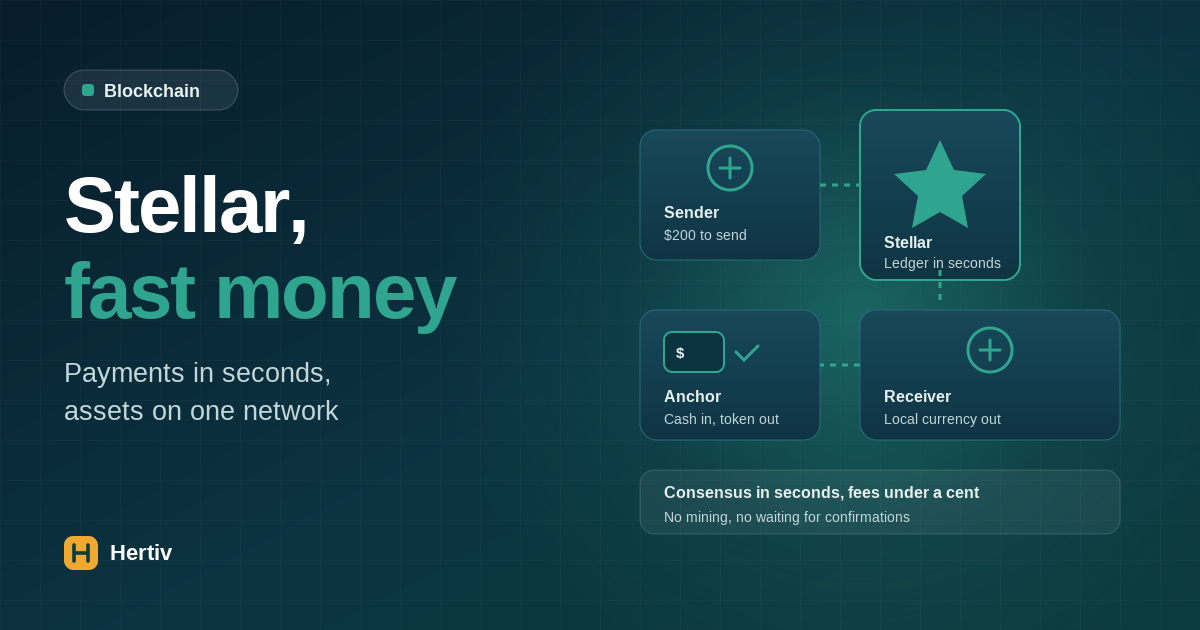
Example (hypothetical): a small remittance company lets workers send money home. A sender in one country pays 200 dollars, and the receiver in another country needs the same value in local currency the same day.
The company holds a stablecoin issued by a licensed anchor. It takes the sender's 200 dollars, converts them to 200 stablecoins on Stellar, and sends them to the receiver's wallet. The transaction settles in about five seconds and costs a fraction of a cent in network fees.
The receiver then redeems the stablecoins through a local anchor, which pays out the local currency. The whole trip takes minutes instead of days, and the fee is the anchor's spread plus a small company margin. If the company sent 100 such payments a day, the network fees would still be under a dollar in total, because each fee is a fraction of a cent.
The numbers are invented to show the arithmetic, not a real price. The point is that the cost of the chain itself is almost nothing in this model; the real costs are the anchors' spreads, compliance and customer support.
What are the common mistakes?
The most common mistakes with Stellar are trusting an anchor without checking it, assuming the network can do everything a smart-contract platform can, and skipping compliance until launch.
- Trusting any anchor. A token is only as good as the institution behind it, so check licences, reserves and redemption history before you build on it.
- Expecting Ethereum-level programmability. Soroban is real but younger, so a product that needs deep contract logic may fit better on a more mature platform.
- Skipping compliance. Moving real money means identity checks, sanctions screening and record-keeping, and regulators do not accept that the chain handled it.
- Forgetting trustlines. An account cannot receive an asset it has not trusted, so a payment to a new wallet fails unless the trustline is set first.
- Treating testnet as production. Test assets have no value and test anchors can disappear, so a testnet success proves little about the live flow.
Most of these mistakes come from treating Stellar as a generic blockchain rather than a payment network with its own rules. Learn the anchor model first, and the rest follows.
Key takeaways
- Stellar is a public blockchain built for fast, low-cost payments and asset transfers
- Consensus uses trusted validator slices, not mining, so ledgers close in about five seconds
- Anchors connect Stellar to real money by issuing and redeeming tokens for deposits
- The built-in exchange swaps assets in a single transaction, which helps cross-currency payments
- Check the anchor's licences and reserves before you build a product on its token
Frequently asked questions
What is Stellar used for?
Stellar is mainly used for cross-border payments, remittances and stablecoin transfers. Banks, payment firms and fintech companies use it to move value between countries quickly and cheaply, and developers build wallets, exchanges and payment apps on top of it.
Is Stellar the same as Ripple?
No. Both are payment-focused networks, but they are separate projects with different designs. Stellar is a public, open network run by many independent validators, while Ripple's XRP Ledger and its business are run by the company Ripple. They share a history but not a network.
What are lumens (XLM)?
Lumens, or XLM, is Stellar's native currency. It pays the small transaction fees and funds the minimum balance every account must hold, which keeps spam off the network. It is not the money that most payments move; that role belongs to tokens issued by anchors.
Can Stellar run smart contracts?
Yes, through Soroban, Stellar's smart-contract platform. It lets developers write custom logic such as escrow, lending rules or automated payments. It is newer than Ethereum's contract ecosystem, so the tooling and libraries are still growing.
How fast and cheap is Stellar?
A ledger closes in about five seconds, and the network fee is a fraction of a cent per transaction. The total cost of a payment is usually set by the anchors involved, through their spreads and fees, rather than by the network itself.
Is Stellar decentralised?
Stellar is a public network with many independent validators, but trust depends on which validators participants choose to trust. The network is safer when many different organisations run validators, so the mix of validators matters more than the raw count.


