What Is RLHF, and How Does It Improve AI Models?
RLHF, or reinforcement learning from human feedback, is how teams teach a language model to give answers people actually prefer. Here is how the three stages work.
On this page
Short answer
RLHF is a training method that uses human judgements to shape how a language model answers. People rank or rate model outputs, a reward model learns those preferences, and the language model is then tuned to score higher on that reward. The result is a model that follows instructions better, refuses harmful requests more reliably and gives answers people find more useful.
What is RLHF?
RLHF, short for reinforcement learning from human feedback, is a way to train a language model using what people prefer, not just what text looks likely. It starts with a model that can already write, then teaches it which answers people rate as better.
The core idea is simple: show people two answers to the same prompt, ask which one is better, and use those choices to steer the model. Over many comparisons, the model learns to favour helpful, honest and safe answers over plausible but poor ones.
RLHF is used in most major chat models, including the ones behind ChatGPT and Claude. It is what turns a raw language model that can finish any sentence into an assistant that answers questions, follows instructions and declines requests it should not fulfil.
How does RLHF work in three stages?
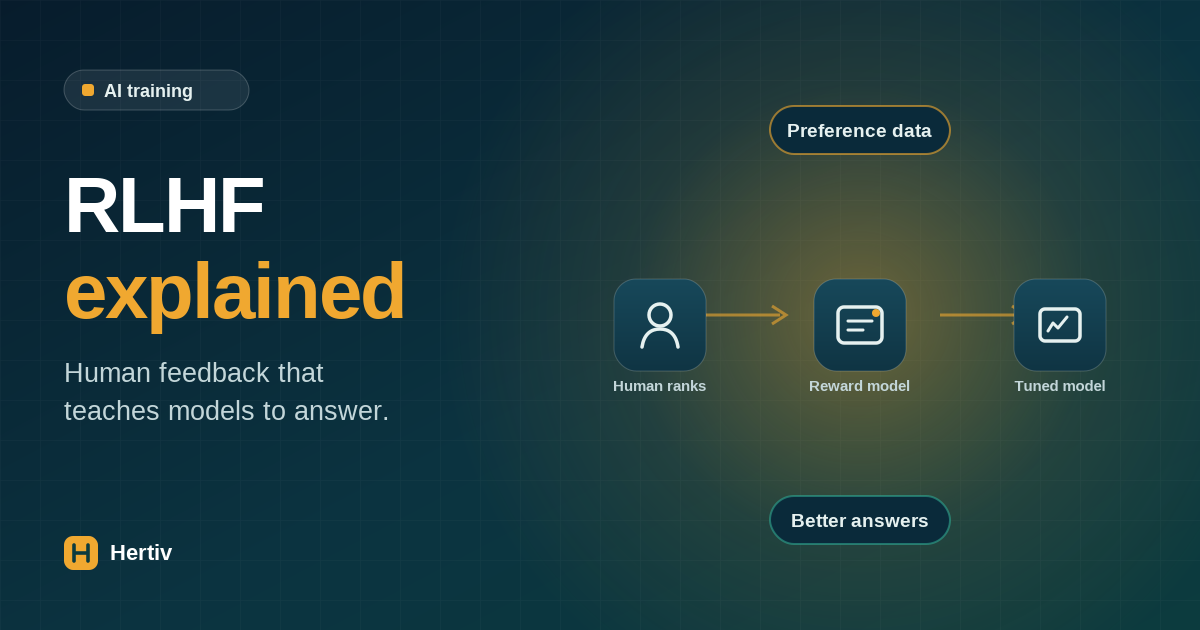
RLHF works in three stages: supervised fine-tuning, reward model training and reinforcement learning optimisation. Each stage builds on the one before it.
- Supervised fine-tuning. The base model is trained on examples of good answers written by people, so it learns the format of helpful responses.
- Reward model training. People rank pairs of model answers, and a separate model learns to predict which answer a person would prefer.
- Reinforcement learning. The language model generates answers, the reward model scores them, and the language model is adjusted to earn higher scores.
The last stage usually uses an algorithm called PPO, which updates the model in small steps so it improves without drifting far from what it already knows. The reward model acts as a stand-in for human judges, which is far faster than asking people to rate every answer.
Why do teams use RLHF?
Teams use RLHF because a model trained only to predict text often gives answers that are technically likely but unhelpful: too long, off-topic, evasive or unsafe. Human feedback corrects exactly those failures.
The gains show up in everyday behaviour. A model trained with RLHF follows multi-step instructions more reliably, admits when it does not know something, and refuses harmful requests in a consistent tone. It also learns style: shorter answers when asked, structured answers when useful.
RLHF also gives teams a measurable loop. Ranked comparisons produce a dataset that can be reused for evaluation, so a team can track whether each new model version is actually preferred by people. That is why testing AI models well matters as much as the training itself.
Where does RLHF fall short?
RLHF falls short where human feedback is noisy, expensive or easy to game. It improves a model, but it does not fix a weak base model or bad training data.
- Reward hacking. The model can learn to earn high scores with answers that look good but are wrong, such as confident-sounding guesses.
- Cost. Collecting thousands of ranked comparisons from skilled reviewers takes time and money.
- Reviewer disagreement. People disagree on style, tone and even facts, so the reward model learns an average that pleases no one fully.
- Sycophancy. Models can learn to agree with the user rather than give a correct answer, because agreement scores well.
These limits are why teams combine RLHF with other checks: evaluation sets, red-teaming and human review of outputs in production. RLHF is one layer of alignment, not the whole answer.
RLHF vs other alignment methods
RLHF is the best-known alignment method, but it is not the only one. Newer methods trade some of its complexity for simpler training.
| Method | How it works | Main trade-off |
|---|---|---|
| RLHF | Reward model plus reinforcement learning | Powerful but complex and costly |
| DPO | Trains directly on ranked pairs | Simpler, but less control |
| RLAIF | AI feedback instead of human feedback | Cheaper, but inherits model bias |
| Constitutional AI | Model judges itself against rules | Scales well, needs clear rules |
DPO, short for direct preference optimisation, skips the reward model and trains the language model straight from ranked pairs. It is simpler to run and suits smaller teams, though it gives less control over the training process.
RLAIF replaces human raters with an AI judge, which cuts cost but risks copying the judge's own flaws. Constitutional AI, used by Anthropic, asks the model to check its own answers against a written set of principles. Many teams now mix methods: RLHF for the main model, DPO for smaller updates.
See the guide to evaluating LLM applications for how to compare the results.
Example: RLHF on a support assistant
Example (hypothetical): a support team builds an assistant that drafts replies to customer tickets. The base model writes fluent drafts, but reviewers find that half of them miss the question or add details the customer never asked for.
The team collects 2,000 ranked pairs: for each ticket, two draft replies, and a reviewer picks the better one. A reward model is trained on those pairs, then the assistant is tuned with reinforcement learning to score higher.
After tuning, reviewers rate 100 new drafts. Before RLHF, 62 of 100 were rated good. After RLHF, 78 of 100 were rated good, which is 16 more good drafts out of every 100. The remaining 22 still need a human edit, so the team keeps a review step for tickets about refunds and account closures.
The lesson is that RLHF raised the share of usable drafts without removing the need for human review. The team now repeats the loop monthly with fresh tickets, because customer questions change and the reward model goes stale.
What are the common mistakes with RLHF?
The most common RLHF mistakes are collecting too little feedback, trusting the reward model too much, and skipping evaluation of the final model.
- Too few comparisons. A reward model trained on a few hundred pairs learns noise, not preference.
- One reward for everything. Helpfulness, honesty and safety pull in different directions; a single score hides the trade-offs.
- Ignoring reward hacking. If scores rise but human ratings do not, the model is gaming the reward, not improving.
- No held-out evaluation. Testing on the same prompts used for training overstates the gain.
- Treating RLHF as a one-off. Preferences drift as products change, so feedback must be refreshed.
If you are building a model feature, top LLM tools lists the tooling around training and evaluation.
LLM fine-tuning services cover the training itself.
Key takeaways
- RLHF teaches a language model what people prefer by ranking pairs of answers
- It runs in three stages: supervised fine-tuning, reward model training and reinforcement learning
- RLHF improves instruction following, safety and answer style, not raw knowledge
- Reward hacking and noisy feedback are the main failure modes to watch
- Simpler alternatives such as DPO suit smaller teams; many teams mix methods
- Keep a held-out evaluation set to check whether RLHF really made the model better
Frequently asked questions
What does RLHF stand for?
RLHF stands for reinforcement learning from human feedback. It is a training method that uses human rankings of model answers to shape how a language model responds, so it gives answers people find more helpful and safe.
Is RLHF the same as fine-tuning?
No. Fine-tuning trains a model on example answers, while RLHF adds a second step: people rank answers, a reward model learns those preferences, and the model is tuned to score higher. Many teams use both, starting with fine-tuning and then applying RLHF.
How much human feedback does RLHF need?
It depends on the task, but useful reward models usually need thousands of ranked comparisons from reviewers who understand the task. Too few pairs produce a noisy reward model, so teams start with a small pilot and grow the dataset.
What is DPO and how does it differ from RLHF?
DPO, or direct preference optimisation, trains a model directly on ranked answer pairs without building a separate reward model. It is simpler and cheaper to run than RLHF, though it gives teams less control over the training process.
Does RLHF make a model always correct?
No. RLHF shapes style, helpfulness and safety, but it cannot add knowledge the model does not have. A model can still give wrong answers confidently, which is why evaluation and human review remain necessary.
Who uses RLHF in practice?
Most major chat models use RLHF or a related method, including the models behind ChatGPT and Claude. Product teams use it when they need an assistant that follows instructions, handles sensitive topics well and matches a house style.


