What Is a Large Language Model, and How Does It Work?
A large language model is an AI system trained on huge amounts of text to predict and produce language. Here is how it learns and where it fits.
On this page
Short answer
A large language model is a type of artificial intelligence trained on very large amounts of text so it can predict, understand and produce human language. It learns patterns from books, articles, websites and code, then uses those patterns to answer questions, write drafts, summarise documents and follow instructions.
What is a large language model?
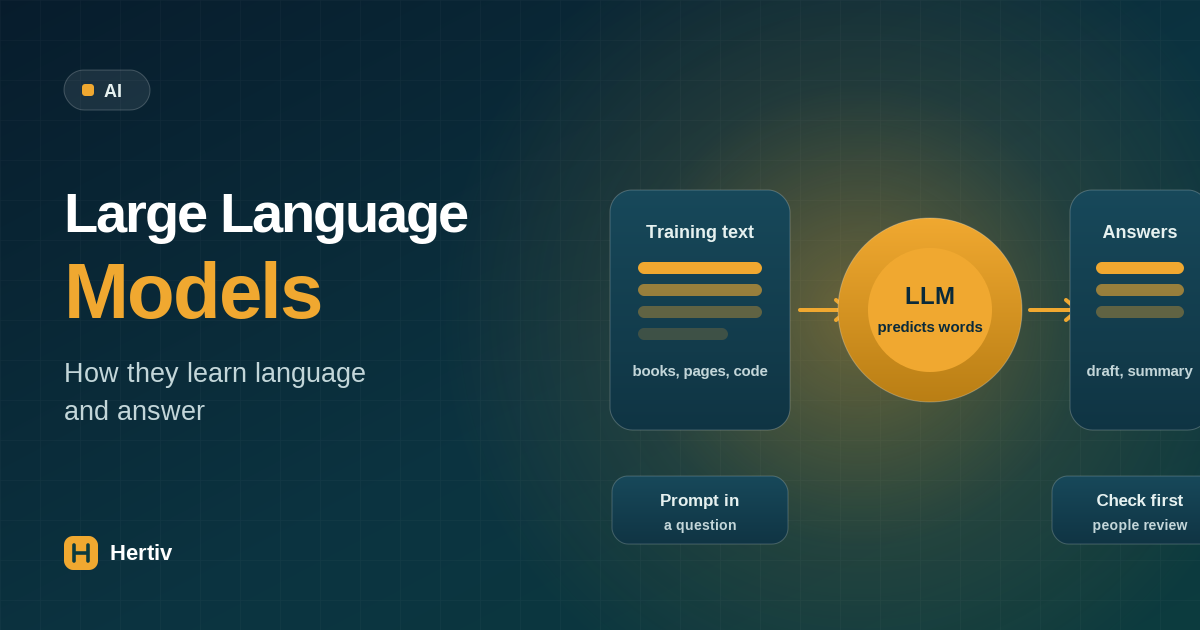
A large language model is a machine learning model with billions of adjustable settings, called parameters, that has been trained to predict the next word in a piece of text. Given a prompt, it works out the most likely continuation, one word at a time, based on the patterns it learned during training.
The word "large" refers to both the model and its training data. A small model may have millions of parameters; a large one has billions or more, trained on trillions of words. Size alone does not make a model good, but larger models usually handle longer, more varied prompts better.
The table below shows the main parts of a large language model and what each one does. Later sections explain how training works, what the model does well, and where it needs checking.
| Part | What it does | Example |
|---|---|---|
| Parameters | Store the patterns learned from text | Billions of tuned values |
| Training data | Text the model learns from | Books, articles, websites, code |
| Tokenizer | Splits text into pieces the model reads | Words and word parts |
| Prompt | The input the model responds to | A question or an instruction |
| Output | Text the model produces word by word | An answer, a draft, a summary |
How is a large language model trained?
A large language model is trained in two main stages: first it learns the patterns of language from a huge body of text, then it is tuned so its answers follow instructions and stay useful.
The training process looks like this:
- Collect and clean text. The team gathers books, articles, code and public web pages, then removes duplicates, personal data and low-quality material.
- Split text into tokens. Text is cut into pieces, usually words or word parts, that the model can process as numbers.
- Pre-train the model. The model reads the text and adjusts its parameters to predict the next token, repeating this billions of times until the predictions improve.
- Tune it to follow instructions. The model is shown examples of questions with good answers, so it learns to respond helpfully rather than just continue text.
- Check and refine. People review the model's answers and rank them, and the model is adjusted to favour answers people rate as helpful and safe.
Training a large model takes weeks on many specialised computers and a large amount of electricity. That is why most businesses use an existing model through an API or a hosted service, rather than training one themselves. For a practical view of testing a model, see how to test AI models before relying on one.
What can a large language model do well?
A large language model does well at drafting, summarising, translating, answering questions from supplied text and following clear instructions. It is strongest when the task is about language and the answer can be checked quickly.
The table below lists common uses and what makes each one a good fit. The pattern is simple: the model saves time on language work, while a person checks the result and stays responsible for it.
| Use | Why it fits | Check needed |
|---|---|---|
| Drafting replies | Fast first drafts in the right tone | Facts and promises |
| Summarising documents | Pulls out the main points quickly | Numbers and names |
| Answering from documents | Finds the relevant passage fast | That the answer is in the source |
| Writing and explaining code | Knows common patterns well | Run and test the code |
| Translating text | Handles tone and phrasing well | Key terms and figures |
What are the limits of a large language model?
The limits of a large language model are that it can state false things confidently, it does not know what happened after its training data was collected, and it cannot reason about facts it has never seen.
The most important limit is that the model predicts likely text, not true text. An answer can read fluently and still be wrong, especially on numbers, dates, names and niche facts. This is why answers that matter should always be checked against a source the team trusts.
Other limits matter in practice: the model forgets the start of a very long conversation, it can be misled by a badly worded prompt, and it has no access to a business's private data unless that data is supplied with the prompt or connected through a tool. A model that answers from supplied documents, as in retrieval-augmented generation, is far more reliable than one asked to recall facts from training alone.
These limits do not make the model useless; they define where it needs a human in the loop. Drafting and summarising are safe uses, while unreviewed decisions about money, safety or legal matters are not.
Example (hypothetical): a support team answers tickets faster
Example (hypothetical): a support team of 10 people handles 500 tickets a day, and each ticket takes about 6 minutes to answer from scratch. That is 500 times 6 minutes, which equals 3,000 minutes, or 50 hours of work a day.
The team adds a large language model that drafts a reply from the ticket and the help articles. An agent reads the draft, fixes any errors and sends it. Drafting now takes 2 minutes per ticket instead of 6, so the team spends 500 times 2 minutes, which equals 1,000 minutes, or about 17 hours a day, saving about 33 hours a day.
The saving only holds if the drafts are good. The team checks a sample of 50 drafts each week: if fewer than 45 of 50 are correct enough to send with small fixes, they improve the help articles and the prompt. The model does the drafting, the agents keep the judgment, and the customer still gets an answer from a person.
How to choose a large language model for your product
You choose a large language model for your product by testing two or three candidates on your own tasks, with your own data, and comparing accuracy, cost and speed.
- List the tasks. Write down the exact jobs the model will do: drafting, classifying, summarising or answering from documents.
- Build a small test set. Collect 50 to 100 real examples with the correct answers, so you can score each model fairly.
- Test two or three models. Run the same test set through each one and record how many answers are right.
- Check the cost per task. Multiply the price per input and output by your expected volume, and compare the monthly totals.
- Check the speed and limits. Confirm the model handles your longest documents and answers fast enough for your users.
- Plan the review step. Decide who checks the answers and how often, before the model goes live.
For the build side, a partner for LLM development can help connect the chosen model to your data and your product safely.
What are the common mistakes?
The most common mistakes with large language models are trusting the output without checking, giving the model tasks it cannot do, and feeding it private data with no controls.
- Trusting the first answer. A fluent answer can still be wrong on numbers and names, so check anything that matters.
- Asking the model to recall facts. Models are weak at remembering facts; give them the source text and ask them to use it.
- No review step. If nobody reads the output before it reaches a customer, errors will reach customers too.
- Sharing private data carelessly. Customer data sent to a model needs a contract, access limits and a retention policy.
- Picking the biggest model by default. A smaller model is often faster and cheaper, and just as accurate on a narrow task.
Key takeaways
- A large language model predicts the next word from patterns learned in training
- Training has two stages: learning language patterns, then tuning to follow instructions
- The model is strongest at drafting, summarising and answering from supplied text
- It can state false things fluently, so answers that matter need a human check
- Choose a model by testing candidates on your own tasks, not by size alone
Frequently asked questions
What is the difference between a large language model and a chatbot?
A chatbot is a product that talks with users; a large language model is the engine that can power it. A chatbot may use a language model, but it also needs a user interface, conversation rules, access to business data and a way to hand over to a person.
How much text is a large language model trained on?
Large models are trained on trillions of words from books, articles, websites and code. The exact amount varies by model, and the quality of the data matters as much as the size: clean, varied text produces a better model than a larger pile of poor text.
Can a large language model learn new facts after training?
Not on its own. A model cannot know events that happened after its training data was collected unless new information is given in the prompt or connected through a tool. Teams that need current facts connect the model to their own documents or a search step.
Is a large language model the same as generative AI?
No. Generative AI is the broad field of AI that creates new content, including text, images, audio and video. A large language model is one kind of generative AI, focused on text. Other generative models create images or music.
How much does it cost to use a large language model?
It depends on the model and the volume. Most providers charge per amount of text processed, so the cost grows with the number of requests and the length of the documents. Test with your real volume and compare two or three providers before committing.
Can a business run a large language model on its own servers?
Yes, some open models can run on a company's own hardware, which keeps the data inside the business. This needs suitable hardware and staff to maintain it, so it suits teams with steady volume and strict data rules, while others prefer a hosted service.


