What Is Invoice Tokenization, and How Does It Work?
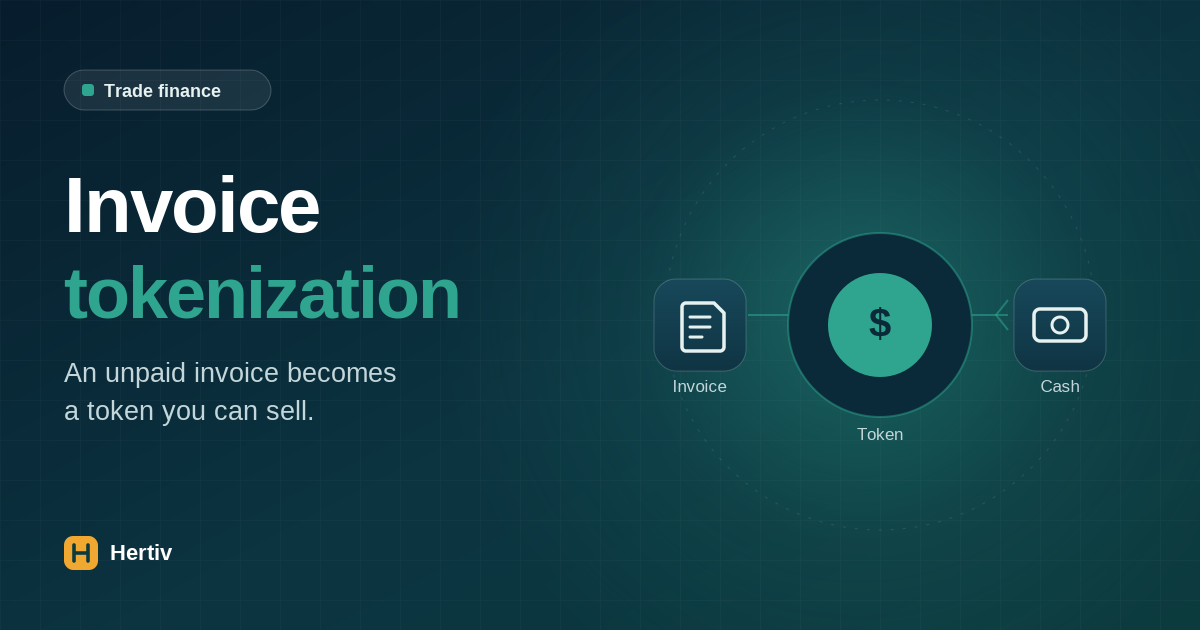
Invoice tokenization turns an unpaid invoice into a token on a blockchain, so a business can sell it or borrow against it before the buyer pays.
On this page
Short answer
Invoice tokenization is the process of recording an unpaid invoice as a token on a blockchain, so the right to be paid can be sold, split or used as collateral. The supplier gets cash early instead of waiting 30 to 90 days, and the investor who buys the token is paid when the buyer settles the invoice.
What is invoice tokenization?
Invoice tokenization is the process of turning an unpaid invoice into a digital token on a blockchain, so the claim to be paid becomes a transferable asset. A supplier issues an invoice with payment terms of 30, 60 or 90 days, and instead of waiting, it can tokenize that invoice and sell the token to an investor for cash now.
The token is a record of the invoice: who owes the money, how much, when it is due, and what evidence supports it. Because the record sits on a shared ledger, every party sees the same version of the claim, which reduces double-selling, where the same invoice is financed twice. That problem is one of the oldest frauds in invoice finance, and it is the main reason tokenization interests lenders.
Invoice tokenization is a form of real-world asset tokenization, focused on short-term trade receivables rather than property or bonds. The invoices are usually small and numerous, so a platform pools many of them and lets investors buy fractions of the pool. For a closer look at the wider pattern, see tokenization in cryptocurrency.
How does invoice tokenization work?
Invoice tokenization works by verifying the invoice, minting a token that represents the claim, selling that token to investors, and settling it when the buyer pays. Each step has a check behind it, because the token is only as good as the invoice it represents.
- Issue and verify the invoice. The supplier uploads the invoice and the delivery evidence, such as a signed delivery note or a purchase order. The platform checks the buyer is real and the invoice has not been financed already.
- Mint the token. A smart contract creates a token that records the invoice amount, the due date and the buyer. The token is held in escrow until the sale completes.
- Price and sell the token. Investors buy the token at a discount to the invoice value. The discount is their return, and it reflects the time until payment and the buyer's credit risk.
- Pay the supplier. The supplier receives the discounted amount, usually within a day or two, instead of waiting for the full payment term.
- Settle at maturity. When the due date arrives, the buyer pays the full invoice amount into a settlement account, and the smart contract distributes it to whoever holds the token.
- Handle late payment. If the buyer pays late, the contract applies the agreed penalty or recovery process, and the token holder bears the delay unless insurance covers it.
The supplier trades a small discount for speed. The investor trades cash now for a return later. The blockchain adds a shared record that makes the claim hard to sell twice.
Invoice tokenization vs traditional invoice factoring
Invoice tokenization and traditional factoring solve the same problem, but the mechanics differ. Factoring is a private deal between a supplier and a factor; tokenization moves the claim onto a shared ledger where it can be split, traded and settled by code.
| Feature | Traditional factoring | Invoice tokenization |
|---|---|---|
| Who buys the invoice | One factor, usually a bank or finance firm | Many investors, including smaller ones |
| Minimum invoice size | Often high, to justify the manual work | Lower, because verification is partly automated |
| Speed to cash | Days to a week, after paperwork | Often one to two days once verified |
| Can the claim be split | Rarely, the factor takes the whole invoice | Yes, tokens can be fractionalised |
| Double-financing check | Manual checks and registries | Shared ledger record of the claim |
| Regulation | Established factoring and lending rules | Depends on the jurisdiction and token design |
Tokenization does not remove the credit risk. If the buyer does not pay, the token holder loses, just as a factor would. What changes is who can participate and how transparent the claim is.
What kinds of invoices can be tokenized?
Not every invoice suits tokenization. The best candidates are invoices from creditworthy buyers, with clear delivery evidence and a fixed due date, because investors need to price the risk and the timing.
- B2B trade invoices. A manufacturer selling to a large retailer, or a supplier delivering to a construction firm, where payment terms run 30 to 90 days.
- Cross-border invoices. Exporters waiting on overseas buyers, where tokenization can also simplify settlement across currencies. See tokenization in cross-border payments for the payment side.
- Recurring service invoices. Monthly invoices from IT, logistics or facilities providers to established clients with a payment history.
- Government and large corporate receivables. Invoices owed by public bodies or listed companies, where default risk is low but payment is slow.
Invoices that do not fit are small consumer debts, invoices under dispute, and invoices with no delivery evidence. A platform that accepts those is taking on risk it cannot price, and investors will notice quickly.
What are the benefits and the limits?
The main benefit of invoice tokenization is speed of cash for the supplier and access to a new asset class for investors. Small businesses that wait 60 days for payment can turn that wait into working capital without taking on a loan.
For investors, tokenized invoices offer short-dated, asset-backed returns that do not move with crypto prices. The return comes from the discount, not from token price speculation, which makes the product closer to a money-market instrument than to a cryptocurrency.
The limits are real. First, the token is only as good as the invoice, so verification quality decides everything. Second, regulation varies: in some jurisdictions the token is a security, in others it is a receivable, and the difference changes who can buy it.
Third, liquidity is thin, because most tokens are held to maturity rather than traded. Fourth, if the buyer defaults, recovery depends on ordinary debt collection, and no smart contract can force a company to pay.
Tokenization improves the plumbing of invoice finance. It does not remove the need to judge whether the buyer will pay.
Example: a supplier financing one invoice
Example (hypothetical): a packaging supplier delivers goods to a retailer and issues a $50,000 invoice payable in 60 days. The supplier needs cash now to buy raw materials for the next order.
The supplier tokenizes the invoice. An investor buys the token for $49,000, a 2% discount, so the supplier receives $49,000 within two days and the investor expects $50,000 at maturity. The $1,000 difference is the investor's return for 60 days, which works out to roughly 12% on an annualised basis, before fees.
On the due date the retailer pays $50,000 into the settlement account. The smart contract sends $50,000 to the token holder, and the token is burned. If the retailer pays 15 days late, the contract applies a penalty of $25 per day, so the investor receives $50,375 and the supplier's discount stays the same.
The numbers are illustrative and the discount depends on the buyer's credit and the payment term. The point is the shape of the deal: the supplier gives up a small slice of the invoice for cash now, and the investor is paid for waiting.
What are the common mistakes?
The most common mistakes with invoice tokenization are tokenizing invoices that have not been verified, assuming the token removes credit risk, and ignoring the legal treatment of the token.
- Skipping verification. A token backed by a fake or disputed invoice is worthless. Delivery evidence and buyer confirmation come first.
- Treating the token as risk-free. The buyer can still default. A token does not make a weak buyer strong.
- Ignoring regulation. Whether the token counts as a security changes who can buy it and what disclosures are needed. Get legal advice before selling to the public.
- Assuming secondary trading. Most invoice tokens are held to maturity. Plan for a hold-to-maturity return, not a quick resale.
- Underpricing the discount. A discount that is too small leaves no margin for late payment or default, and investors will stop buying.
Key takeaways
- Invoice tokenization turns a payment claim into a tradable token
- The supplier gets cash early and gives up a small discount in return
- A shared ledger record makes double-financing the same invoice harder
- The token is only as good as the invoice and the buyer behind it
- Most invoice tokens are held to maturity rather than traded
Frequently asked questions
What is the difference between invoice tokenization and invoice factoring?
Factoring is a private deal where one factor buys the whole invoice. Tokenization records the claim as a token on a shared ledger, so it can be split among many investors and settled by a smart contract. The underlying credit risk is the same in both cases.
Who buys tokenized invoices?
Investors looking for short-dated, asset-backed returns, including funds, fintech platforms and, on some platforms, smaller investors who buy fractions of a pool of invoices. The discount on the invoice is their return.
How long does it take to get paid?
Once the invoice is verified and the token is sold, the supplier usually receives funds within one to two days. The investor is paid when the buyer settles the invoice on its due date, typically 30 to 90 days later.
What happens if the buyer does not pay?
The token holder bears the loss unless the invoice is insured or guaranteed. The smart contract can apply penalties for late payment, but it cannot force a company to pay, so recovery follows ordinary debt collection.
Is a tokenized invoice a security?
It depends on the jurisdiction and how the token is structured. In some places it is treated as a security, in others as a receivable or a loan. Teams should get legal advice on the token design before offering it to investors.
Can small invoices be tokenized?
Yes, and that is one of the advantages over factoring, because verification is partly automated and tokens can be fractionalised. A platform usually pools many small invoices so investors can buy into a diversified set rather than a single claim.


