What Is a Hybrid Blockchain and When Should You Use One?
A hybrid blockchain mixes a private chain for sensitive data with a public chain for proof and audit. It fits networks needing privacy and public trust together.
On this page
Short answer
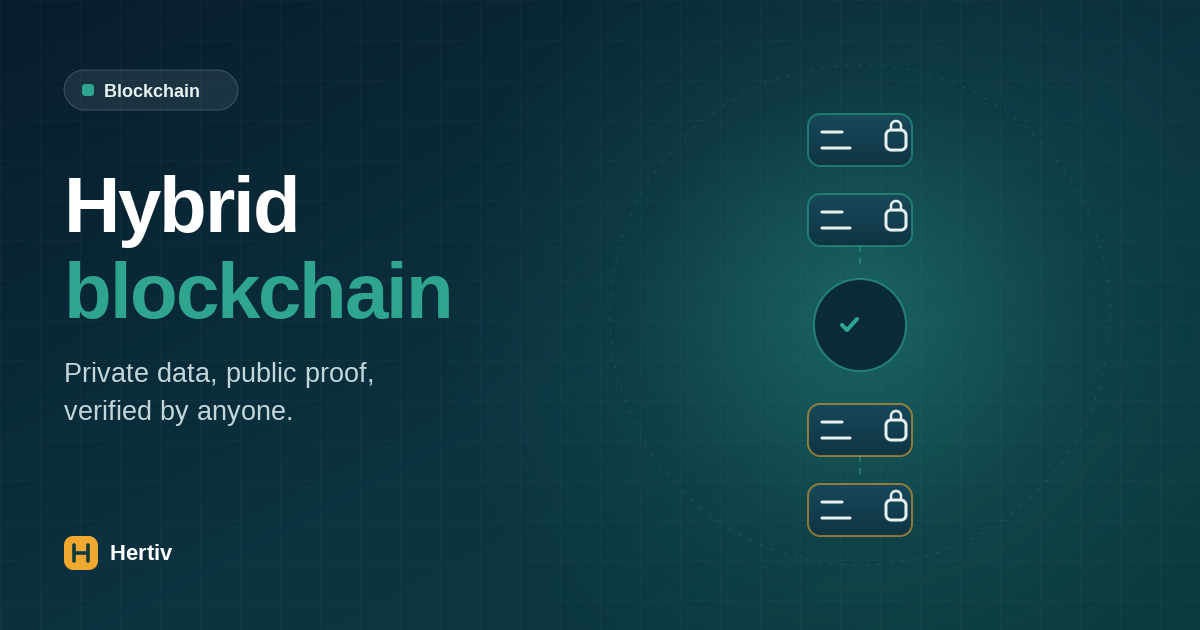
A hybrid blockchain is a blockchain design that combines a private, permissioned ledger with a public blockchain. Private transactions stay visible only to approved participants, while proofs or hashes of those transactions are anchored on a public chain so anyone can verify them later.
What is a hybrid blockchain?
A hybrid blockchain is a blockchain design that combines a private, permissioned ledger with a public blockchain. Private transactions stay visible only to approved participants, while proofs or hashes of those transactions are anchored on a public chain so anyone can verify them later.
Think of it as two layers doing different jobs. The private layer handles the day-to-day work: fast transactions between known parties, with access controlled by the network's rules. The public layer provides a tamper-evident record that outsiders, auditors and regulators can check without seeing the private details.
Hybrid designs exist because neither a fully public nor a fully private chain fits every network. Public chains are open and verifiable but expose data and move slowly. Private chains are fast and confidential but hard for outsiders to trust. A hybrid design tries to keep the useful half of each.
How does a hybrid blockchain differ from public and private chains?
The difference is who can see what, and who can verify it. A public chain lets anyone read and check everything. A private chain restricts both reading and writing to approved members. A hybrid chain splits the two: private data stays inside, public proof goes outside.
| Feature | Public chain | Private chain | Hybrid chain |
|---|---|---|---|
| Who can read data | Anyone | Approved members only | Members read data; anyone can verify proofs |
| Who can write | Anyone, under the chain's rules | Approved members only | Approved members; proofs anchored publicly |
| Speed | Slower, many validators | Faster, few validators | Fast on the private layer |
| Privacy | Low, data is public | High, data stays inside | High for data, public for proofs |
| Outside trust | High, anyone can verify | Low, outsiders must trust members | Medium to high, proofs are public |
| Cost per transaction | Varies with network fees | Low, controlled by the network | Low privately, plus anchoring fees |
The anchor is the key idea. The private chain records a hash, a short fingerprint of a transaction or a batch, on the public chain. The hash reveals nothing about the contents, but it proves the record existed at a certain time and has not changed since. For the design side, enterprise blockchain covers how permissioned networks are built.
Where do hybrid blockchains fit?
Hybrid blockchains fit networks where the members need privacy between themselves but outsiders need proof that the records are real. Supply chains, trade finance, healthcare records and government registries are the usual cases.
In a supply chain, competing suppliers share one network but do not want each other to see their prices or volumes. A hybrid chain keeps each deal private while anchoring proofs publicly, so a buyer or auditor can verify that a product's history has not been rewritten.
In healthcare, patient records stay on the private layer, while proof of consent or proof of a record's existence can be checked without revealing the record itself. In trade finance, banks share documents privately and anchor proofs so that no party can alter a document after the fact.
Hybrid designs do not fit every case. If all participants trust each other fully, a shared database is simpler. If everything should be public, a public chain is simpler. The hybrid design earns its place only when both privacy and public proof matter at the same time.
How to design a hybrid blockchain
You design a hybrid blockchain by deciding what stays private, what gets anchored publicly, and who runs each layer. Getting those three decisions right matters more than the choice of platform.
- Map the data. List every data type the network handles and mark what must stay private, what can be shared between members, and what outsiders need to verify.
- Choose the private layer. Pick a permissioned ledger for member transactions, with clear rules for who can join, who can write and how disputes are resolved.
- Choose the public anchor. Pick a public chain to record hashes, and decide how often to anchor: per transaction, per batch or per day.
- Define the anchor format. Decide exactly what goes into each hash, so verifiers can reproduce it and check it independently.
- Set the governance. Write down who approves new members, who can change the rules, and what happens when a member leaves or misbehaves.
- Build the verification path. Make sure an auditor can take a private record, recompute its hash and find it on the public chain without help from the network operator.
Test the verification path with a real auditor before launch. If an outsider cannot verify a record on their own, the public anchor is not doing its job.
Example: a supply chain network sharing proofs
Example (hypothetical): five food suppliers share a network with two large buyers. The suppliers will not share prices with each other, but the buyers want proof that each shipment's origin record has not been changed after delivery.
The network runs a private ledger for shipment records, with each supplier seeing only its own deals. Once a day, the network anchors a hash of the day's shipment batch on a public chain. The hash reveals nothing about prices or volumes.
When a buyer checks a shipment, the network gives them the record and the public anchor reference. The buyer recomputes the hash and finds it on the public chain, confirming the record existed on that date and has not changed. The check takes minutes and needs no trust in the suppliers.
The arithmetic shows the anchoring cost. The network anchors one batch a day, 365 anchors a year. At a planning fee of 2 currency units per anchor, that is 730 currency units a year, against a network that moves 1,200 shipments a month. The cost per shipment works out to about 0.05 currency units, which is small next to the cost of a single disputed delivery.
What are the trade-offs?
The main trade-off is complexity. A hybrid design is two systems, not one, and the bridge between them is a new point of failure. If the anchoring service stops, the private layer keeps working but the public proof stops, and the trust benefit disappears until anchoring resumes.
Cost is the second trade-off. Private transactions are cheap, but every public anchor carries a fee, and anchoring every transaction can become expensive. Most networks anchor in batches, which keeps costs down but means proofs are only as fresh as the last batch.
Governance is the third. A hybrid network needs rules for both layers, and the members must agree on who can change those rules. Disputes about membership or anchoring frequency are more common than technical failures, so the governance document deserves as much care as the code.
What are the common mistakes?
The most common hybrid blockchain mistakes are anchoring data that should stay private, treating the design as a single system, and skipping the independent verification test.
- Anchoring raw data. Only hashes belong on the public chain. Anything readable there is public forever.
- One layer doing both jobs. Putting private data on the public layer, or expecting the private layer to prove itself, defeats the design.
- No independent verification. If only the operator can verify a record, the public anchor adds no trust.
- Anchoring too rarely. Weekly batches leave a long window where records could change unnoticed.
- Weak governance. Unclear membership and rule-change processes cause disputes that stall the network.
- Choosing hybrid by default. If all members trust each other, a shared database is simpler; if everything should be public, a public chain is simpler.
If you are weighing a hybrid design against a private or public chain, blockchain consulting can help you map the data and governance before you build.
Key takeaways
- A hybrid blockchain pairs a private ledger for sensitive data with a public chain for proofs.
- Only hashes go on the public chain; the private data stays inside the network.
- Hybrid fits when members need privacy and outsiders need proof at the same time.
- Batch anchoring keeps public fees low, but proofs are only as fresh as the last batch.
- Test the verification path with a real auditor before launch.
Frequently asked questions
What is the difference between a hybrid blockchain and a sidechain?
A sidechain is a separate chain linked to a main chain, usually to move assets between them. A hybrid blockchain is a design pattern that combines a private ledger with public anchoring for proof. The two ideas can overlap, but they solve different problems: sidechains move value, hybrid designs prove records.
Is a hybrid blockchain more secure than a private chain?
It is more verifiable, which is not the same as more secure. The public anchor makes tampering visible to outsiders, but the private layer still depends on its own access controls and governance. Security comes from both layers being done well, not from the word hybrid.
Which public chains are used for anchoring?
Any public chain that supports storing a small piece of data can anchor hashes. The choice depends on fees, finality time and how long the chain is likely to last. What matters more than the chain is the anchor format: verifiers must be able to reproduce the hash and find it independently.
Can a hybrid blockchain be fully decentralised?
The public layer can be, but the private layer usually is not, because membership is controlled and a small set of validators runs it. That is a deliberate trade-off: the network gives up some decentralisation to gain privacy and speed, and uses the public anchor to keep the record honest.
How often should a hybrid network anchor to the public chain?
As often as the trust requirement demands, balanced against fees. Daily batch anchoring suits most supply chain and registry networks; per-transaction anchoring suits high-value trade finance. Weekly anchoring leaves a long window where changes could go unnoticed.
Do hybrid blockchains need cryptocurrency?
The private layer usually does not. The public anchor may need a small amount of the public chain's currency to pay transaction fees, so the network operator needs a way to hold and spend it. That is a practical detail, not a design requirement.


