What Is Generative AI, and How Does It Work?
Generative AI creates new text, images, code and audio from patterns it learned in training data. Here is how it works, what it can do, and where it falls short.
On this page
Short answer
Generative AI is software that creates new content, such as text, images, code or audio, by learning patterns from large sets of examples and then predicting what should come next. A model is trained on that data, tuned with human feedback, and then given a prompt; it produces an output that follows the patterns it learned, which a person should check before using.
What is generative AI?
Generative AI is software that creates new content, such as text, images, code, audio or video, by learning patterns from large sets of examples. Where older software followed fixed rules, a generative model produces something new each time it runs, guided by a prompt from the user.
The word generative matters. A classifier sorts things into categories, such as spam or not spam. A generative model creates: a draft email, a product image, a code function, a summary of a long document. The output is new, even though it is built from patterns in the training data.
Most teams meet generative AI through chat interfaces and copilots, but the same models sit behind document processing, search, coding assistants and customer support tools. See generative AI use cases that work in production for where the technology actually earns its keep.
How does generative AI work?
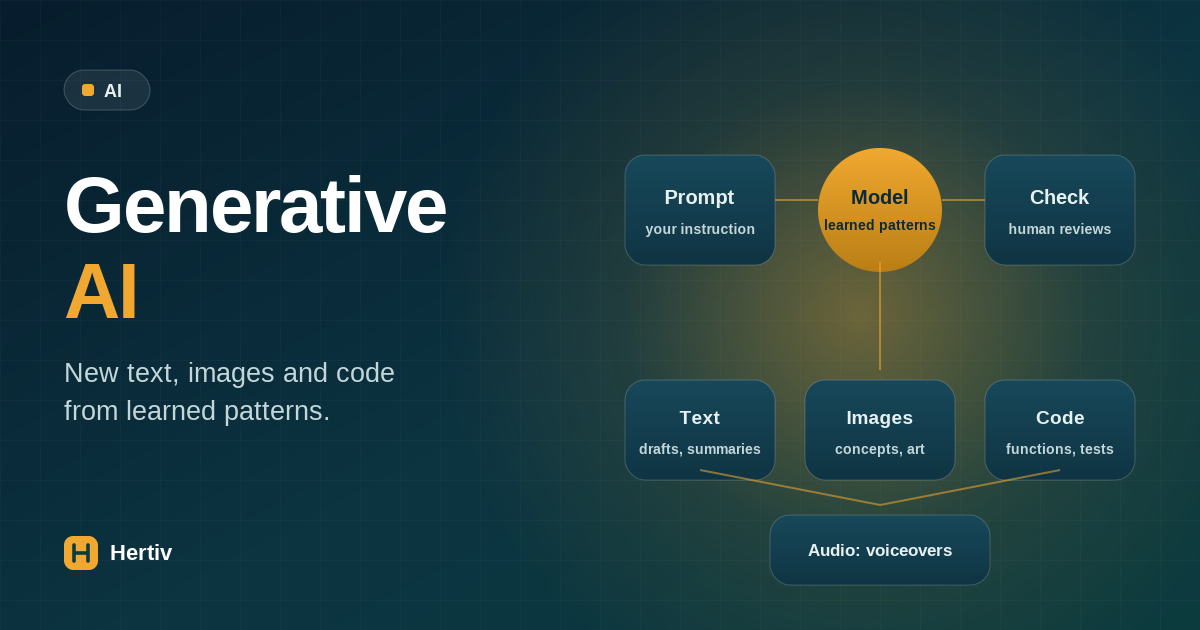
Generative AI works in three stages: training, tuning and generation. During training, the model reads a very large set of examples and adjusts its internal settings so it can predict what comes next in a sequence, whether that is the next word in a sentence or the next part of an image.
During tuning, the model is guided towards useful behaviour. Human reviewers rank outputs, and the model is adjusted to favour answers that are helpful, safe and well formatted. This stage is what turns a raw model into a product people can use.
During generation, the user gives a prompt and the model produces an output one piece at a time, each piece chosen from what the model predicts should follow. That is why the same prompt can give different answers: the model samples from likely options rather than looking up a fixed reply.
Retrieval is often added on top. When a question needs facts from your own documents, the system first searches those documents, then gives the model the relevant passages alongside the prompt. The answer is still generated, but it is grounded in sources the model can quote, which makes errors easier to spot.
What can generative AI make?
Generative AI can make many kinds of content, but it is strongest where a human already reviews the output and where the source material is digital.
| Output type | Common use | Needs a human to check |
|---|---|---|
| Text | Drafts, summaries, replies | Facts and tone |
| Code | Functions, tests, fixes | Correctness and security |
| Images | Concepts, marketing art | Brand fit and likeness |
| Audio | Voiceovers, music beds | Quality and rights |
| Data | Synthetic test rows | Realism and privacy |
The pattern that works is draft plus review. The model produces a first version quickly, and a person edits, verifies and owns the result. Teams that publish model output unchecked usually regret it.
What are the limits of generative AI?
Generative AI has real limits, and knowing them is part of using it well. It can produce confident-sounding text that is wrong, it can repeat biases in its training data, and it cannot know facts that appeared after its training or that live in your private systems.
It also struggles with exactness. Asking it to add a column of figures or follow a strict format will often produce small errors, which is why finance and legal work needs validation rules around the model rather than trust in it.
- Hallucination. The model can invent facts, quotes, sources and figures that sound plausible.
- Stale knowledge. It does not know events or prices after its training data ends.
- No private context. It cannot see your documents unless you connect them, usually through retrieval.
- Bias. Training data reflects the world it came from, including its skews.
- Weak arithmetic. Multi-step calculation is unreliable without a calculator or code tool.
Grounding the model in your own documents and adding checks for facts, figures and sources reduces these risks. Testing AI models covers how teams measure whether a model is good enough for a real workflow.
How to start using generative AI in 5 steps
Starting with generative AI works best when the first use case is narrow, measured and owned by one team. A broad assistant with no owner usually stalls.
- Pick one workflow. Choose a task where a human already reviews output, such as drafting replies or summarising documents.
- Write a clear prompt. State the task, the audience, the format and what must not be invented. Good prompts are specific.
- Build a small test set. Collect twenty real inputs with known good outputs, and score the model against them.
- Add a review step. Route low-confidence or sensitive outputs to a human before they reach a customer.
- Measure one outcome. Track time saved, edit rate or accuracy on the test set, and decide from the numbers.
Only then consider wider rollout, retrieval over your own documents, or fine-tuning. Each step adds cost and complexity, so earn it with results from the step before.
Example (hypothetical): a support team tries generative AI
Example (hypothetical): a support team of 10 people handles 300 tickets a day, and each ticket takes about 6 minutes to answer. That is 300 times 6 minutes, or 1,800 minutes, about 30 hours of answering work a day.
The team adds a generative model that drafts replies from the help centre, and agents review each draft before sending. Drafts take about 1 minute to check, and the team accepts 200 of the 300 drafts. Answering time falls to 200 minutes of checks plus 100 tickets at 6 minutes, which is 800 minutes, about 13 hours a day.
The team saves about 17 hours a day, but only because drafts are grounded in the help centre and every draft is reviewed. Without those two controls, wrong answers would reach customers and the saving would vanish.
What are the common mistakes?
The most common generative AI mistakes are skipping evaluation, publishing unchecked output, and expecting the model to know things it cannot see.
- No test set. Without fixed cases and known good answers, quality debates are anecdotal.
- Publishing raw output. Unreviewed drafts drift in tone and can contain invented facts.
- Vague prompts. A prompt that says "write something good" gets a generic answer. Be specific.
- Ignoring privacy. Pasted customer data may leave your systems. Check where prompts go before use.
- Treating the model as a database. It predicts text; it does not retrieve facts. Connect it to your sources instead.
Key takeaways
- Generative AI creates new content by predicting what should come next, based on patterns in training data
- It works best as draft plus human review, not as an unsupervised publisher
- Its main limits are invented facts, stale knowledge and no access to private data
- Start with one narrow workflow, a test set and a review step
- Ground the model in your own documents before trusting its answers
Frequently asked questions
Is generative AI the same as AI?
No. AI is the broad field of software that performs tasks that need human-like judgement. Generative AI is one branch of it, focused on creating new content. Other branches include classification, prediction and optimisation, which do not generate text or images.
Does generative AI need the internet to work?
Most hosted models run in the cloud and need a connection, but some smaller models can run on local hardware. Local models suit sensitive data, while hosted models usually offer more capability. Check the vendor site for the deployment options of the model you plan to use.
Can generative AI replace writers or designers?
It can speed up first drafts and routine variations, but it cannot replace judgement about facts, brand, audience and taste. Teams that use it well keep a human as editor and owner of the final output, and use the model to remove repetitive drafting work.
How do you stop generative AI from inventing facts?
Ground it in your own documents through retrieval, ask it to cite sources, and add validation rules for figures and dates. Then review outputs before they reach customers, and track errors on a fixed test set so improvements are measurable.
What data does generative AI need?
It needs examples of the task you want done: past replies, documents, code or images, plus a test set with known good outputs. Clean, current source material matters more than volume, since the model repeats whatever patterns the data contains.
Is generative AI expensive to run?
Costs vary by model, volume and deployment, so check the vendor site for current pricing. The main costs are per-token usage, any retrieval infrastructure and the human review step. Start with one workflow and measure cost per task before scaling.


