What Is Edge AI, and How Does It Work?
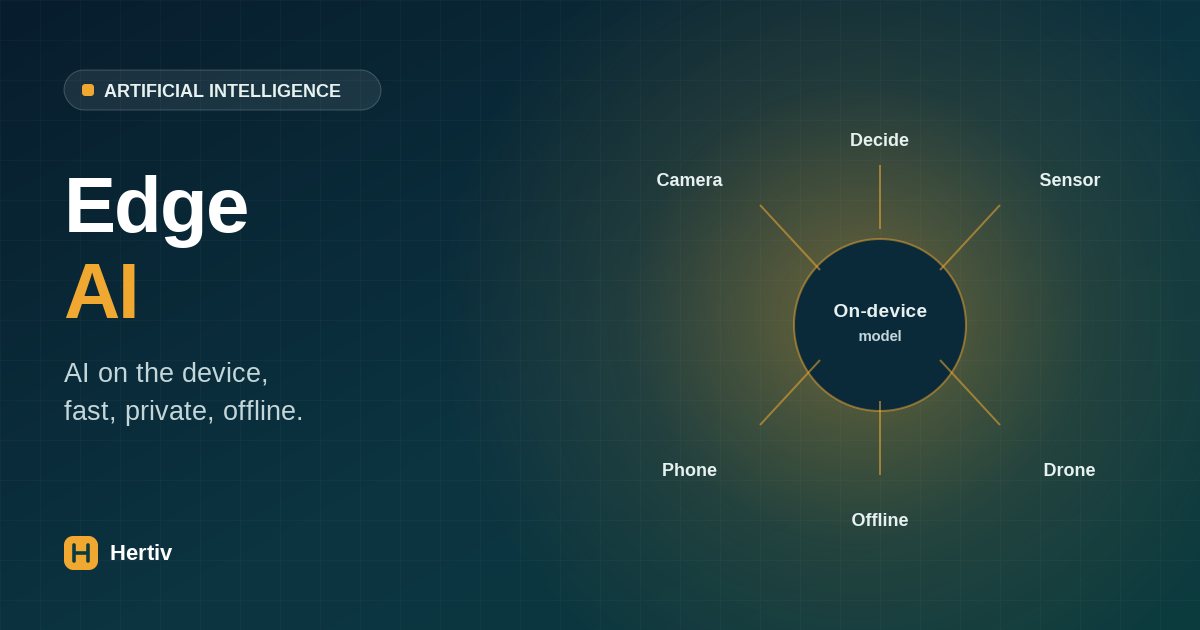
Edge AI runs machine learning models on the device itself, such as a camera or phone, instead of sending data to a server, so it answers faster and works offline.
On this page
Short answer
Edge AI is machine learning that runs on the device where the data is created, such as a camera, a phone, a sensor or a machine on a factory floor, instead of sending the data to a distant server. The model makes its decision locally, which cuts delay, keeps raw data on the device and lets the system work when the connection drops.
What is edge AI?
Edge AI is artificial intelligence that runs on a local device at the "edge" of a network, close to where data is created. A camera that spots a faulty part, a phone that transcribes speech offline and a sensor that flags a failing pump are all edge AI: the model lives on the device and answers without waiting for a server.
It differs from cloud AI, where data travels to a data centre, is processed there and the answer travels back. Edge AI skips the round trip, so it suits tasks that need a fast answer, that handle private data or that must keep working when the network is down. It is the same idea as machine learning, moved from the server room onto the device.
How does edge AI work?
Edge AI works in four stages. First, a model is trained on a server or in the cloud, where there is enough computing power and data. Second, the trained model is shrunk so it fits on a small device, using methods that cut its size and speed it up without losing much accuracy.
Third, the small model is loaded onto the device, often with a chip built for AI work. Fourth, the device runs the model on new data as it arrives and acts on the result, sending only a short summary or an alert to the server when needed. The raw video, audio or sensor readings can stay on the device.
| Stage | Where it happens | What happens |
|---|---|---|
| Train | Server or cloud | Model learns from a large dataset |
| Shrink | Server or cloud | Model is compressed to fit a small device |
| Load | Device | Model is installed on the edge hardware |
| Run | Device | Model answers new data as it arrives |
When should you use edge AI?
Use edge AI when delay matters. A robot arm that must stop before it hits something cannot wait for a server round trip. A door camera that flags a person should answer in well under a second. A voice assistant in a car should keep working in a tunnel.
Use it when data should stay private. A health monitor or a home camera sends less raw data out when the model runs locally. Use it when the connection is weak or costly, such as on a farm, a ship or a remote site. If none of those apply, a cloud model is usually simpler to build and update.
Retail is another common case. A shelf camera that counts stock can run all day without sending video to a server, and a checkout camera can flag an unscanned item in the moment. In both cases the value is the instant answer, not a report that arrives hours later.
What are the limits of edge AI?
Edge devices have less memory and less computing power than servers, so edge models are smaller and less capable than the largest cloud models. A small model may miss details a large model would catch, and it may need retraining when the task changes.
Updates are harder too. Sending a new model to thousands of devices takes planning, and a failed update can leave a device with a broken model. Security matters as well: a device in the field can be opened and studied, so models and keys on the device need protection. Plan for updates and monitoring from the start.
Cost is a limit as well. Edge hardware with AI chips costs more than a plain sensor, and that cost repeats across every device you install. A project that needs ten devices can afford it; a project that needs ten thousand must justify the hardware spend against the value of the faster answer.
How do teams build an edge AI product?
Teams build edge AI in five steps. First, they define the decision the device must make and how fast it must answer. Second, they collect and label data from the real setting, not just from a lab. Third, they train a model and test it on that real data.
Fourth, they shrink the model and test it on the actual device, because a model that works on a laptop may be too slow on a camera chip. Fifth, they ship it with a way to update the model and watch its accuracy over time. The guide on how to build an AI proof of concept covers the early testing steps that apply here too.
- Define the decision and the speed it needs.
- Collect and label data from the real setting.
- Train and test the model on that data.
- Shrink the model and test it on the device.
- Ship it with updates and accuracy monitoring.
Example (hypothetical): a factory inspection camera
A packaging line checks 240 boxes an hour for damage. A person needs about 5 minutes per flagged box to inspect it, and manual review of every box would take 20 hours a day, which is not practical across a shift.
An edge AI camera checks each box as it passes and flags 30 boxes an hour for a person to review. Those 30 reviews take 2 hours 30 minutes a day, saving about 17 hours 30 minutes of review time each day, while the camera keeps working even if the factory network drops. The team still checks the camera's accuracy each week, because a model that drifts will flag the wrong boxes.
Common mistakes
The first mistake is training on clean lab data and testing on messy real data, which makes accuracy collapse on the factory floor. The second is picking a model that is too large for the device, so it answers too slowly to be useful.
The third is shipping with no update plan, so a model that goes stale stays stale. The fourth is ignoring privacy and security on the device itself. Test on the real device, in the real setting, with real data, and plan updates before the first install.
The fifth mistake is measuring accuracy in the lab and never again. Lighting, dust, new products and seasonal change all shift what the camera sees, so a model that scored well in testing can quietly get worse. Check accuracy on a schedule and keep a log of what changed.
Key takeaways
- Edge AI runs machine learning models on the device where data is created.
- It answers faster than cloud AI and keeps working when the connection drops.
- Models are trained in the cloud, shrunk, then loaded onto the device.
- Small devices limit model size, so edge models trade some capability for speed.
- Test on the real device with real data before shipping.
Frequently asked questions
What is edge AI in simple terms?
Edge AI is machine learning that runs on a local device, such as a camera, phone or sensor, instead of sending data to a distant server. The device makes the decision itself, which cuts delay and keeps raw data on the device.
What is the difference between edge AI and cloud AI?
Cloud AI runs models on remote servers, while edge AI runs them on the device where the data is created. Cloud models can be larger and more capable, while edge models answer faster, work offline and send less raw data out.
What devices use edge AI?
Common edge AI devices are security cameras, phones, smart speakers, wearables, drones, factory sensors and vehicles. Any device that must decide fast, work offline or keep data private is a candidate for edge AI.
Is edge AI more private than cloud AI?
Edge AI can be more private because raw video, audio or sensor data can stay on the device, with only short results or alerts sent out. It still needs security on the device itself, so private data is not a guarantee without proper protection.
Why is edge AI used in factories?
Factories use edge AI because machines need fast answers, networks can drop, and cameras produce far more data than is practical to send to a server. A camera that flags only the faulty parts saves review time and bandwidth.
How do you update an edge AI model?
Teams update edge AI models by pushing a new compressed model to devices over the network, often in stages so a bad update can be rolled back. Devices should keep the previous model until the new one proves it works.


