What Is Crypto Arbitrage, and How Does It Work?
Crypto arbitrage buys a coin where it is cheaper and sells it where it costs more, keeping the gap. Learn how it works, what it costs, and where traders go wrong.
On this page
Short answer
Crypto arbitrage is buying a cryptocurrency on one exchange at a lower price and selling it on another at a higher price, keeping the difference as profit. The same asset trades at slightly different prices across exchanges, and the gap usually lasts only seconds or minutes before traders close it.
What is crypto arbitrage?
Crypto arbitrage is the practice of buying a cryptocurrency on one exchange where its price is lower and selling it on another where its price is higher, keeping the difference as profit. The same asset can trade at slightly different prices on different exchanges because each exchange has its own buyers, sellers and liquidity.
The price gap usually lasts seconds or minutes, since traders and bots act on it quickly. Arbitrage does not depend on the market going up or down; it depends on the gap between two prices at the same moment.
It sounds simple, but the profit is only real after fees, transfer times and price movement are counted. Many gaps look profitable on screen and disappear once the trade is executed.
How does crypto arbitrage work?
Crypto arbitrage works by spotting a price difference for the same asset, buying low, moving the asset if needed, and selling high. The trade can happen across exchanges, across trading pairs, or across regions.
| Type | How it works | Main risk |
|---|---|---|
| Cross-exchange | Buy on exchange A, sell on exchange B | Transfer delay |
| Triangular | Three trades within one exchange | Slippage on each leg |
| Funding rate | Hold spot, short the future | Rate changes |
| Stablecoin gap | Buy a stablecoin below its peg, sell at par | Peg may not return |
Cross-exchange arbitrage needs the asset on both exchanges, or a transfer between them. Triangular arbitrage stays inside one exchange, so it avoids transfer time but needs three trades to line up. Funding-rate arbitrage earns the rate paid by one side of a futures market, which changes constantly.
Why do price gaps appear?
Price gaps appear because crypto markets are fragmented. Each exchange matches its own orders, so a large buy on a small exchange moves its price more than the same buy on a large one.
Other causes include slow transfers between exchanges, regional demand differences, and new listings that exist on one exchange first. Withdrawal limits and network congestion can keep a gap open longer than expected.
Gaps are smallest for large, liquid assets such as bitcoin and ether, and larger for small tokens on thin order books. Larger gaps usually mean higher risk, because the same thin market that creates the gap also makes it hard to exit.
What does arbitrage cost?
Arbitrage costs come from trading fees, withdrawal fees, network fees and the spread between buy and sell prices. Each of these eats into the gap, and a trade that looks profitable before fees can lose money after them.
Transfer time is the hidden cost. Moving coins between exchanges can take minutes on a fast chain and much longer on a congested one. During that time the gap can close or reverse, leaving the trader holding the asset at the worse price.
Some traders keep funds on both exchanges so they can buy and sell at once without waiting for a transfer. That removes the transfer risk but ties up capital on two platforms, and both balances carry exchange risk.
Example (hypothetical): a cross-exchange trade
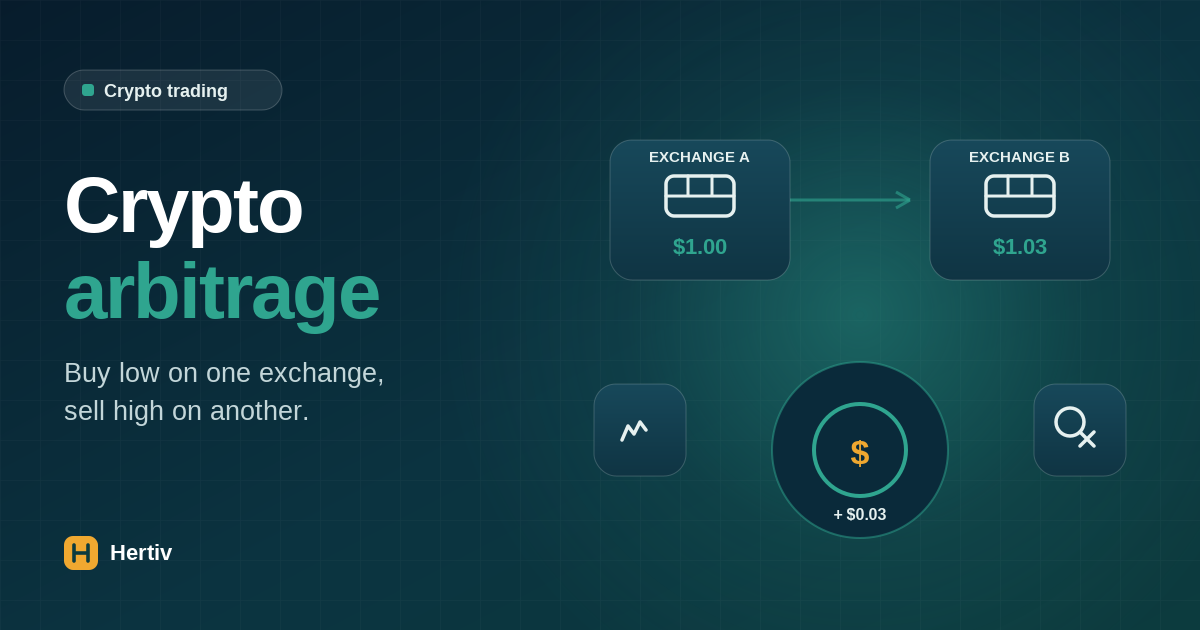
Example (hypothetical): a trader holds funds on two exchanges. Exchange A lists a token at $1.00 and exchange B lists the same token at $1.03, a gap of 3 cents per token.
The trader buys 1,000 tokens on exchange A for $1,000 and sells 1,000 tokens on exchange B for $1,030, a gross gain of $30. Trading fees of 0.1% on each side cost $1.00 and $1.03, leaving about $27.97.
If the trader had instead transferred the tokens from A to B, a withdrawal fee of $2 and a 15-minute delay might have closed the gap entirely. Keeping funds on both exchanges avoids that delay, but the trader must then rebalance the balances before the next trade.
Is crypto arbitrage legal?
Crypto arbitrage is legal in most places because it is simply buying and selling an asset at different prices. It is a normal market activity, and exchanges expect traders to act on price differences.
Tax rules still apply. In many countries each trade is a taxable event, so frequent arbitrage can create a large reporting burden. Keep records of every trade, fee and transfer, and check the rules where you live.
Some exchanges limit arbitrage in their terms, for example by restricting API use or withdrawals during high demand. Read the terms of each exchange you use, and never use an account in someone else's name to get around a limit.
What are the common mistakes?
The most common crypto arbitrage mistakes are ignoring fees, trusting a stale price, and trading illiquid tokens.
- Forgetting fees. Trading, withdrawal and network fees can erase a small gap; work out the net result before trading.
- Using a stale price. A price shown on a dashboard may be seconds old, and the real price may have moved.
- Trading thin markets. A large gap on a token with little volume may not survive your own order.
- Ignoring transfer time. A gap that needs a 30-minute transfer is not the same as a gap you can take at once.
- Keeping large balances on one exchange. Exchange failures and freezes are real risks, so limit what you leave on any platform.
Teams building trading tools or exchange software should treat security and testing as core work from the start, which is where crypto exchange development expertise matters.
How do you start with crypto arbitrage?
You start with crypto arbitrage by learning the costs and risks on paper before risking real money. Paper trading a strategy for a few weeks shows whether the gaps you see survive fees and delays.
- Pick one pair of exchanges. Choose two large, liquid exchanges you already trust.
- List every fee. Trading, withdrawal and network fees for the exact asset you plan to trade.
- Measure transfer times. Time a small test transfer before you rely on that route.
- Set a minimum gap. Only trade when the gap is larger than all costs combined, with room to spare.
- Start small. Use small amounts until the process works end to end, including rebalancing.
For a deeper look at how the underlying systems work, read our guide to smart contract development and how decentralised exchanges set prices.
Key takeaways
- Arbitrage profits from price gaps, not market direction
- Fees, transfer time and slippage decide whether a gap is real
- Triangular arbitrage stays in one exchange; cross-exchange trades need transfers
- Thin markets show bigger gaps and bigger exit risk
- Record every trade: tax rules apply to each one
Frequently asked questions
Is crypto arbitrage profitable?
It can be, but only when the gap is larger than all fees and the trade can be completed before the gap closes. Most visible gaps are small, and many disappear once fees and transfer time are counted. Treat it as a trading strategy with real costs, not free money.
Is crypto arbitrage risky?
Yes. Prices can move while a transfer is in progress, an exchange can freeze withdrawals, and thin markets can make it hard to exit. Keeping funds on several exchanges also spreads exposure to exchange failures, so limit what you leave on any one platform.
What is triangular arbitrage?
Triangular arbitrage uses three trades inside one exchange, for example trading bitcoin for ether, ether for a stablecoin, then the stablecoin back to bitcoin. It avoids transfer delays, but each of the three trades carries a fee and slippage, so all three legs must line up.
Do I need a bot for crypto arbitrage?
Not to learn the idea, but gaps usually last seconds, so manual trading rarely catches them. Bots are common, yet they need reliable price data, fast execution and careful error handling, and a badly written bot can lose money faster than a human.
Which exchanges are best for arbitrage?
Large, liquid exchanges with low fees and fast withdrawals give the most chances. The right pair depends on the asset you trade and where you live, so compare fees, withdrawal times and supported assets on the vendor site before choosing.
Can beginners try crypto arbitrage?
Beginners can learn it with paper trading and small amounts, but they should expect to lose money while learning. Start by tracking gaps and fees on paper for a few weeks, and only trade real money when the numbers work after every cost.


