What Is Business Process Management, and How Does It Work?
Business process management is how a company designs, runs and improves its repeatable work. This guide explains the lifecycle and where to start.
On this page
Short answer
Business process management is the discipline of mapping, running, measuring and improving the repeatable processes a company depends on, such as handling an order, onboarding a new hire or approving an invoice. It turns work that lives in people's heads into a defined process that can be followed, measured and fixed.
What is business process management?
Business process management is the discipline of mapping, running, measuring and improving the repeatable processes a company depends on, such as handling an order, onboarding a new hire or approving an invoice. It turns work that lives in people's heads into a defined process that can be followed, measured and fixed.
A process is a series of steps that turns an input into an outcome. An order arrives, it is checked, packed and shipped. A job application arrives, it is screened, interviewed and decided. When nobody has written the steps down, each person does it differently, and nobody can say where the delays are.
Business process management, often shortened to BPM, gives that work a structure. You model the process, you run it with clear owners and handoffs, you measure how long each step takes, and you change the steps that cause the most delay or the most errors. The cycle then repeats.
BPM is not the same as buying workflow software. Software helps, but the discipline starts with understanding the work. A team that maps its process on paper first will get far more from a tool than a team that buys the tool and hopes the process sorts itself out. For teams that want to automate the steps once they are mapped, business automation software covers the tooling side.
Why does business process management matter?
Business process management matters because most of the cost and delay in a company sits in handoffs between people and systems, not in any single task. A process that nobody owns will be slow in ways nobody can explain.
Three problems show up again and again. First, the same work is done differently by different people, so quality varies. Second, work waits in queues between steps, and nobody sees the queue. Third, when something goes wrong, nobody can say which step failed, so the same mistake repeats.
BPM fixes these by making the work visible. Once a process is mapped and measured, the delays have a place on the page. A manager can see that invoices wait four days for approval, not because approvers are slow, but because the approval request sits in an inbox nobody checks.
It also matters as a company grows. A process that works when five people do it breaks when fifty do it, because the informal habits that carried it no longer scale. Written processes let new staff learn the job without shadowing someone for a month.
What are the five stages of the BPM lifecycle?
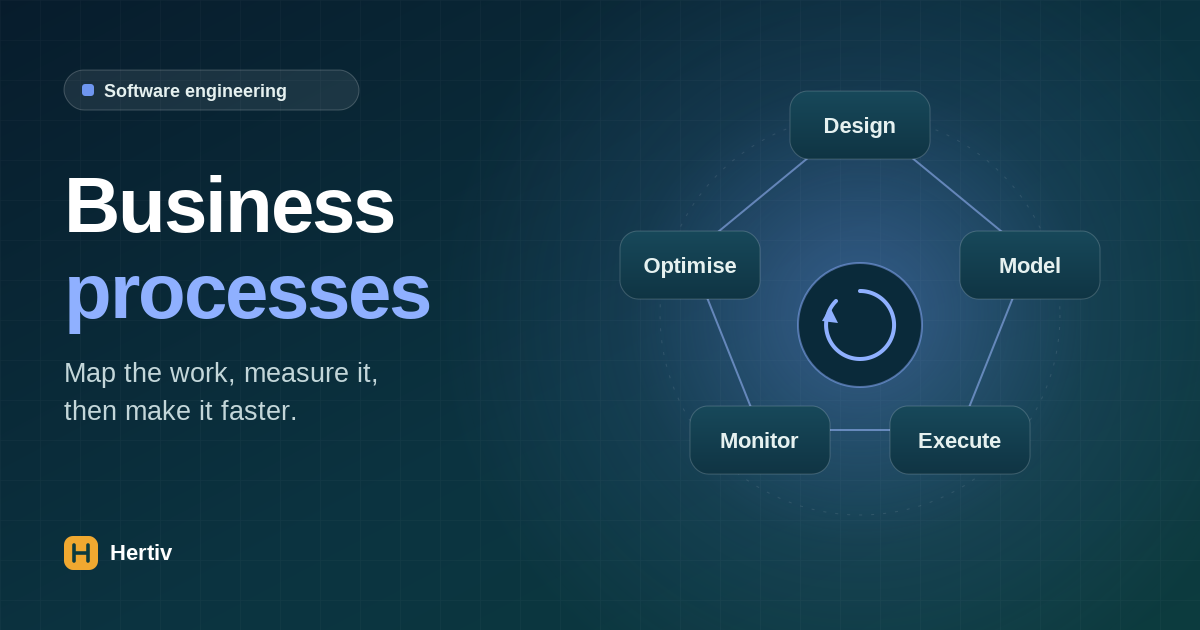
The BPM lifecycle has five stages: design, model, execute, monitor and optimise. Each stage feeds the next, and the cycle repeats as the process changes.
| Stage | What happens | What good looks like |
|---|---|---|
| Design | Agree what the process should achieve | One clear outcome and owner |
| Model | Draw the steps, decisions and handoffs | A map everyone can follow |
| Execute | Run the process with real work | Each step has a named owner |
| Monitor | Measure time, cost and errors per step | A dashboard, not a guess |
| Optimise | Change the slowest or most error-prone steps | One change at a time, measured |
Most teams skip the monitor stage and jump from execute to optimise, which means changes are based on opinion. Measure first, even with a simple spreadsheet of times per step, and the right change usually becomes obvious.
The cycle is meant to be short. A small process can go around the loop in a few weeks. A large one takes longer, but the same stages apply. The point is that improvement never stops; it just gets smaller and more targeted over time.
How is BPM different from workflow automation?
BPM is different from workflow automation because BPM is the discipline of understanding and improving a process, while workflow automation is one way of running it. Automation is a tool inside BPM, not a replacement for it.
Workflow automation moves work between people and systems according to rules: when a form is submitted, send it to the right approver; when it is approved, create the record. That is useful, but it only helps if the steps are the right ones. Automating a bad process just produces bad results faster.
BPM asks the questions automation cannot: should this step exist at all, who should own it, and what does good look like? A team doing BPM might remove three steps before automating the rest. A team that only automates will keep all of them.
The two work best together. Map and improve the process first, then automate the steps that are stable and repeatable. Steps that change often or need judgement should stay with people, with the system handling the routing and the record-keeping around them.
How do you start a BPM programme?
You start a BPM programme by picking one painful process, mapping it with the people who do the work, and measuring it before you change anything. A small win on one process earns the trust to do the next one.
- Pick one process. Choose something that hurts: slow, error-prone, or complained about. Invoice approval, onboarding and order handling are common first picks.
- Talk to the people who do it. Ask each person what they do, what they wait for, and what goes wrong. The map you draw from these talks will surprise you.
- Draw the map. Put the steps, decisions and handoffs on one page. Mark where work waits and where errors happen.
- Measure the baseline. Time ten real cases through the process. You need the before number to know if a change helped.
- Change one thing. Remove a step, clarify an owner, or move a check earlier. Measure the same ten cases again.
- Write it down and assign owners. A process with no owner drifts back to the old way within weeks.
Resist the urge to start with software. A whiteboard and a spreadsheet are enough for the first process. Buy tooling once you know which steps need it, not before. Teams that want help scoping the work can start with an AI readiness assessment or a process review before committing to a platform.
Example: fixing an invoice approval process
Example (hypothetical): a 120-person company takes nine days on average to approve an invoice. Suppliers complain, and the finance team cannot say where the time goes.
The team maps the process with accounts payable and the department heads. They find five steps: invoice arrives by email, it is printed and filed, the department head approves it when they see it, finance checks it against the purchase order, and payment is scheduled. The map shows the invoice waits in two places: in the email inbox before anyone files it, and on the department head's desk for approval.
They measure ten invoices. The work itself takes about 40 minutes per invoice; the waiting takes eight days. The fix is small: invoices go to a shared inbox with a named owner each day, and approvals move to a simple form with a two-day limit and a reminder. Nothing is automated yet.
After a month they measure again. Average approval time is three days, and the two-day approval limit accounts for most of the remaining time. The team now has a baseline and a map, so the next step, automating the form and the reminders, is a clear decision rather than a guess.
What are the common mistakes?
The most common BPM mistakes are mapping a process nobody follows, changing everything at once, and treating the project as finished once the map is drawn.
- Mapping the ideal, not the real. A map drawn in a meeting room rarely matches what people actually do. Talk to the people doing the work first.
- No owner. A process with no named owner has nobody to fix it when it breaks. Assign one person per process.
- Changing everything at once. Five changes at once make it impossible to know which one helped. Change one thing and measure.
- Skipping the baseline. Without a before number, every change looks like progress and none of it can be proven.
- Buying software first. A tool chosen before the process is mapped usually gets bent to fit the old way of working.
- Treating it as a project. Processes drift as people, products and rules change. Review each mapped process at least twice a year.
Key takeaways
- BPM is the discipline of mapping, running, measuring and improving repeatable work
- Most delay sits in handoffs and queues, not in the tasks themselves
- The lifecycle is design, model, execute, monitor, optimise — and it repeats
- Map and simplify a process before automating any of it
- One named owner per process, one change at a time, measured against a baseline
Frequently asked questions
What is the difference between BPM and business process reengineering?
Reengineering means redesigning a process from scratch, often with large changes. BPM is the ongoing discipline of improving processes step by step. Reengineering suits a process that is broken at its core; BPM suits the steady work of keeping processes fast and correct as a company changes.
Do I need BPM software to do business process management?
No. The discipline starts with a map, an owner and measurements, which need no software at all. Software helps once a process is stable and the volume justifies it, by routing work, reminding owners and recording what happened. Buy it after the map, not before.
How long does it take to see results from BPM?
A single process often improves within a few weeks of being mapped and measured, because the map alone reveals waiting time nobody had seen. Larger programmes take months, but each process should show a measured improvement before the next one starts.
Who should own a business process?
One named person who does the work or manages the team that does it, not a committee. The owner keeps the map current, watches the measurements and decides on changes. Without an owner, a process drifts back to the old way within weeks.
How do you measure a process?
Track time per step, total time from start to finish, error rate and rework. Time ten real cases before any change to get a baseline, then measure the same way after. A simple spreadsheet of start and finish times per step is enough to begin.
Can small companies benefit from BPM?
Yes, and often more than large ones, because a small team feels every delay directly. Start with one process, map it on a page, and measure it. The habit of mapping and measuring matters more than the size of the company.


