What Is AutoGPT, and How Does It Work?
AutoGPT is an open source agent that takes a goal, breaks it into tasks and runs them in a loop using a language model, web search and files.
On this page
Short answer
AutoGPT is an open source AI agent that takes a goal in plain language, breaks it into smaller tasks, and works through them on its own using a large language model, web browsing, files and other tools. It runs in a loop, checking its own results and choosing the next step, while a human reviews what it does.
What is AutoGPT?
AutoGPT is an AI agent, not a chatbot. A chatbot answers one message at a time and waits for the next one. AutoGPT takes a goal such as "research this market and write a summary" and keeps working on it, step by step, until it decides the goal is done or it runs out of steps.
It was released as an open source project in 2023 and became one of the best-known examples of the agent pattern.
The agent works by combining a large language model with tools. The model does the thinking: it plans, writes and judges results. The tools do the doing: searching the web, reading files, writing files and running code. A short memory holds the current task, and a longer memory keeps notes across steps so the agent does not forget what it already found.
AutoGPT is best understood as a demo of an idea, not a finished product. It shows what an agent can do, and it also shows the limits: agents are slow, they make mistakes, and they need a human watching. That is why most teams that use the idea today build smaller, narrower agents for one job instead of a general agent for everything.
How does AutoGPT work, step by step?
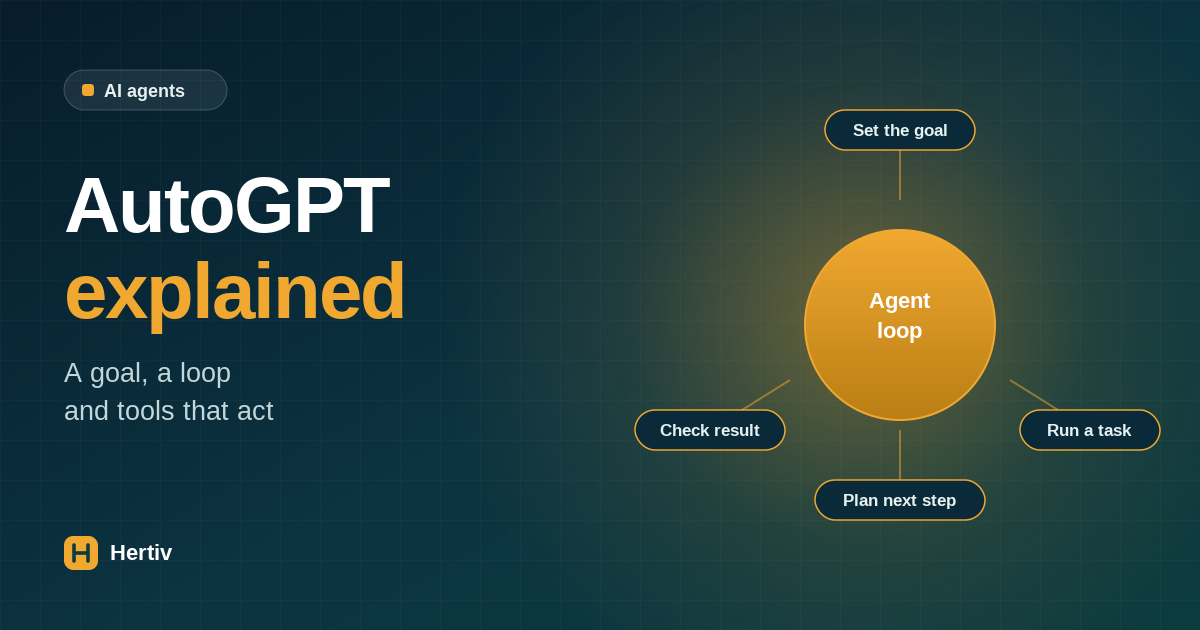
AutoGPT works in a loop with four stages: plan, act, observe and replan. The loop repeats until the goal is reached or the step limit is hit, and each round uses the results of the last one.
- Set the goal. You write a goal and a few rules, such as a budget or a list of sites it may not visit.
- Break it into tasks. The model turns the goal into a short task list, for example search, read, compare, write.
- Run the first task. The agent picks a tool, such as web search or file writing, and runs it.
- Check the result. The model reads what came back, judges whether it helped, and updates its notes.
- Choose the next task. It picks the next task from the list, or writes a new one if the plan changed.
- Stop or ask for help. It stops when the goal is done, and it should stop and ask a human when it is stuck or about to spend money.
The loop is simple, which is both its strength and its weakness. A simple loop is easy to follow and debug, but it can also wander: a bad early result can send the agent down a wrong path for many steps. Good agent setups keep the task list short and check the results often.
What can AutoGPT do, and what can it not do?
AutoGPT is good at open-ended research jobs where the steps are not known in advance. It can search the web, collect facts, compare options and draft a summary. It is also useful for repetitive online chores that follow a pattern, such as gathering links or checking pages, as long as a human reviews the output before it is used.
It is weak at jobs that need exactness. It can misread a page, quote a number wrong, or invent a detail when a search comes up empty. It is also slow and costly compared with a simple script, because every step calls a large model. And it should never be given access to money, private accounts or systems it can change without approval.
| Job | Good fit? | Why |
|---|---|---|
| Web research and summaries | Yes | Steps vary and the model can adapt |
| Comparing products or options | Yes | Search, read and compare in a loop |
| Drafting from public sources | Yes | Writing is the model's strength |
| Exact numbers or prices | No | Easy to misread or invent |
| Spending money or changing systems | No | Too risky without human approval |
| Private or sensitive data | No | Data leaves your machine with each call |
How do you set up AutoGPT safely?
AutoGPT runs on your own machine or server, and it needs an API key for a language model plus keys for any tools you enable. The setup is a developer task: install the code, add the keys, set the goal, and run it with a step limit so it cannot loop forever.
Safety comes from limits, not from trust. Give the agent read-only tools where you can, and keep write access, payments and account changes off limits. Set a low step limit for the first runs, watch the log as it works, and check the output file before you use it. Most problems come from agents that were given too much access and too little supervision.
If you only want to try the idea, run it on a small, harmless goal first, such as researching a public topic and writing a summary. That shows you how the loop behaves and where it goes wrong, without risking anything that matters. Building a small proof of concept first is the same approach: test the idea small, then decide whether to invest more.
Example (hypothetical): researching three tools with AutoGPT
Suppose a small team wants a short comparison of three project tools and gives AutoGPT the goal: "Compare three project tools for a team of ten and write a one-page summary." They set a limit of 20 steps and tell it to use only public pages and to save the result to a file.
The agent searches for the tools, reads their feature pages, and notes the main differences in a file. After 12 steps it has a draft with a small table. A team member reads it and finds two errors: one price is from an old page, and one feature is listed for the wrong plan. They fix both in ten minutes and use the summary.
The arithmetic of the run is simple: 12 steps at about 30 seconds each is about 6 minutes of run time, and each step calls the model once, so the run costs a handful of model calls. The human check took 10 minutes. The lesson is that the agent saved the searching and drafting time, but the checking time stayed, and the checking is what kept the result honest.
What are the common mistakes?
The most common mistake is giving AutoGPT a vague goal. "Research AI" is not a goal; "list five AI note tools with their main feature and price page" is. A vague goal produces a long, wandering run and a summary that says little. Write the goal the way you would write a brief for a new team member.
Another mistake is letting the agent run without a step limit. Without one, a stuck agent can loop for hours and run up a large model bill. Set a low limit, watch the first runs, and raise the limit only when the agent proves it can finish cleanly.
A third mistake is trusting the output without checking it. Agents sound confident even when they are wrong, and a summary with one wrong price or one invented feature can do real damage if it reaches a customer. Treat every agent output as a draft, and check the facts that matter before you use it.
Where does AutoGPT fit today?
AutoGPT's main legacy is the pattern it popularised: a model in a loop with tools and memory. Most production agents today are narrower than AutoGPT. They handle one job, such as answering support tickets or triaging documents, with a fixed set of tools and clear rules about what they may change. That narrow scope is what makes them reliable enough to trust.
If you want to learn how agents work, AutoGPT is still a useful study project. Read the code, run it on a safe goal, and watch the loop.
If you want an agent for real work, start from the job, not from the demo: define one task, pick the smallest set of tools it needs, and add a human check before anything leaves the system. Testing an AI system before launch matters even more for agents, because their behaviour changes with each run.
Key takeaways
- AutoGPT is an agent that works through a goal in a loop: plan, act, check, replan.
- It is good for open-ended research and drafting, and weak at exact numbers and risky actions.
- Set a step limit, give it read-only tools where possible, and watch the first runs.
- Every output is a draft: check the facts that matter before you use it.
- Most production agents today are narrower than AutoGPT, with one job and clear rules.
Frequently asked questions
Is AutoGPT free?
AutoGPT itself is open source and free to download, but it calls a language model for every step, and those calls are billed by the model provider. A short run costs little, while a long run with no step limit can cost far more than expected.
Does AutoGPT need coding skills?
Setting it up does: you install the code, add API keys and run it from a terminal. Using it needs no coding, since you only write the goal. If you want to change the tools or add new ones, you will need to edit the code.
What is the difference between AutoGPT and ChatGPT?
ChatGPT answers one message at a time and waits for you. AutoGPT takes a goal and keeps working through tasks on its own until it finishes or hits its step limit. The difference is the loop: AutoGPT plans and acts without waiting for a new message.
Can AutoGPT browse the web?
Yes, when web search is enabled it can search and read pages as part of its task list. It can misread pages and quote old information, so any facts it finds should be checked against the source before you rely on them.
Is AutoGPT safe to use?
It is safe when it runs with limits: a step limit, read-only tools where possible, and no access to money or private accounts. It is risky when given broad access and left unsupervised, so watch the first runs and check the output.
Do companies use AutoGPT in production?
Very few run AutoGPT itself in production. Most teams use the same loop pattern in narrower agents built for one job, with fixed tools and a human check before anything is sent or changed.


