What Is Aptos? The Move Blockchain Explained
Aptos is a Layer 1 blockchain built by former Meta engineers around the Move language and parallel execution. Here is how it works and who it fits.
On this page
Short answer
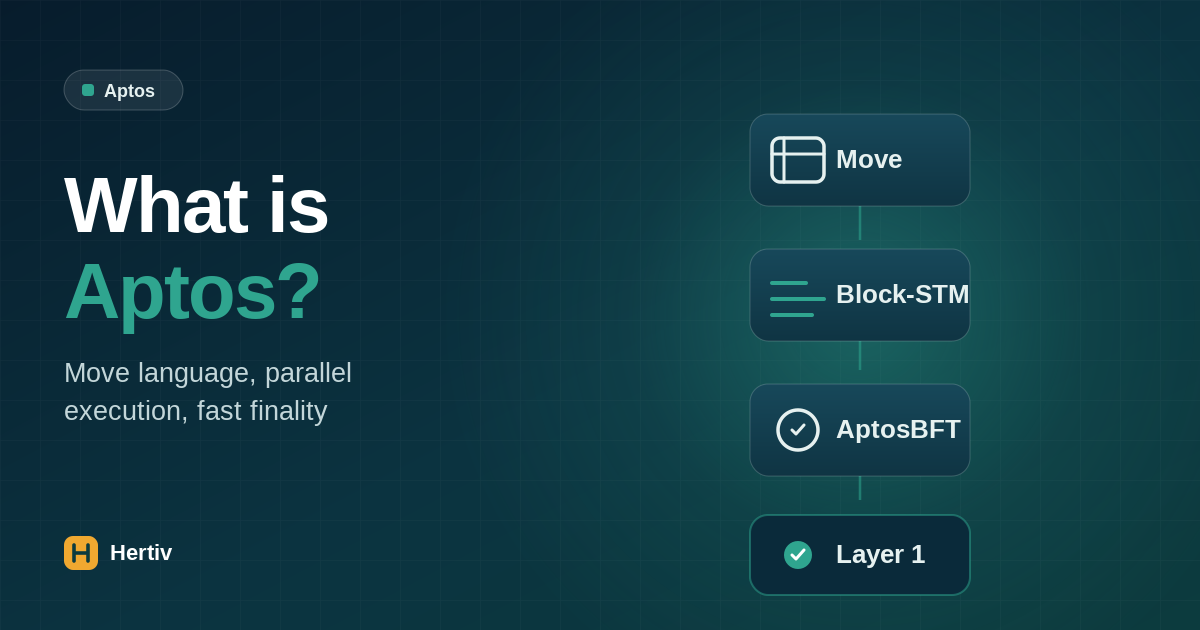
Aptos is a Layer 1 blockchain that runs smart contracts in the Move programming language, processes transactions in parallel with an engine called Block-STM, and reaches agreement with AptosBFT consensus on proof of stake. It launched its mainnet in October 2022, built by former engineers from Meta's Diem project. Developers use it for DeFi, payments, gaming and tokenised assets.
What is Aptos?
Aptos is a Layer 1 blockchain that runs smart contracts in the Move programming language, processes transactions in parallel, and reaches agreement with AptosBFT consensus on proof of stake. It launched its mainnet in October 2022, built by former engineers from Meta's Diem project.
The team behind Aptos, Aptos Labs, was founded in 2021 by Mo Shaikh and Avery Ching, who had led blockchain work at Meta. When Meta shut down Diem, the team carried the technology forward into a public chain. That origin matters, because Aptos inherits years of research into safe smart contracts and fast consensus.
Aptos is a general-purpose chain. Developers build DeFi apps, payments, games and tokenised assets on it, and users hold its native token, APT, to pay fees and stake. For a direct comparison with its closest rival, see Aptos vs Sui.
How does Aptos work?
Aptos works by splitting transaction processing into three parts: consensus, execution and storage, each running in parallel where possible. Transactions are ordered by AptosBFT, executed by the Block-STM engine, and stored in a versioned database that keeps the full history.
| Part | What it does | Why it matters |
|---|---|---|
| Move language | Runs smart contracts safely | Stops common asset bugs |
| Block-STM | Executes transactions in parallel | Higher throughput |
| AptosBFT | Orders transactions by consensus | Fast, final agreement |
| Proof of stake | Validators stake APT to secure the chain | Energy-efficient security |
Block-STM is the part that sets Aptos apart from most chains. It runs transactions in parallel and re-runs only the ones that conflict, instead of processing every transaction one after another. Validators stake APT tokens to take part in consensus, and the chain upgrades through on-chain governance without hard forks. See what is blockchain for the basics behind these parts.
What is the Move language, and why does it matter?
Move is a programming language first developed for Meta's Diem project, designed to make digital assets safer to program. Its core idea is that assets are resources: a token cannot be copied by accident, lost by a bug, or spent twice, because the language enforces those rules at the level of the code.
That matters because most smart contract failures come from asset handling, not from cryptography. A contract that moves tokens the wrong way can drain a pool in one transaction. Move's resource model makes that class of bug harder to write, and its formal verification tools let developers prove key properties of a contract before it is deployed.
Move is also used by Sui, Aptos's closest rival, but the two chains have built different dialects. Aptos keeps closer to the original Diem Move, with an account-based model, while Sui uses an object-based model. Developers moving between the two need to learn the differences, not just the shared name.
What can you build on Aptos?
You can build the same kinds of apps on Aptos as on other Layer 1 chains: DeFi, payments, games, NFT marketplaces and tokenised assets. The chain's pitch is that these apps run faster and with fewer asset bugs than on older chains, thanks to parallel execution and Move.
| Use case | What runs on Aptos | Why Aptos fits |
|---|---|---|
| DeFi | Exchanges, lending, stablecoins | Parallel execution for busy markets |
| Payments | Wallets, remittances, micropayments | Low fees and fast finality |
| Gaming | In-game assets and marketplaces | Fast transactions for many players |
| Tokenised assets | Funds, real estate, collectibles | Move's safe asset handling |
The ecosystem is still younger than Ethereum's, so the tooling and the number of live apps are smaller. A team choosing Aptos is betting on the technology and the team behind it, not on the size of the ecosystem today. For the developer view, see how to build a dApp on Aptos.
How does Aptos compare with other Layer 1 chains?
Aptos compares with other Layer 1 chains on three points: how it executes transactions, how it handles assets, and how it upgrades. Against Ethereum, it offers parallel execution and lower fees, but a smaller ecosystem. Against Solana, it offers similar speed with a different safety model, built around Move rather than Rust.
The closest comparison is Sui, which shares the Move origin. The two differ in how they model data: Aptos uses accounts, like Ethereum, while Sui uses objects. That difference shapes how developers write contracts and how the chains parallelise work, even though both aim at the same high-throughput goal.
For most teams, the choice comes down to the ecosystem and the developers available, not the benchmark numbers. A chain with the developers you can hire and the tools you already know beats a faster chain you have to learn from scratch. The comparison with Sui covers the details in full.
Example (hypothetical): a payments team picks a chain
Example (hypothetical): a payments team wants to move 10,000 small payments a day between users in three countries, and needs each payment to settle in seconds.
The team estimates fees first. At 0.2 cents per transaction, 10,000 payments a day cost about 20 dollars a day, or about 600 dollars a month. That is low enough that fees are not the deciding factor, so the team looks at finality and tooling instead.
The team builds a small pilot on Aptos and one on another chain, moving 1,000 test payments on each. The Aptos pilot settles each payment in under two seconds, and the Move contract handles the payment logic in about 80 lines of code. The team picks Aptos for the pilot, but keeps the payment logic in a separate module, so the product can move chains later if the ecosystem shifts.
What are the common mistakes?
The most common mistakes are treating Aptos and Sui as the same chain, trusting benchmark speed numbers as production speed, and building on a young ecosystem without a fallback plan.
- Confusing Aptos with Sui. Both use Move, but their data models and dialects differ. Code written for one does not run unchanged on the other.
- Trusting benchmark numbers. Test benchmarks show what a chain can do in a lab, not what it does under real load with real users.
- Ignoring the ecosystem size. A young ecosystem means fewer tools, fewer auditors and fewer developers to hire.
- Skipping the audit. Move reduces some bugs, but it does not remove the need for a contract audit before mainnet.
- Locking into one chain. Keep the business logic separate from chain-specific code, so the product can move if it needs to.
Key takeaways
- Aptos is a Layer 1 chain built from Meta's Diem technology, launched in October 2022
- Block-STM runs transactions in parallel and re-runs only the ones that conflict
- Move treats assets as resources that cannot be copied or spent twice by accident
- Aptos and Sui share Move origins but differ in data model and dialect
- Judge a chain by your own workload, not by benchmark numbers
Frequently asked questions
What is Aptos in simple terms?
Aptos is a Layer 1 blockchain for building apps such as DeFi, payments and games. It runs smart contracts in the Move programming language, processes transactions in parallel, and launched its mainnet in October 2022. It was built by former engineers from Meta's Diem project.
What is the Move programming language?
Move is a language first developed for Meta's Diem project, designed to make digital assets safer to program. Assets are treated as resources that cannot be copied by accident or spent twice. It also has tools that let developers prove key properties of a contract before deploying it.
How is Aptos different from Ethereum?
Aptos processes transactions in parallel with Block-STM, while Ethereum processes them one after another, so Aptos aims for higher throughput and lower fees. Ethereum has a far larger ecosystem, more tools and more developers. The trade-off is speed against ecosystem size.
How is Aptos different from Sui?
Both chains come from the Move language and Meta's Diem work, but they model data differently. Aptos uses an account-based model like Ethereum, while Sui uses an object-based model. Their Move dialects have also diverged, so code written for one does not run unchanged on the other.
What is the APT token used for?
APT is the native token of the Aptos chain. Users pay transaction fees in APT, and validators stake APT to take part in consensus and help secure the network. Token holders can also take part in on-chain governance, which decides chain upgrades.
Is Aptos a good chain to build on?
It depends on the project. Aptos offers parallel execution, Move's safety features and fast finality, but its ecosystem is younger and smaller than Ethereum's. Test it with a small pilot on your own workload, and keep the business logic separate from chain-specific code.


