What Is AI Hallucination, and Why Does It Happen?
An AI hallucination is a confident answer that sounds right but is wrong. Models predict likely words, not facts, so they can invent details.
On this page
Short answer
An AI hallucination is a confident, fluent answer from an AI model that sounds right but is factually wrong. It happens because a language model predicts the most likely next words from patterns in its training, rather than checking a fact against a source. The result can be an invented date, name, quote or rule.
What is AI hallucination?
AI hallucination is the name for a confident answer from an AI model that is wrong. The model writes in a smooth, certain tone, so the answer looks trustworthy, but the facts in it may be invented. It can invent a study, a price, a law or a person's words.
The key point is that the model is not lying. It has no intent and no idea whether its words are true. It is predicting which words are most likely to follow, based on patterns in the text it was trained on. When it does not know the answer, it often fills the gap with something plausible.
| Type | What it looks like | Example |
|---|---|---|
| Invented facts | A detail that was never true | A made-up product price |
| Invented sources | A citation that does not exist | A fake study or article link |
| Wrong details | Real topic, wrong numbers | A wrong date or amount |
| Mixed-up names | Two real things confused | One person's quote given to another |
Hallucinations are easy to miss because the writing is fluent and the wrong detail is often small. That is why a check matters more than the tone of the answer. To see how teams cut them down, read how to reduce LLM hallucinations.
Why do AI models hallucinate?
AI models hallucinate because they are trained to predict words, not to verify facts. A language model learns which words tend to follow other words, and it uses those patterns to write. When a question touches a rare topic or a detail it never saw, the model still has to produce an answer, so it guesses.
Training data also has gaps. The model may have seen many articles about a topic but not the exact detail you asked for, so it fills the gap with the most likely sounding version. Dates, numbers and names are the most fragile, because a small change in a number still reads as normal text.
Long answers make it worse. Each sentence the model writes becomes part of the context for the next one, so an early invented detail can shape the rest of the answer. The model has no separate fact-checking step unless one is built into the system around it.
How can you spot a hallucination?
You can spot a hallucination by checking the specific claims, not the style. A fluent answer with precise numbers, dates and quotes is the most suspicious, because those are the details a model invents most easily. If an answer gives a number, a date or a name, check it against a source you trust.
Ask for the source and then open it. A real source should exist, say what the model claims it says, and come from a place you recognise. If the link does not open, the study cannot be found, or the quote is not in the source, the answer is likely wrong.
Ask the same question in a different way and compare the answers. If the model gives a different date, a different price or a different name each time, it is guessing. A fact that is stable across reworded questions is more likely to be grounded in something real.
What happens when a hallucination reaches users?
When a hallucination reaches users, it can cost money, trust and time. A support chatbot that invents a refund policy may promise money the company never agreed to pay. A sales assistant that invents a feature may sell a product that cannot do what was promised.
The damage is worse when the answer looks official. Users trust a well-written answer, especially when it comes from a company chatbot or an internal tool. If the wrong answer leads to a bad decision, the user blames the company, not the model.
Inside a team, a hallucination can waste hours. A developer who follows an invented API call, or a researcher who cites a fake study, has to redo the work once the error is found. That is why the cost of a hallucination is not just the wrong answer, but the work it creates afterwards.
How do teams reduce hallucinations?
Teams reduce hallucinations by grounding the model in their own sources. The most common method is retrieval: the system looks up the relevant documents first, then asks the model to answer only from those documents. That turns the model from a memory into a reader, and the answer can be checked against the source. For testing methods, see how to test AI models.
Teams also limit what the model may say. A support chatbot can be told to say it does not know when the answer is not in the documents, instead of guessing. That single rule removes many of the worst errors, because the model stops inventing when it has nothing to work from.
Testing matters too. A team can run a set of questions with known answers and count how many the model gets right, then fix the worst cases before launch. The test set should include the questions users actually ask, not only easy ones. For a grounding method, read what retrieval-augmented generation is.
Example (hypothetical): a support chatbot invents a refund policy
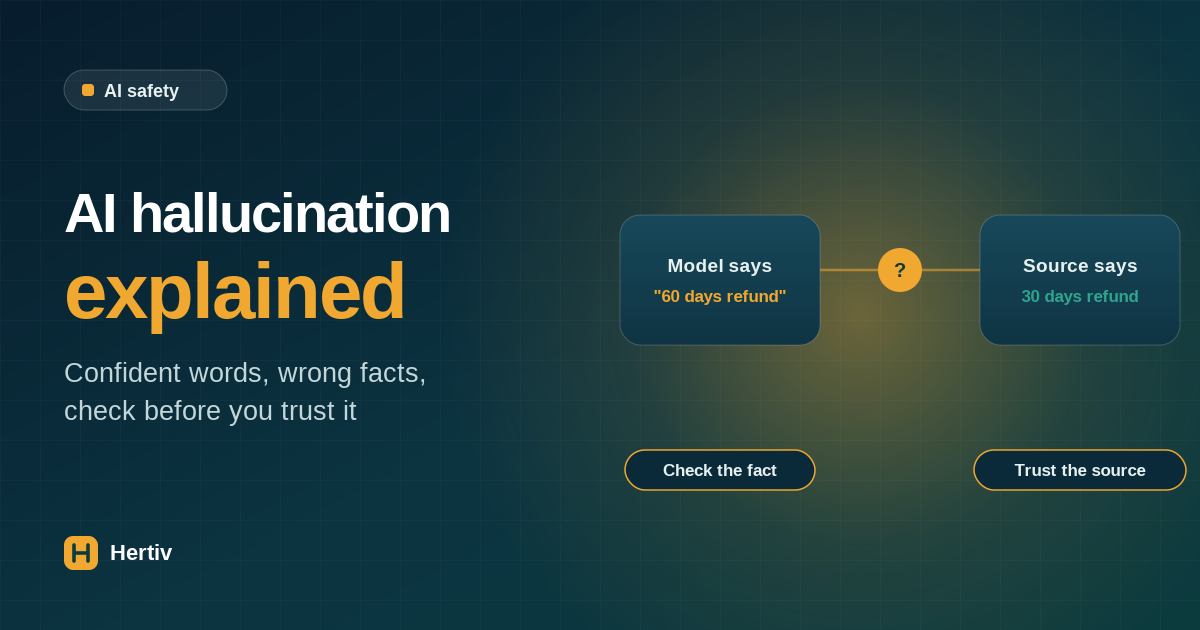
Example (hypothetical): a shop's support chatbot answers 300 questions a day. A customer asks about returns, and the chatbot replies that returns are free within 60 days. The real policy is 30 days, and only for unused items.
The team checks 100 answers from one week and finds 12 wrong ones, so about 1 in 8 answers has an error. Of the 12, 5 are about refunds and returns, 4 are about delivery times, and 3 are about product features. The team decides to ground the chatbot in its policy documents and add a rule: if the answer is not in the documents, the chatbot must say it does not know.
After the change, the team checks another 100 answers and finds 3 wrong ones, down from 12. The 3 remaining errors are all about delivery times, so the team fixes the delivery page and adds it to the chatbot's sources. The arithmetic shows the point: grounding cut errors from 12 in 100 to 3 in 100, a drop of three quarters.
What are the common mistakes?
The most common mistakes with AI hallucination are trusting fluent answers, skipping checks, and treating the model as a source of facts.
- Trusting the tone. A confident, smooth answer is not evidence that the facts are right.
- Skipping the check. Numbers, dates and quotes need a source, even when the answer looks clean.
- No grounding. A chatbot that answers from memory alone will invent details; give it documents to read.
- No fallback. If the model cannot say it does not know, it will guess instead.
- Testing too little. A few easy questions do not prove the model is safe for the questions users actually ask.
Key takeaways
- A hallucination is a confident answer that is factually wrong
- Language models predict likely words, not facts, so they can invent details
- Check numbers, dates and quotes against a source you trust
- Grounding the model in your own documents cuts errors sharply
- Let the model say it does not know when the answer is not in its sources
Frequently asked questions
How common are AI hallucinations?
It depends on the task and the setup. A model answering from its own memory will invent details often, especially on rare topics, while a model that reads from your documents and says it does not know when the answer is missing will make far fewer errors. Test with your own questions before you trust the answers.
Can you stop hallucinations completely?
No. Any model that writes freely can invent a detail, so the goal is to reduce errors and catch the ones that slip through. Grounding, a do-not-know rule, human review for high-risk answers and regular testing together bring errors down to a level most teams can manage.
Are hallucinations the same as bias?
No. A hallucination is a wrong fact, while bias is a slant in how the model treats people or topics. Both matter, but they need different fixes: hallucinations need grounding and checks, while bias needs better data, testing and review of the answers.
Do bigger models hallucinate less?
Bigger models often know more, so they guess less on common topics, but they can still invent details on rare topics and they still write with the same confidence. Size helps, but it does not replace grounding, testing and a rule that lets the model say it does not know.
Should I let an AI chatbot answer customer questions?
Yes, if the answers are grounded in your own documents and checked before launch. Start with low-risk questions, test with real customer wording, and route high-risk topics to a person. Keep a log of wrong answers and fix the sources that caused them.
What is the fastest way to cut hallucinations?
Ground the model in your documents and add a rule that it must say it does not know when the answer is not there. Those two steps alone remove most invented facts, and they are cheaper than rebuilding the model or writing a long list of rules.


