What Is Agentic RAG, and How Does It Work?
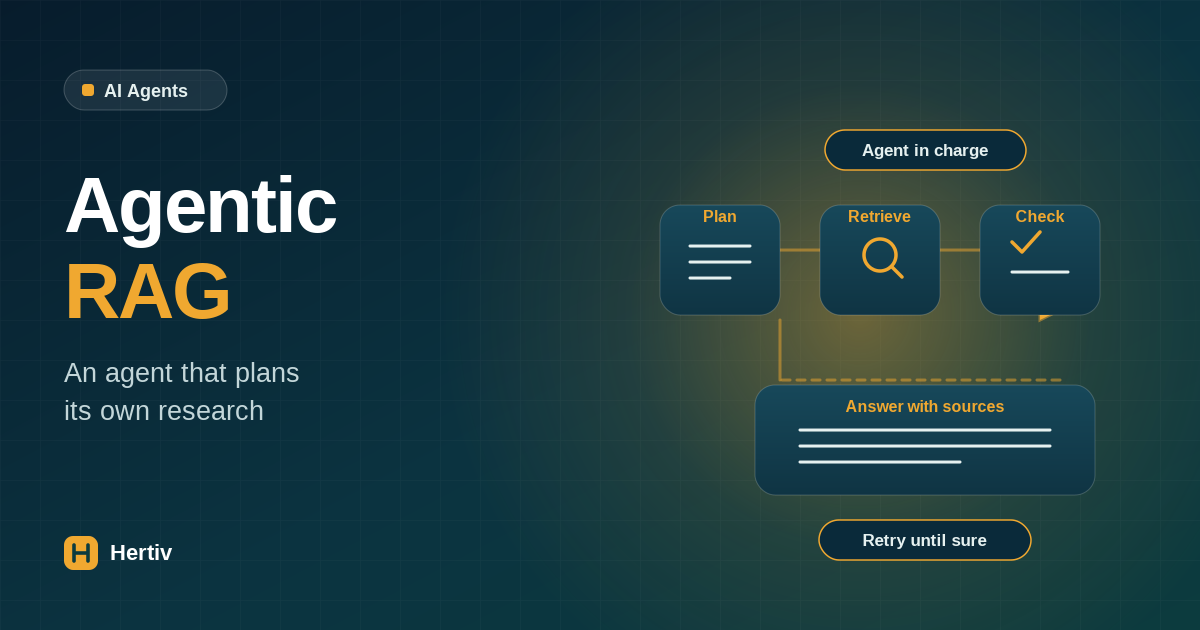
Agentic RAG is retrieval-augmented generation with an agent in charge. The agent plans the search, checks the results and then answers, which suits hard questions.
On this page
Short answer
Agentic RAG is retrieval-augmented generation run by an AI agent instead of a fixed pipeline. The agent plans what to search for, reads the results, decides whether they are enough, and searches again or uses a tool when they are not. It answers only when it has what it needs, which makes it better than plain RAG for questions that need several steps.
What is agentic RAG?
Agentic RAG is retrieval-augmented generation with an AI agent in charge of the search. In plain RAG, a question is turned into a search, the top documents are fetched, and a model writes an answer from them. In agentic RAG, an agent runs that loop: it plans the search, reads what comes back, judges whether it is enough, and tries again or calls a tool when it is not.
The difference is judgement. Plain RAG follows the same steps for every question. Agentic RAG changes its plan based on what it finds. If the first search returns nothing useful, it rewrites the query. If the question needs a number from a database and a paragraph from a document, it fetches both and combines them.
| Point | Plain RAG | Agentic RAG |
|---|---|---|
| Who plans | Fixed pipeline | The agent, per question |
| Searches | One, then answer | As many as needed |
| Tools | Usually none | Search, databases, APIs |
| Checking | Rarely | The agent checks its own work |
| Best for | Simple fact questions | Multi-step research |
For the plain version first, see what retrieval-augmented generation is.
How does agentic RAG work?
Agentic RAG works as a loop: plan, search, read, check, and either answer or repeat. The agent starts by breaking the question into parts and deciding what it needs to find. It then searches the document store, reads the top results, and asks itself whether they actually answer the question.
If the answer is yes, it writes a reply grounded in the sources it found. If the answer is no, it changes the search — different words, a different source, a tool call — and tries again. Most systems cap the number of tries, so a question that cannot be answered ends with a clear "I could not find that" instead of a guessed answer.
The loop is what makes it agentic. The agent is not following a fixed script; it is making small decisions at each step, and those decisions are logged so a team can see what the agent did and why. That log is also how you debug it when the answer is wrong.
What tools does an agentic RAG system use?
An agentic RAG system uses four kinds of tools: search, document stores, databases and outside services. Search finds text in documents; a vector store finds passages by meaning rather than exact words. Databases answer questions with numbers, such as a price or a stock level. Outside services, reached through APIs, fetch live data such as an order status or a timetable.
The agent picks tools by the question. A question about a policy needs the document store. A question about an order needs the database. A question that needs both gets both, and the agent combines the results. The tools are described in plain language so the model can choose the right one and pass it the right inputs.
Guardrails sit around the tools. The agent may only call the tools it is allowed to use, may only read the data its user may see, and may not take actions such as refunds or cancellations without a human check. A customer-service deployment shows this in practice: see how to deploy agentic RAG for customer service.
Where does agentic RAG help most?
Agentic RAG helps most where questions need more than one source or more than one step. Customer support is the classic case: a customer asks why a delivery is late, and the answer needs the order record, the delivery policy and the tracking status. A fixed pipeline would fetch one of those and guess; an agent fetches all three.
Research and analysis are another fit. An analyst asking for a comparison across several reports needs the agent to read each one, pull the right figures and combine them. Internal knowledge search is a third: employees asking questions that span handbooks, tickets and wikis, where no single document has the full answer.
It helps least for simple, single-fact questions. If the answer is one sentence in one document, plain RAG is faster, cheaper and easier to test. Agentic RAG earns its complexity only when the question genuinely needs planning, several searches or a tool call. For an ecommerce example, see agentic RAG in ecommerce.
How to build an agentic RAG system, step by step
You build an agentic RAG system by starting with one use case, a small set of sources and a fixed test set, then adding tools and steps only when the tests show you need them.
- Pick one use case. Choose a question type with a clear answer and a clear source, such as support questions about one product.
- Prepare the sources. Clean the documents, split them into passages and store them so the agent can search by meaning, not only by keyword.
- Write the test set. Collect 30 to 50 real questions with the correct answers, so you can measure whether the system improves.
- Build the first loop. Give the agent search and one tool, a limit on tries, and a rule to say it does not know when the sources are thin.
- Add guardrails. Limit which tools it may call, what data it may see and which actions need a human check.
- Measure and improve. Run the test set after every change, and log every agent step so you can see where it went wrong.
Resist adding tools early. Each new tool is a new way for the agent to fail, and a system with three tools that works beats a system with ten that does not. Hertiv's RAG development service follows the same test-first approach.
Example (hypothetical): a support team answers faster
Example (hypothetical): a support team receives 300 questions a day, each taking about 5 minutes to answer by hand. That is 300 times 5 minutes, or 25 hours of work a day. The team builds an agentic RAG system that reads the help centre, the order database and the delivery tracker.
After launch, the agent answers 200 questions directly, and a person reviews each answer for about 1 minute. That is 200 minutes, or about 3 hours and 20 minutes of review. The remaining 100 questions go to people and take the usual 5 minutes each, or 500 minutes, which is about 8 hours and 20 minutes. The total is 700 minutes, or about 11 hours and 40 minutes a day.
The saving is 25 hours minus 11 hours and 40 minutes, or about 13 hours and 20 minutes a day. The team uses the saved time on the hard cases the agent cannot handle, and the review step keeps the agent's answers grounded in real sources. The gain comes from the agent doing the searching, not from removing people.
What are the common mistakes?
The most common mistakes with agentic RAG are adding tools too early, skipping the test set, and letting the agent answer when it has no good source.
- Too many tools at launch. Each tool is a new failure mode. Start with search and one tool, and add more only when tests show you need them.
- No test set. Without fixed questions and correct answers, you cannot tell whether a change helped or hurt. Write the tests first.
- No limit on tries. An agent that can search forever will burn time and money. Cap the steps and end with a clear "I could not find that".
- Weak guardrails. An agent with access to everything will eventually read or change something it should not. Limit tools, data and actions from day one.
- Skipping the logs. Without a log of each agent step, you cannot debug a wrong answer. Log every search, tool call and decision.
Key takeaways
- Agentic RAG puts an agent in charge of the search, so it can plan, retry and use tools
- Plain RAG follows fixed steps; agentic RAG changes its plan based on what it finds
- It helps most for multi-step questions that need several sources or a database
- Build it test-first: one use case, a small source set and a fixed test set
- Cap the agent's steps, limit its tools and log every decision
Frequently asked questions
What is the difference between RAG and agentic RAG?
RAG follows a fixed pipeline: search once, then answer from what was found. Agentic RAG gives an agent control of that loop, so it can plan the search, read the results, search again, call tools and check its own work before answering. The agent adds judgement that a fixed pipeline cannot.
Is agentic RAG better than plain RAG?
It is better for hard, multi-step questions and worse for simple ones. Plain RAG is faster, cheaper and easier to test when the answer sits in one document. Agentic RAG earns its cost only when the question needs planning, several searches or a tool call.
Does agentic RAG hallucinate less?
It can, because the agent checks its sources and can search again when the first results are thin. But it can also go wrong in new ways, such as searching the wrong source or combining facts badly. A test set, source checks and human review are still needed.
What data does agentic RAG need?
It needs clean, searchable sources: documents split into passages, a database for numbers and live data through APIs where needed. The quality of the sources decides the quality of the answers, so clean the documents before you build the agent.
How do you test an agentic RAG system?
Write a fixed test set of real questions with correct answers, then run it after every change. Check whether the answer is right, whether it cites the right sources and how many steps the agent took. Log every step so you can see where a wrong answer came from.
Can agentic RAG take actions, such as refunds?
It can, but it should not do so without a human check. Let the agent prepare the action and show its reasoning, then let a person approve it. Actions that move money or change customer data should always pass through human review.


