What Is Account Abstraction, and Why Does It Matter?
Account abstraction turns a crypto wallet into a programmable smart contract, with social recovery, batched transactions and gas paid in tokens.
On this page
Short answer
Account abstraction is a way to make a blockchain account a programmable smart contract instead of a single private key. It lets wallets offer features such as social recovery, spending limits, batched transactions and gas fees paid in tokens, while keeping the same address. On Ethereum it is defined by the ERC-4337 standard.
What is account abstraction?
Account abstraction is a design that turns a blockchain account into a programmable smart contract, so the rules for who can spend and how are written in code rather than fixed by the protocol. A normal account is controlled by one private key; lose the key and the account is gone. A smart contract account can use different rules, such as several keys, a time lock or a recovery contact.
The idea is to separate the account from the key. Today, the key is the account: whoever holds it controls everything. Account abstraction moves that control into a contract, so a wallet can behave like a bank account with rules, rather than a single key with no safety net.
It matters because key loss and key theft are the main ways people lose crypto. A wallet that can be recovered through trusted contacts, or that limits how much can move in a day, removes the single point of failure that makes ordinary wallets unforgiving. For teams building wallets, see crypto wallet development.
How does account abstraction work?
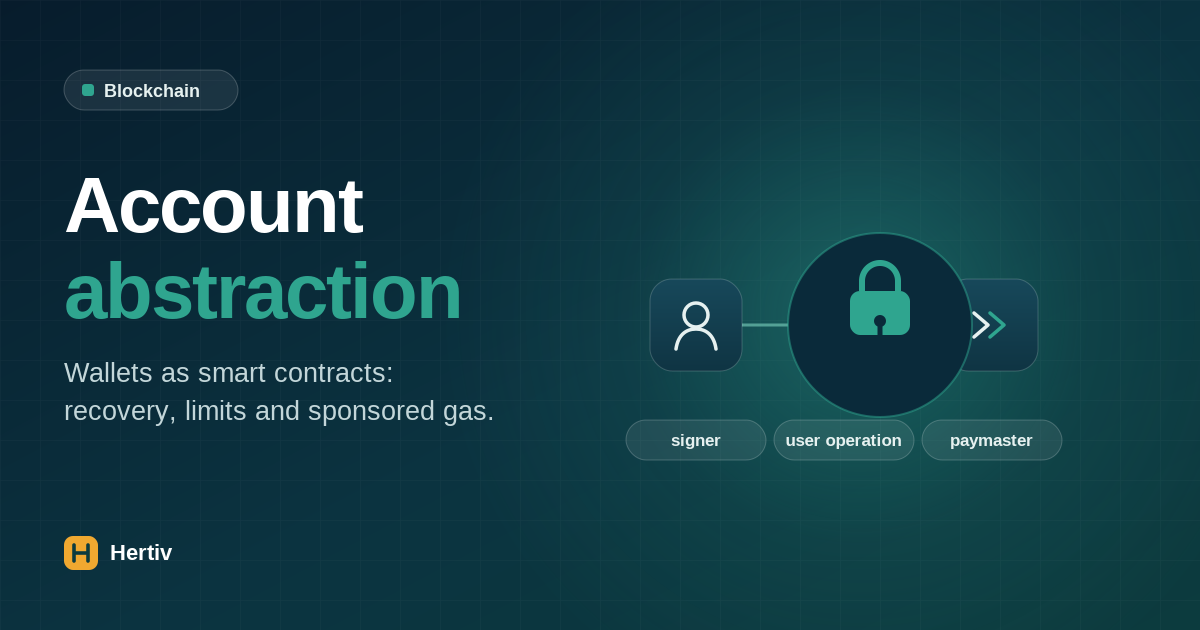
Account abstraction works by replacing direct transactions with user operations, which are bundled together and submitted to the chain by a separate service. The smart contract account then checks each operation against its own rules before executing it.
The flow on Ethereum, under the ERC-4337 standard, has four parts:
- User operation. The wallet builds an intent, such as "send 10 tokens", and signs it with whatever method the account allows, which can be a key, a passkey or a session key.
- Bundler. A service collects user operations from many wallets, packs them into one transaction and submits it to the chain.
- EntryPoint contract. A single contract on the chain receives the bundle, checks each operation against its account contract, and pays the gas.
- Paymaster. An optional contract that pays the gas on the user's behalf, or lets the user pay in a token instead of the chain's native currency.
The key point is that the chain itself does not need to change. ERC-4337 works on top of Ethereum as it is, which is why wallets could adopt it without waiting for a protocol upgrade.
| Feature | Normal account | Smart contract account |
|---|---|---|
| Controlled by | One private key | Code in a contract |
| Key lost | Funds are gone | Recovery through trusted contacts |
| Gas payment | Native token only | Any token, or sponsored |
| Transactions | One at a time | Several batched into one |
| Spending rules | None | Daily limits, allow lists |
What can a smart contract wallet do?
A smart contract wallet can do things a normal wallet cannot, because its rules are code. The most useful features are recovery, limits and automation, all of which make a wallet safer to use every day.
Social recovery is the headline feature. You name a few trusted contacts, and if you lose your key, a majority of them can approve a new key for the same account. The address stays the same, so nothing else needs to change.
Other features include daily spending limits, so a stolen session key can only move a small amount; batched transactions, so an approval and a swap happen in one step; and session keys, so a game or app can act on your behalf within strict limits and a short expiry. Paymasters can also sponsor gas, so a new user can try an app without first buying the chain's native token.
These features are already live in wallets on Ethereum and its layer 2 networks, and they are the reason account abstraction is often described as the path to wallets that ordinary users can actually use. What is Ethereum explains the network these wallets run on.
What is ERC-4337?
ERC-4337 is the Ethereum standard that defines how account abstraction works without changing the core protocol. It was published in 2023 and is now the standard that most smart contract wallets follow.
The standard defines the user operation format, the EntryPoint contract and the roles of bundlers and paymasters. Because it is a standard rather than a protocol change, any wallet, bundler or paymaster that follows it can work together, and apps do not need to know which wallet a user has.
Later work builds on ERC-4337. Native account abstraction, planned for future Ethereum upgrades, would move some of this logic into the protocol itself, which would lower costs and simplify wallets. Until then, ERC-4337 is the working version, and it already runs in production on mainnet and layer 2 networks.
What are the risks and limits of account abstraction?
Account abstraction has real risks, and they are different from the risks of a normal wallet. The main ones are contract bugs, bundler trust and cost.
A smart contract account is code, and code can have bugs. A bug in an account contract can lock funds or allow an unintended transfer, so wallets should use audited contracts and keep their logic simple. This is why smart contract development practices, including audits, matter for wallets as much as for DeFi apps.
Bundlers are a second concern. A bundler sees your user operations before they reach the chain, so it can in theory censor or reorder them. The design limits this by letting any bundler submit, and by letting users submit directly if needed, but a single dominant bundler would be a weak point.
Cost is the third limit. Smart contract accounts use more gas than normal accounts, because every operation runs contract code. On layer 2 networks the difference is small, but on mainnet it can be noticeable, which is why most account abstraction wallets are aimed at layer 2 first.
Example: a company wallet with recovery and limits
Example (hypothetical): a small company keeps its operating funds in a smart contract wallet with three managers. The wallet allows any two of the three to approve a payment, caps daily spending at 5,000 dollars, and names an external adviser as a recovery contact.
The wallet processes about 500 user operations a month. Each operation costs about 5 cents in gas on a layer 2 network, so the monthly gas cost is 500 times 0.05, which is 25 dollars. A paymaster sponsors gas for the team's app users, covering about 2,000 operations a month at the same 5 cents, which is 100 dollars a month.
When one manager loses a phone, the other two approve a new key for that manager, and the address stays the same, so no payment details change. The daily limit means that even if a session key is stolen, the most that can move in a day is 5,000 dollars, and the team can freeze the wallet while they investigate.
What are the common mistakes?
The most common mistakes are treating account abstraction as a magic fix, using unaudited account contracts, and ignoring gas costs.
- Assuming it removes all risk. Account abstraction moves risk from key loss to contract code. A bug in the account contract can be worse than a lost key, so audits and simplicity matter.
- Using unaudited contracts. Only use account contracts that have been audited and used in production. A custom account contract written for one project is a risk, not a feature.
- Ignoring gas costs. Smart contract accounts cost more per transaction. Measure the cost on the network you will actually use before promising users free transactions.
- Overcomplicating recovery. A recovery setup with too many contacts or too many steps will fail when it is needed. Test recovery before you rely on it.
- Trusting one bundler. If your wallet only works with one bundler, that bundler is a single point of failure. Support fallback submission.
Key takeaways
- Account abstraction turns a wallet into a programmable contract with its own rules
- ERC-4337 defines user operations, bundlers, the EntryPoint contract and paymasters
- Social recovery, spending limits, batched transactions and sponsored gas are the main gains
- Smart contract accounts cost more gas and carry contract risk, so use audited code
- Most account abstraction wallets run on layer 2 networks first, where gas is cheap
Frequently asked questions
Is account abstraction the same as a multisig wallet?
No, but they overlap. A multisig wallet is one kind of smart contract account, with several keys and a threshold. Account abstraction is the broader design that lets any account be a contract, with recovery, limits, batched transactions and sponsored gas as well as multisig rules.
Do I need a new address to use account abstraction?
No. A smart contract wallet has its own address, like any account, and you can keep using it once it is created. Existing normal accounts cannot be converted in place, so you move funds to the new account address.
Which chains support account abstraction?
Ethereum and its layer 2 networks support it through ERC-4337, and several other chains have native versions built into the protocol. Check the chain you use, because the standard and the tooling differ between networks.
Does account abstraction make wallets free to use?
No. Gas still has to be paid, either by the user in a token or by a paymaster that sponsors it. Sponsored gas is a business choice by the app or wallet, not a property of the standard itself.
Is account abstraction safe for large amounts?
It can be, if the account contract is audited, the recovery setup is tested and spending limits are set. Large holdings still deserve a cold wallet for the bulk of funds, with a smart contract wallet for day-to-day use.
What is a paymaster?
A paymaster is a contract that pays gas on behalf of a user, or accepts payment in a token other than the chain's native currency. Apps use paymasters to sponsor their users' first transactions, so a new user does not need to buy gas before trying the app.


