What Is a Pre-ICO and How Does It Work?
A pre-ICO is a private token sale held before a public ICO, usually at a lower price. This guide explains how it works and the risks buyers take.
On this page
Short answer
A pre-ICO is a private token sale that takes place before a project's public initial coin offering, usually to raise early funding from a small group of buyers. Tokens are normally sold at a lower price than the public sale, often with a lock-up period, and the money funds development, audits and marketing before the public launch.
What is a pre-ICO?
A pre-ICO is a private token sale that takes place before a project's public initial coin offering (ICO). A small group of early buyers purchases tokens at a set price, usually below the price planned for the public sale, and the project uses the money to finish building, pay for security audits and prepare its public launch.
Pre-ICO buyers are usually funds, early supporters or people connected to the project team. The sale is not open to the general public, and the minimum purchase is often higher than in a public sale. In return for buying early, buyers accept that the tokens may be locked for months and that the project may never reach a public sale.
The pre-ICO is one stage in a token launch, not a separate kind of token. A project may run a private round, then a pre-ICO, then a public ICO, or it may skip a stage. If you are planning a launch, a guide to how to launch an ICO covers the full sequence from idea to public sale.
How is a pre-ICO different from an ICO?
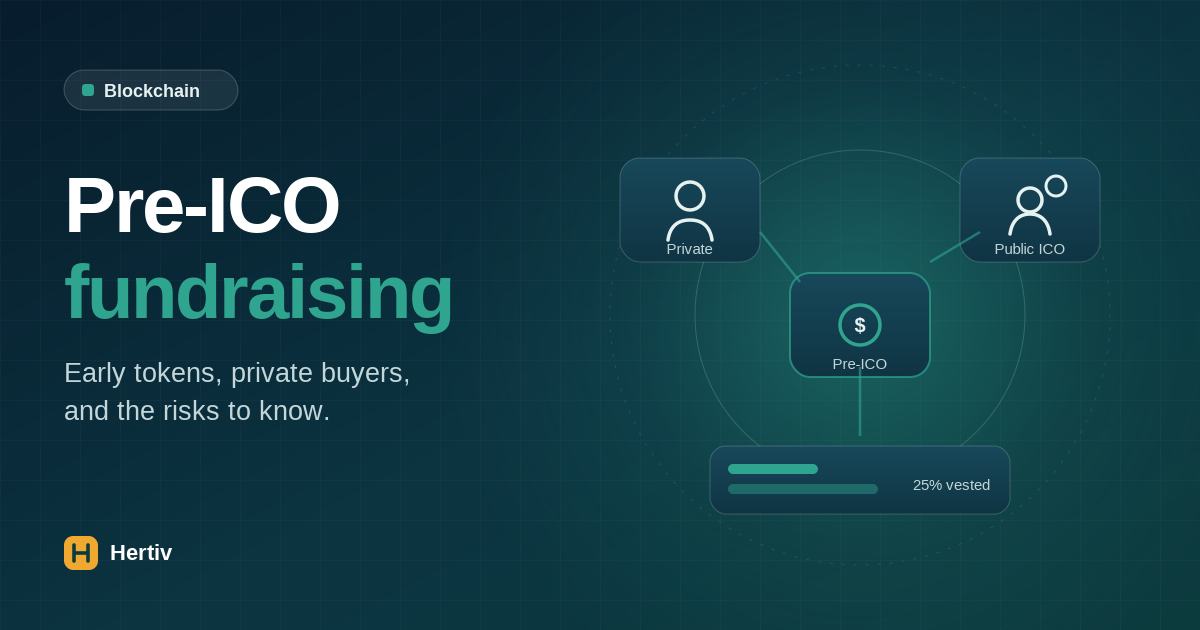
The main differences between a pre-ICO and an ICO are the audience, the price and the terms. A pre-ICO is private and early, while an ICO is public and later. Both sell the same token, but the deals around them are very different.
| Feature | Pre-ICO | Public ICO |
|---|---|---|
| Who can buy | Selected early buyers | Anyone who meets the rules |
| Token price | Usually lower, often discounted | Set public price |
| Minimum purchase | Often high | Usually low or none |
| Lock-up | Common, months long | Often none |
| Marketing | Private, word of mouth | Public campaign |
| Purpose | Early funding and testing demand | Wide distribution and funding |
The discount is the reason buyers accept the lock-up and the risk. A token bought at a lower price is worth more if the public price holds, but the buyer cannot sell while the lock-up lasts. That trade-off is the core of the pre-ICO deal.
How does a pre-ICO work, step by step?
A pre-ICO follows a short sequence: set the terms, find buyers, collect payment, lock the tokens, then deliver them. Each step should be written down before any money moves.
- Set the token supply and price. Decide how many tokens the pre-ICO sells, at what price, and how much of the total supply that represents.
- Write the terms. Define the minimum purchase, the discount against the public price, the lock-up schedule and what happens if the public sale never happens.
- Find and check buyers. Approach funds and early supporters directly, and run the identity checks your jurisdiction requires.
- Collect payment. Buyers usually pay in a major cryptocurrency or a stablecoin to a wallet the project controls.
- Lock the tokens. Use a smart contract that releases tokens on the agreed schedule, so the team cannot change the deal later.
- Deliver and report. Send tokens as they vest and keep buyers informed about development and the public sale date.
Smart contracts matter here. A vesting contract that releases tokens on a fixed schedule gives buyers a reason to trust the terms. A project that holds all tokens in a plain wallet and promises to send them later is asking buyers to trust a promise instead of code.
Why do projects run a pre-ICO?
Projects run a pre-ICO to raise money early, test demand and build a base of committed holders before the public sale. Early money pays for the work that makes a public sale credible, such as audits, a working product and legal advice.
A pre-ICO also gives the team a price signal. If early buyers accept the terms, the team has evidence that the public sale may work. If buyers refuse, the team learns that the price or the story needs work before spending money on a public campaign.
There is a marketing benefit too. Early buyers have a reason to talk about the project, because their tokens gain value if the public sale succeeds. That attention can help, but it is not a substitute for a working product. A pre-ICO that raises money for a project with no plan beyond the sale rarely ends well.
What do buyers get, and what are the risks?
Buyers get tokens at a lower price than the public sale, plus early access to a project they believe in. The discount is the reward for taking on risk that public buyers do not face, and the lock-up is the price of that discount.
The risks are real. The project may never launch, the public price may fall below the pre-ICO price, or the tokens may have no buyer when the lock-up ends. Some pre-ICOs are outright scams: a team collects money and disappears, or sells tokens that were never meant to exist.
- Project failure. Most early-stage crypto projects do not reach a working product.
- Illiquidity. Locked tokens cannot be sold, even if the price falls.
- Regulatory risk. Token sales face different rules in different countries, and a sale that ignores them can be shut down.
- Weak terms. A discount means little if the team can mint more tokens later and dilute holders.
Before buying, read the whitepaper, check who the team members are, look for an audit, and confirm how the tokens are locked. The rules for a lawful launch are covered in the guide to how to launch an ICO legally.
Example (hypothetical): a pre-ICO raise that adds up
Example (hypothetical): a project plans to sell 10,000,000 tokens in its pre-ICO at $0.10 each. That raises $1,000,000, because 10,000,000 times $0.10 is $1,000,000.
The public sale price is set at $0.15. If the price holds, the pre-ICO tokens are worth $1,500,000, because 10,000,000 times $0.15 is $1,500,000. That is a 50 per cent paper gain for early buyers.
The tokens vest over four months, with 25 per cent released at launch. That is 2,500,000 tokens, worth $375,000 at the public price, because 2,500,000 times $0.15 is $375,000. The rest arrives in three monthly releases of 2,500,000 tokens each.
The lesson is that the gain only exists if the public price holds and the project ships. If the price falls to $0.05, the same 10,000,000 tokens are worth $500,000, which is half of what buyers paid.
What are the common mistakes?
The most common mistakes in pre-ICOs are skipping the terms, selling too much supply early, and buying without checking the team. Each one is avoidable with written terms and basic checks.
- No written terms. A pre-ICO without a published lock-up schedule and refund terms is a promise, not a deal.
- Selling too much early. If pre-ICO buyers hold most of the supply, the public sale has little left to distribute.
- No vesting contract. Tokens held in a team wallet can be sold or moved at any time.
- Buying on hype alone. A discount is not a reason to buy; a working product and a named team are.
- Ignoring local rules. Some countries restrict or ban token sales to their residents, and buyers who ignore that can lose access to their tokens.
If you are comparing pre-ICO offers, start with the terms sheet, not the discount. The discount is easy to advertise; the lock-up, vesting and refund terms are what decide whether the deal is fair. A comparison with ICO versus IPO shows how token sales differ from regulated share offerings.
Key takeaways
- A pre-ICO is a private token sale before the public ICO, usually at a discount
- Buyers accept a lock-up and higher risk in exchange for the lower price
- Written terms and a vesting smart contract are what make a pre-ICO trustworthy
- A 50 per cent paper gain disappears if the public price falls or the project fails
- Check the team, the audit and the token supply before buying
Frequently asked questions
What is the difference between a pre-ICO and a private sale?
A private sale is the earliest, most restricted round, often for funds and close contacts. A pre-ICO is the next stage, still private but open to a wider group of early buyers, and it usually comes just before the public ICO. The terms overlap, so read the specific deal rather than relying on the label.
How much discount do pre-ICO buyers usually get?
Discounts vary widely by project and market conditions, and there is no standard figure. A large discount often comes with a longer lock-up. Compare the discount with the vesting schedule and the share of supply sold early before judging whether the deal is good.
Are pre-ICO tokens locked?
Usually yes. Most pre-ICOs lock tokens for weeks or months and release them on a schedule. A vesting smart contract enforces the schedule automatically. If a project offers no lock-up and no vesting contract, ask why before buying.
Can anyone join a pre-ICO?
No. Pre-ICOs are private sales aimed at selected buyers, and many require identity checks. Some countries also restrict who can buy tokens. Public buyers should wait for the public sale or buy on an exchange after launch.
What happens if the public ICO never happens?
It depends on the terms. Some pre-ICOs include a refund clause, while others do not, and buyers may lose their money. This is why the terms sheet matters more than the marketing. Never buy into a pre-ICO that has no written refund or delivery terms.
Is a pre-ICO legal?
Token sale rules differ by country, and some jurisdictions treat tokens as securities. A project should take legal advice for each country it sells in, and buyers should check the rules where they live. A sale that ignores the rules can be stopped, and tokens can be frozen.


