Web3 Security: What Can Go Wrong and How to Stay Safe
Web3 security covers wallets, smart contracts, bridges and the people using them. Here is where attacks happen, what to check, and the habits that keep funds safe.
On this page
Short answer
Web3 security is the practice of protecting wallets, smart contracts and decentralised applications from theft, fraud and technical failure. Most losses come from a small set of causes: stolen seed phrases, malicious token approvals, buggy or unaudited contracts, and bridge failures, so the basics — a hardware wallet, limited approvals and checked contracts — prevent most of them.
What is Web3 security?
Web3 security is the practice of protecting wallets, smart contracts, decentralised applications and the people who use them from theft, fraud and technical failure. It covers the code, the infrastructure around it, and the habits of the people who sign transactions.
Web3 changes the security model because there is no bank to call when something goes wrong. Transactions on a public blockchain are final, and a stolen private key gives the thief full control of the wallet. That makes prevention far more important than recovery, and it makes small habits, such as checking an address before signing, worth real money.
The field splits into three parts. Smart contract security looks at the code that holds funds. Wallet and key security looks at how people store and use their keys. And operational security looks at the front ends, bridges and social channels around a project, which are where many attacks actually start. What is Web3 explains the building blocks this security work protects.
Where do Web3 attacks actually happen?
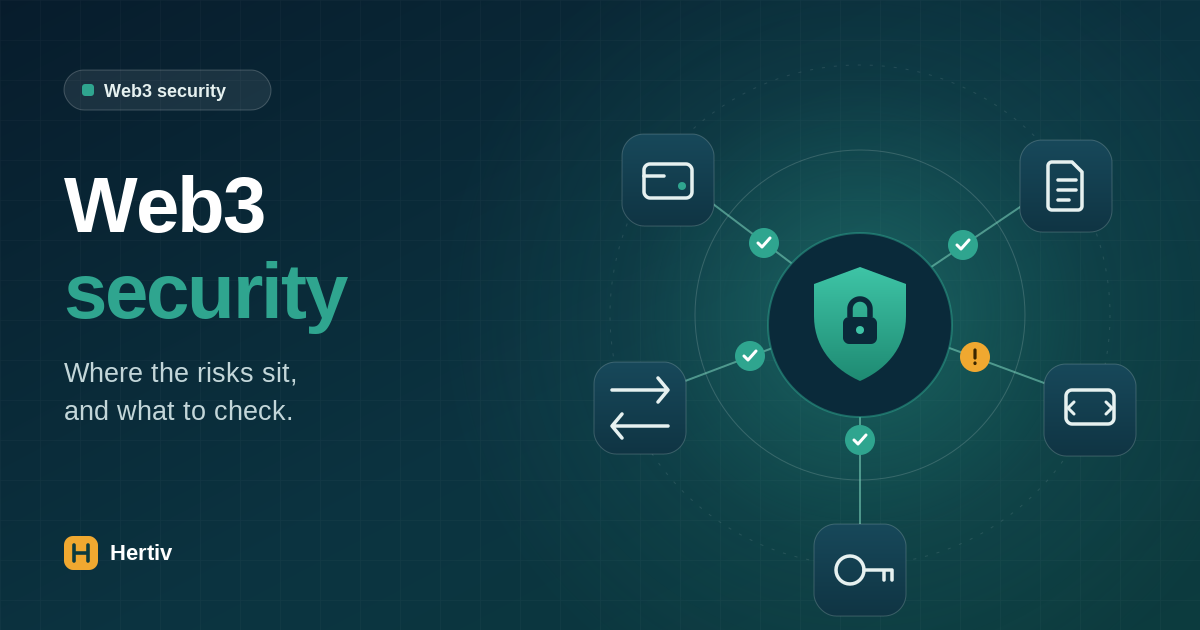
Web3 attacks happen at the wallet, the smart contract, the bridge, the front end and the person, and each surface fails in a different way. Knowing which surface an attack uses tells you which defence matters.
| Attack surface | Common attack | What it costs you |
|---|---|---|
| Wallet | Seed phrase phishing, malicious approvals | Everything in the wallet |
| Smart contract | Re-entrancy, price oracle manipulation | Funds locked in the contract |
| Bridge | Validator compromise, faulty minting | Wrapped assets on the other chain |
| Front end | DNS hijack, fake website | Deposits sent to the attacker |
| Social channels | Fake support, impersonation | Keys and approvals given away |
| Private keys | Malware, cloud backup leaks | Full control of the wallet |
The pattern is that the code is rarely the weakest link for an ordinary user. Phishing, fake websites and bad approvals cause more losses than contract bugs, because they target the person rather than the protocol. Teams building products need the opposite focus: their contracts hold other people's money, so code review matters most.
How do wallet attacks work?
Wallet attacks work by getting the victim to hand over the key or the permission, rather than by breaking the cryptography. The most common route is a fake website or message that looks like a real project and asks the user to connect a wallet and sign a transaction.
Malicious approvals are the quiet version of the same trick. A token approval lets a contract move your tokens, and many sites ask for an unlimited approval so you never have to approve again. If that contract is malicious, or later gets hacked, the approval lets it drain the wallet. Checking and revoking approvals is one of the highest-value habits in Web3.
Seed phrase theft is the other route. A seed phrase is the master key to a wallet, and anyone who has it owns the wallet. Attackers collect phrases through fake support chats, fake wallet apps and phishing pages.
A seed phrase should never be typed into a website, sent in a message or stored in a cloud document. A hardware wallet keeps the key off the computer, so malware cannot read it even if the machine is infected.
What should you check before using a smart contract?
Before using a smart contract, check whether it has been audited, how long it has held funds, who can change it, and what permissions you are being asked to grant. None of these checks is perfect on its own, but together they filter out most bad projects.
An audit is a review of the code by an independent firm, and the report should be public, recent and specific about what was fixed. An audit is not a guarantee: audited contracts have still been hacked. Treat it as a minimum, not as a safety certificate, and read the findings rather than just the headline.
Admin keys matter more than most users realise. If one key can pause the contract, change the fees or upgrade the code, then the project is only as safe as the person holding that key. Look for timelocks, multi-signature control and a public record of past upgrades. How smart contracts work explains the mechanics behind these controls.
For the review itself, smart contract audits cover what a proper review includes and what to look for in the report.
How do bridges and cross-chain transfers add risk?
Bridges and cross-chain transfers add risk because they move value between chains that do not trust each other, and the bridge itself becomes a single point of failure. A bridge locks tokens on one chain and mints wrapped versions on another, so the wrapped tokens are only as safe as the lock and the minting logic.
Most bridge failures come from the same few causes: a small validator set that can be compromised, a bug in the minting or release logic, or a key held by one person or one server. When the bridge fails, the wrapped tokens on the destination chain can lose their backing, and holders are left with tokens nobody will redeem.
Users can reduce the risk by keeping bridge use short and small: move what you need, use the transfer, and move the rest back rather than leaving large sums wrapped for months. Teams building cross-chain products should treat the bridge as the highest-risk component in the design, not as a commodity add-on. What is blockchain covers the base layer that bridges sit on top of.
Example (hypothetical): a small team checks a new DeFi app
Example (hypothetical): a three-person team wants to put $10,000 of company funds into a new lending app for a trial. Before moving any money, they spend an afternoon checking the app the way a careful user would.
First they read the audit report and find two high-severity issues marked as fixed, with the fix confirmed in a follow-up review. Then they check the contract age: it has held funds for eight months with no incident. They also find that upgrades need three signatures and a two-day timelock, so no single person can change the code overnight.
Next they look at the approval the app requests. The default is unlimited, so they set a custom limit of $500 instead. That means the worst case from a bad approval is $500, not the full $10,000. They move $500 first, test a deposit and a withdrawal, and only then move the remaining $9,500.
The trial runs for a month without incident. The team keeps a note of what they checked, so the next app gets the same review instead of starting from scratch.
What are the common mistakes?
The most common mistakes in Web3 security are trusting a website because it looks right, granting unlimited approvals, and treating an audit as a guarantee.
- Signing without reading. A signature is an instruction, not a login. Read what the transaction does before approving it, especially when it involves token approvals.
- Unlimited approvals. Approving a contract to move any amount of a token, forever, is the default in many apps. Set a limit that matches what you actually plan to spend.
- Storing the seed phrase online. A phrase in a cloud document, a photo or a chat is one breach away from an empty wallet. Keep it offline, on paper or metal, in two places.
- Trusting the audit headline. An audit report with unfixed findings is a warning, not a pass. Read the findings and check whether they were fixed.
- Using one wallet for everything. A single wallet holding long-term savings and daily trading funds means one mistake costs everything. Split funds across wallets by purpose.
- Believing support messages. Real support teams never ask for a seed phrase or a remote session. Anyone who does is an attacker.
Key takeaways
- Web3 transactions are final, so prevention matters far more than recovery
- Most user losses come from phishing and bad approvals, not contract bugs
- Set approval limits that match what you actually plan to spend
- An audit is a minimum check, not a guarantee of safety
- Keep seed phrases offline and split funds across wallets by purpose
Frequently asked questions
What is Web3 security?
It is the practice of protecting wallets, smart contracts, decentralised applications and their users from theft, fraud and technical failure. It covers code review, key storage, front-end safety and the habits of the people who sign transactions.
Is Web3 safe to use?
It can be, if you follow the basics: a hardware wallet, limited token approvals, checked contracts and seed phrases kept offline. The risk is real, but most losses come from a small set of avoidable mistakes rather than from the technology itself.
What is a malicious token approval?
It is a permission that lets a smart contract move your tokens. Many apps ask for an unlimited approval, and if that contract is malicious or later hacked, it can drain the wallet. Set a limit that matches what you plan to spend, and revoke approvals you no longer use.
Does an audit mean a smart contract is safe?
No. An audit is a review by an independent firm, and it is a useful minimum, but audited contracts have still been hacked. Read the findings, check whether issues were fixed, and also look at contract age, admin keys and how long the contract has held funds.
What is the safest way to store crypto?
Use a hardware wallet for funds you do not need daily, keep the seed phrase offline on paper or metal in two places, and keep a separate hot wallet with small amounts for everyday use. Never store a seed phrase in a cloud document, photo or chat.
How do I know if a Web3 website is fake?
Check the address carefully, use a bookmark rather than a search result or a link from a message, and be suspicious of urgency, giveaways and support agents who contact you first. A real project never asks for your seed phrase.


