How Web3 Is Changing the Future of Payments
Web3 payments move value on open networks with programmable money, cutting out banks and card rails. See how they work, where they fit, and what holds them back.
On this page
Short answer
Web3 payments are payments made on open blockchain networks, where value moves directly between wallets using tokens and smart contracts instead of banks and card networks. They can settle in minutes, run at any hour, and carry their own rules in code, but they still face price swings, unclear rules and a harder experience for ordinary users.
What are Web3 payments?
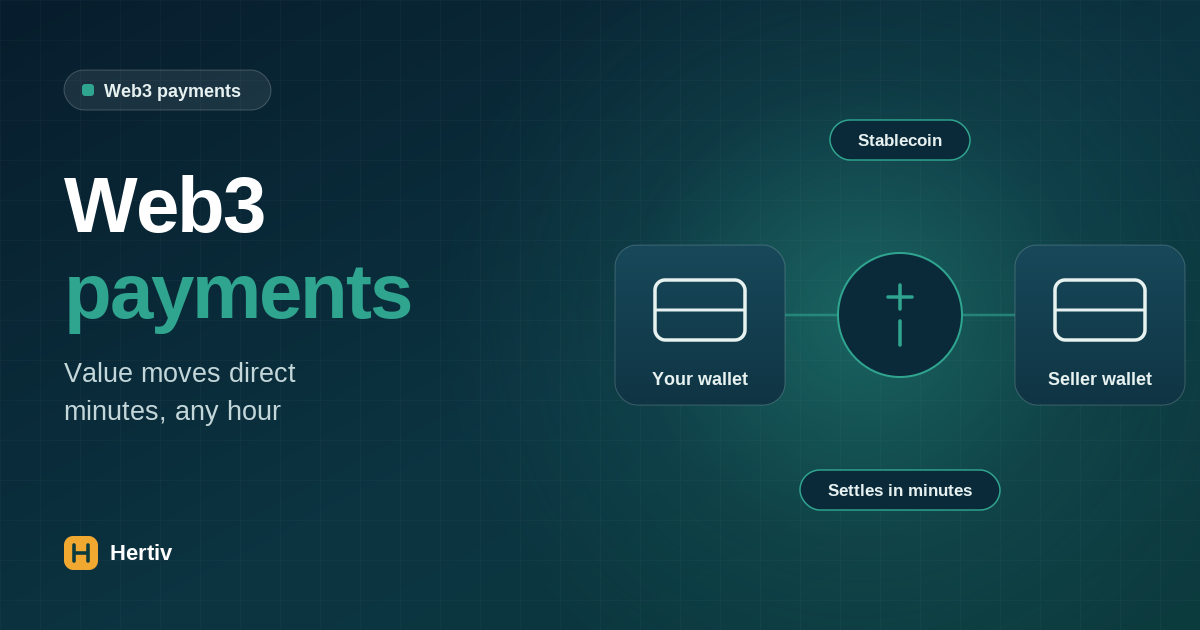
Web3 payments are payments that move value on a blockchain network instead of through a bank or a card network. A buyer sends tokens from a wallet to a seller's wallet, and the network records the transfer. No bank sits in the middle, and the payment does not wait for business hours.
The key parts are the wallet, the token and the contract. The wallet holds the funds and signs the payment. The token is the money: it can be a stablecoin tied to a dollar, or a network token whose price moves. The smart contract is the code that runs the payment's rules, such as releasing funds only when a delivery is confirmed.
Compared with a card payment, a Web3 payment has fewer middlemen. A card payment passes through a gateway, an acquirer, a card network and an issuing bank, and each one takes a fee and a day or two. The table below shows how the two differ.
| Point | Web3 payment | Card or bank payment |
|---|---|---|
| Who moves the money | Blockchain network | Banks and card networks |
| Settlement | Minutes, any hour | Hours to days, business hours |
| Cost | Network fee, often small | Percentage fee per payment |
| Rules | Smart contract code | Bank and network rules |
| Reversals | Usually not possible | Chargebacks possible |
The trade-off is clear: Web3 payments are faster and more direct, but they give up the safety nets people expect from cards, such as refunds and chargebacks. That is why they fit some payments well and others poorly.
How does a Web3 payment move?
A Web3 payment starts in a wallet. The buyer picks the token and the amount, and the wallet signs the transaction with the buyer's private key. That signature proves the buyer approved the payment, and no one else can sign it for them.
The signed transaction goes to the network, where it is checked and added to the chain. Once it is recorded, the seller's wallet shows the new balance. On a fast network this takes under a minute; on a busy one it can take longer and cost more, since the network fee rises with demand.
Smart contracts add rules to the flow. A contract can hold the payment until a delivery is confirmed, split it between two sellers, or pay a subscription every month without a new approval each time. The rules run as written, which is both the strength and the risk: a mistake in the contract is hard to undo.
Where do Web3 payments fit today?
Web3 payments fit best where the old rails are slow or costly. Cross-border payments are the clearest case: sending money across countries through banks can take days and cost a visible share of the amount, while a stablecoin transfer can arrive in minutes for a small network fee.
They also fit creator and freelance payments, where many small payments go to people in different countries. A creator can be paid in stablecoins without setting up a bank account in each market, and the payment history is on the chain for both sides to see.
They fit poorly where buyers expect refunds. A crypto payment gateway can add some of that protection, but a plain token transfer cannot be reversed. Shops that sell physical goods should think hard about how they handle a wrong order before they accept direct token payments.
What are the risks and limits?
Price swings are the first risk. A payment in a token whose price moves can lose value between the sale and the moment the seller converts it. Stablecoins reduce this risk, but they bring their own question: who holds the reserves, and can they be checked?
Rules are the second risk. Different countries treat crypto payments differently, and the rules are still changing. A business that accepts Web3 payments needs to know how its country treats them for tax, reporting and customer checks, and that answer can change.
The third limit is the user experience. Losing a wallet key can mean losing the funds, and there is no password reset. Web3 in general still asks more of its users than a card does, and that is the main reason most people have not switched.
How to try Web3 payments in 5 steps
- Pick one payment type to test, such as cross-border payouts to freelancers, and leave the rest of the business unchanged.
- Choose a stablecoin and a network, and check the fees and the time a payment takes on a small test amount first.
- Set up a business wallet with more than one person needed to approve large payments, and write down who holds the keys.
- Write the rules for refunds, mistakes and tax records before the first real payment, not after a problem appears.
- Run the test for a month, measure the cost, the time and the problems, then decide whether to widen it.
Start small and keep the old payment method running alongside. A test that runs in parallel shows the real cost and the real problems without putting the business at risk. Payment gateway trends show how more businesses are adding this option as a second rail rather than a replacement.
Example (hypothetical): paying freelancers abroad
Example (hypothetical): a small studio pays 20 freelancers in other countries each month. Through its bank, each payment costs about $30 in fees and takes 3 days to arrive. That is 20 times $30, or $600 a month in fees, plus the waiting time.
With stablecoin payments on a low-fee network, each payment costs about $2 in network fees and arrives in minutes. That is 20 times $2, or $40 a month, a saving of $560 a month, or $6,720 a year.
The saving is only real if the freelancers can use the stablecoins, or convert them cheaply. If conversion costs each freelancer $5, the total cost becomes $40 plus 20 times $5, or $140 a month, still a saving of $460 a month. The team should check the conversion cost before it counts the saving.
Common mistakes
The most common mistake is accepting volatile tokens for everyday sales and then watching the value fall before the money is converted. Stablecoins exist for this reason, and a business that takes crypto payments should pick its token on purpose, not by default.
The second mistake is skipping the refund plan. A customer who cannot get a refund will not come back, and a business that cannot reverse a payment needs a clear process for wrong orders, duplicates and fraud.
The third mistake is treating a wallet like a bank account. There is no password reset and no support line that can restore a lost key. Keys need a written plan, more than one approver for large amounts, and a safe backup that the team actually tests.
Key takeaways
- Web3 payments move value directly between wallets, settling in minutes at any hour.
- They fit cross-border and freelance payments best, where old rails are slow and costly.
- Stablecoins cut price risk, but refunds, rules and key safety still need a plan.
- Start with one payment type, a small test amount, and the old method running alongside.
- Check conversion costs before counting any saving.
Frequently asked questions
What is a Web3 payment?
A Web3 payment moves value on a blockchain network, directly between wallets, using tokens and smart contracts instead of banks and card networks. It can settle in minutes at any hour, and its rules can be written into code.
Are Web3 payments cheaper than card payments?
Often, but not always. A stablecoin transfer on a low-fee network can cost far less than a card fee, especially across borders. But network fees rise when a chain is busy, and converting tokens to local money can add costs.
What is a stablecoin payment?
A stablecoin payment uses a token designed to hold a steady value, usually tied to a dollar. It removes the price swings of other tokens, which is why most businesses that accept Web3 payments start with stablecoins.
Can a Web3 payment be reversed?
Usually not. A token transfer on a blockchain cannot be undone by a bank or a card network. That is why businesses need a written plan for refunds, wrong orders and mistakes before they accept direct token payments.
Do I need a bank account to receive Web3 payments?
No, a wallet is enough to receive tokens. But converting tokens into local money for rent, salaries and tax usually needs an exchange or a payment service, which may ask for identity checks.
Are Web3 payments legal?
It depends on the country. Rules on crypto payments, tax and customer checks differ by place and are still changing. Check the rules where your business operates before you start, and keep records of every payment.


