What Is a Voice AI Agent Platform, and Do You Need One?
A voice AI agent platform answers calls with a spoken AI agent instead of a menu or a queue. Here is what it is made of, how calls flow, and when it pays off.
On this page
Short answer
A voice AI agent platform is software that takes a phone call, understands what the caller says, decides what to do, and replies in a natural voice, using your business systems for bookings, orders and account checks. It combines speech recognition, a dialogue model, text-to-speech, telephony and integrations, and it hands off to a human when the call needs judgement.
What is a voice AI agent platform?
A voice AI agent platform is software that lets a spoken AI agent answer phone calls on behalf of a business. Instead of a touch-tone menu or a queue for a human, the caller speaks naturally, the agent understands the request, and it answers, books, orders or checks an account in the same call.
The difference from a chatbot is the channel. A chatbot works in text, on a screen, where the user can read and re-read. A voice agent works in real time, over a phone line, where the caller expects an answer in seconds and cannot see a menu. That changes the design: the agent must handle interruptions, background noise, accents and callers who change their mind mid-sentence.
Platforms come in two shapes. Some are ready-made services where you configure call flows, connect your systems and go live. Others are toolkits of speech and dialogue services that your developers assemble into a platform of your own. The first is faster; the second gives more control over voice, logic and data. Most teams start with a ready-made platform and only build their own when the call volume or the integration needs justify it.
What are the parts of a voice AI agent platform?
A voice AI agent platform has six parts, and a weakness in any one of them shows up on every call. The parts work as a chain: audio in, meaning out, action, then speech back.
| Part | What it does | What good looks like |
|---|---|---|
| Telephony | Connects the phone call to the platform | Works with your existing numbers |
| Speech recognition | Turns the caller's speech into text | Handles accents and background noise |
| Dialogue model | Decides what the caller wants and what to do | Stays on task and asks one question at a time |
| Business integrations | Reads and writes bookings, orders and records | Uses your real systems, not a copy |
| Text-to-speech | Turns the reply into a natural voice | Clear, steady, and easy to interrupt |
| Handoff and logging | Passes hard calls to a human and records all of them | Full transcript with the reason for handoff |
The integrations matter more than the voice. An agent that can check a real booking system is useful; one that can only read a script is a fancier phone menu. When comparing platforms, ask which of your systems each one connects to, and how the connection is maintained. For the basic concepts, see what an AI voice agent is.
How does a call flow through the platform?
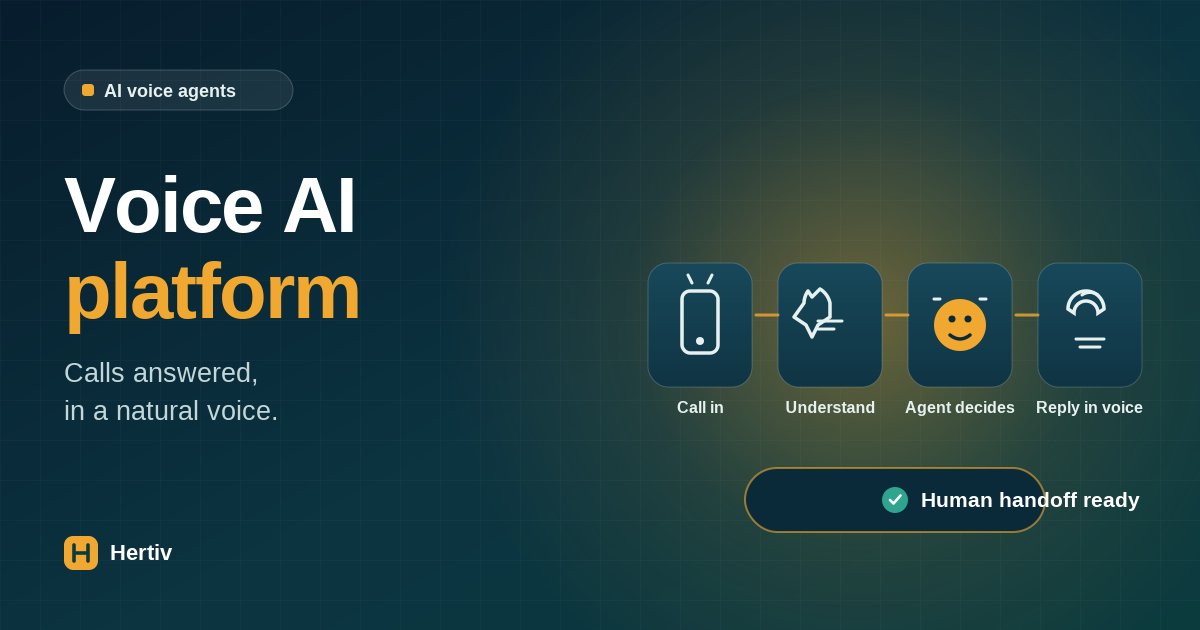
A call flows through the platform in a short loop that repeats until the caller's request is done or the agent hands off. The whole loop usually takes a few seconds per turn, which is why latency matters more than clever wording.
- The call connects. The telephony layer answers, plays a short greeting, and starts listening. The caller speaks in their own words.
- Speech becomes text. The recognition service transcribes the caller's words, including partial speech when the caller pauses.
- The dialogue model decides. The model works out the intent, checks what it already knows from the call, and picks the next step: ask a question, look something up, or act.
- The platform checks your systems. It looks up the booking, order or account, or writes the change the caller asked for, using the same rules your staff follow.
- The agent replies in voice. Text-to-speech reads the reply aloud, and the platform listens for the caller's next words or an interruption.
- The call ends or hands off. The agent confirms the outcome, offers a text summary if needed, and passes the call to a human with the full transcript when the request needs judgement.
Every turn is logged with the transcript, the system calls made and the outcome. That log is the raw material for improving the agent: it shows where callers got stuck, which questions repeat, and where the handoff rule should change. How an AI voice agent works covers the same flow in more depth.
When does a platform beat building with APIs?
A platform beats building with APIs when you need a working voice agent in weeks and your call flows are standard: bookings, order status, opening hours, account checks and simple changes. The platform supplies the telephony, the voice, the dialogue tooling and the monitoring, so your team configures flows instead of wiring services together.
Building with APIs fits when the voice agent is the product, not a channel. If you need a custom voice, unusual call routing, deep control over latency, or a dialogue design no platform supports, assembling speech, dialogue and telephony services yourself gives you that control. The price is a team that owns telephony, monitoring and every integration, for as long as the agent runs.
Cost cuts both ways. A platform charges per minute or per call, which is predictable at low volume and grows with usage. A build costs more up front in engineering time, then less per call, but you pay the maintenance either way. If you are weighing the build option, how to build an AI voice agent sets out the parts and the effort involved.
How do you evaluate a voice AI agent platform?
You evaluate a voice AI agent platform by testing it on your own calls, not by reading feature lists. Set up a trial with one real call flow and a fixed set of test calls, then score the platform on what callers actually experience.
- Latency. Measure the gap between the caller finishing a sentence and the agent replying. Long pauses make callers repeat themselves or hang up.
- Voice quality. Listen to the voice on a real phone line, not a studio recording. It should be clear at low volume and easy to interrupt.
- Recognition accuracy. Test with your customers' accents, names and product words. Generic accuracy figures do not predict performance on your vocabulary.
- Integrations. Check that it reads and writes your booking, CRM or order system, and that the connection survives a system update.
- Handoff. Confirm a human receives the transcript and the reason for handoff, so the caller does not repeat everything.
- Data and pricing. Ask where call recordings are stored, who can access them, and how the per-minute price changes as volume grows.
Run the trial for at least two weeks, with real callers who were not involved in setting it up. Internal testers know what the agent is supposed to do, so they forgive failures that real callers will not. If you need help running the trial, AI voice agent development covers the evaluation and rollout design.
Example: a clinic moves bookings to a voice agent
Example (hypothetical): a dental clinic takes 120 booking calls a day, each lasting about 4 minutes. That is 480 minutes, or 8 hours, of receptionist time every day, and most calls are simple: book, move or cancel an appointment.
The clinic puts a voice AI agent platform on the bookings line. The agent checks the appointment system, offers slots, confirms the booking and sends a text summary. It handles the routine calls and passes the rest to reception: complaints, insurance questions and anything the caller repeats twice.
The arithmetic is straightforward. If the agent handles 60 percent of calls, that is 72 of the 120 daily calls, each about 4 minutes, giving 288 minutes, or about 4 hours and 48 minutes, of receptionist time freed each day. The clinic uses that time for check-ins and insurance calls, which need a person. The agent does not replace reception; it takes the repetitive half of the queue.
After a month, the clinic checks the logs: how many calls completed, how many handed off, and which questions the agent failed on. Two flows get fixed, the handoff rule is widened for insurance calls, and the completion rate rises. The log review is a weekly job, not a one-off task.
What are the common mistakes?
The most common voice AI agent platform mistakes are launching on every call flow at once, trusting a demo voice, and leaving no one to review the call logs.
- Launching too wide. Start with one flow, such as bookings, and add the next only when the first completes reliably.
- Trusting the demo. A vendor demo uses clean audio and friendly questions. Test with your real callers, accents and background noise.
- No handoff rule. If the agent cannot say "let me get a person", callers get trapped in a loop. Define the handoff triggers in writing.
- Ignoring latency. A reply that takes four seconds feels broken on a phone call, even if the answer is right.
- No log review. The call logs show where callers get stuck. If nobody reads them, the same failures repeat for months.
- Forgetting consent and data rules. Callers should know they are speaking to an automated agent, and recordings need a clear retention rule.
For a sense of where voice agents already work well, see AI voice agent use cases before choosing your first flow.
Key takeaways
- A voice AI agent platform combines telephony, speech recognition, dialogue, voice and integrations
- The integrations decide usefulness: an agent that reads your real systems beats one that reads a script
- Latency and handoff matter more than voice quality on a feature list
- Start with one call flow and expand only when it completes reliably
- Review call logs weekly; they show where callers get stuck and what to fix
Frequently asked questions
What is the difference between a voice AI agent platform and an IVR?
An IVR follows a fixed menu: the caller presses keys or says a keyword, and the system routes the call. A voice AI agent platform understands free speech, asks follow-up questions, looks up real records and completes tasks in the call. The caller does not need to learn a menu.
How much does a voice AI agent platform cost?
Most platforms charge per minute or per call, plus a monthly fee for the number of lines and integrations. The total depends on call volume, the number of flows and whether you need custom voices. See vendor sites for current pricing, and test with your real call volume before signing.
Can a voice AI agent platform replace reception staff?
No, for most businesses. It takes the repetitive calls, such as bookings and order status, and frees staff for calls that need judgement, empathy or negotiation. Plan the handoff so the agent passes hard calls to a person with the full transcript.
How long does it take to launch a voice AI agent platform?
A single flow, such as bookings, typically takes a few weeks from setup to a live trial, when the booking system already has an API. Adding more flows, custom voices and deeper integrations extends that. The trial with real callers is the part teams most often rush.
Does the platform work with my existing phone number?
Usually yes. Most platforms can port your number or forward calls from it, so callers dial the same number they always have. Confirm number porting, opening hours and out-of-hours behaviour with the vendor before launch.
What data does a voice AI agent platform store?
Typically call recordings, transcripts, the system calls made and the outcome, stored for a period you choose. Ask where the data lives, who can access it, how long it is kept, and whether the vendor uses your calls to train models. Get the answers in writing.


