How Does an AI Voice Agent Work, Step by Step
An AI voice agent turns speech into text, works out what you want, checks its tools, and speaks the answer back. The whole loop usually takes a few seconds.
On this page
Short answer
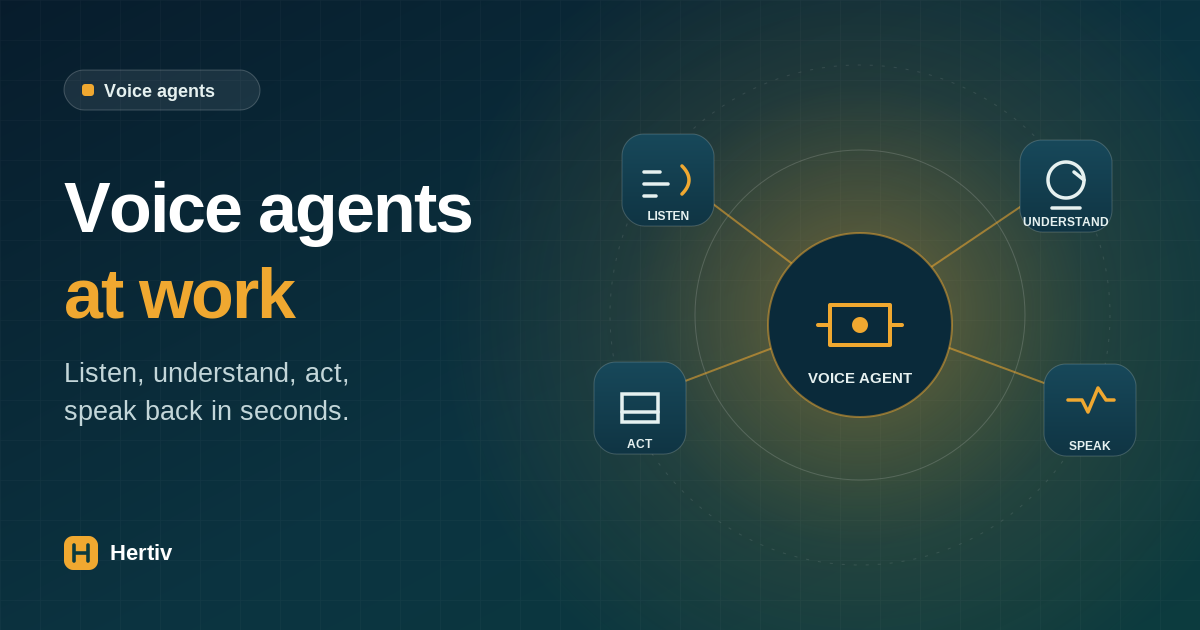
An AI voice agent works in four steps: it transcribes your speech into text, works out your intent and the facts it needs, calls a tool such as a booking system or knowledge base, and turns its answer back into spoken words. The loop runs in a few seconds, and a good agent interrupts cleanly, remembers the context and hands off to a person when it cannot help.
What is an AI voice agent?
An AI voice agent is software that holds a spoken conversation with a caller and takes actions on their behalf. It answers the phone, listens to what the caller says, works out what they want, and does something about it: booking an appointment, checking an order, or answering a question from a knowledge base.
The agent is not a recording and not a menu of numbered options. It understands free speech, asks a follow-up question when something is unclear, and remembers what the caller already said, so the caller does not repeat the order number three times.
| Stage | What happens | What it needs |
|---|---|---|
| Listen | Speech becomes text | Speech recognition model |
| Understand | Intent and facts are worked out | Language model and context |
| Act | Tools are called for facts or actions | Booking, order or CRM system |
| Speak | Answer becomes spoken words | Text-to-speech voice |
Voice agents fit phone lines, smart speakers and in-app calling, wherever customers already speak instead of typing. They work best on tasks with a clear answer and a clear action, such as bookings, order status and appointment changes.
How does speech recognition work in a voice agent?
Speech recognition turns the caller's voice into text, and it is the first step in the loop. The agent listens to the audio stream, splits it into short pieces and matches each piece against the sounds of the language, producing a transcript of what was said.
Modern speech recognition handles accents, background noise and fast speech far better than the old phone menus did, but it is not perfect. A noisy line, a strong accent or an unusual product name can still produce the wrong word, so the agent needs to check what it heard before it acts on it.
The check usually takes the form of a short confirmation: "You said Tuesday at 10, is that right?" That one sentence catches most recognition errors before they become a wrong booking. The confirmation should be short, or callers get annoyed, but skipping it is worse.
Streaming matters here. The agent should transcribe as the caller speaks, not wait for a long silence, because a pause of even a second feels slow on a phone call. NLP development services cover the speech and language models behind this stage.
How does the agent decide what to say?
The agent decides what to say by combining three things: the caller's words, the conversation so far, and the facts from its tools. A language model reads the transcript, works out the intent, such as booking, cancelling or asking a question, and picks the facts it needs to answer.
Tools are the key part. When a caller asks for an appointment, the agent calls the booking system to find free slots. When a caller asks about an order, it calls the order system. The model does not invent the answer; it reads the result the tool returns and turns it into a spoken reply.
Guardrails shape the decision. The agent has rules about what it can and cannot do: it can book, but it cannot cancel a paid order without a person; it can quote a price, but it cannot offer a discount. Those rules are written down in advance, and the agent follows them on every call.
Context is what makes the conversation feel natural. If the caller already gave their name and order number, the agent should not ask again. Good agents keep a short memory of the call and use it, so the caller talks to a helper, not a form. For the definition behind this, see what is an AI voice agent.
How does text-to-speech turn the answer into voice?
Text-to-speech turns the agent's written answer into spoken words, and it is the last step in the loop. The model produces a short text reply, and a speech synthesis model reads it aloud in a chosen voice, with natural pauses, emphasis and pacing.
Latency is the main challenge. A caller expects a reply within a second or two, so the whole loop, transcription, understanding, tool call and speech, has to run fast. The usual trick is streaming: the agent starts speaking the first sentence while the rest is still being prepared, so the caller never waits in silence.
Voice choice matters more than teams expect. A calm, clear voice at a steady pace is easier to understand on a phone line than a fast or expressive one, and the voice should match the brand. Some teams use a custom voice; most start with a standard one and change it only if callers complain.
The spoken answer should be short. A caller can hold about two sentences in mind at once, so a good agent gives the key fact first and offers more detail only if asked. Long spoken lists are forgotten before the agent finishes reading them.
Example: a clinic booking line
Example (hypothetical): a clinic receives 300 calls a day, mostly to book, move or cancel appointments. A person takes about 4 minutes per call, which is 1,200 minutes, or 20 hours, of phone time a day.
The clinic adds a voice agent that handles the straightforward bookings. It answers the call, checks the diary, offers the next free slot and confirms the booking. It resolves 180 of the 300 calls on its own. For each of those, a person now spends about 1 minute reviewing the booking instead of 4 minutes taking the call.
The saving is 3 minutes per call across 180 calls, which is 540 minutes, or 9 hours a day. The remaining 120 calls go to a person, because the patient needs to discuss symptoms, the diary is full, or the caller asks for something the agent cannot do.
The clinic measures success by the share of bookings that are correct on the first try, and by the number of callers who ask for a person. If the agent books the wrong day, the saving disappears, so the team listens to a sample of calls every week and fixes the phrases the agent misunderstands.
What limits an AI voice agent?
The main limit is understanding. Accents, background noise, overlapping speech and unusual names all cause errors, and the agent cannot see the caller's face or read their body language. A short confirmation, "Tuesday at 10, is that right?", catches most errors, but the agent must be willing to ask it.
Interruptions are the second limit. Callers talk over the agent, change their mind mid-sentence and correct themselves. A good agent detects the interruption, stops speaking and listens again. A bad one keeps talking, and the caller hangs up.
Sensitive topics are the third limit. Health, money and complaints need a person, because the caller needs empathy and judgement, not a fast answer. The agent should recognise these topics and hand off early, with the call history attached, rather than trying to handle them.
Finally, there is the limit of the tools. If the booking system is down or the order system has no record, the agent cannot help, however good its language model is. The agent should say so plainly and offer a person, not invent an answer. Best AI voice agents compares the leading products on these points.
What are the common mistakes?
The most common mistakes with AI voice agents are long spoken answers, skipping confirmation, and letting the agent handle topics it should not. All three end with callers asking for a person, or hanging up.
- Long spoken replies. A caller remembers about two sentences. Give the key fact first and offer detail only if asked.
- Skipping confirmation. One short check, "Tuesday at 10, is that right?", catches most recognition errors before they become wrong bookings.
- No interruption handling. Callers talk over the agent. If it cannot stop and listen, the conversation breaks down.
- Handling sensitive topics. Health, money and complaints need a person. Hand off early, with the history attached.
- Inventing answers. If the tool has no record, the agent must say so and offer a person, not guess.
If you are planning a voice agent for your phone line, AI voice agent development covers the design, and the first step is usually a pilot on one call type, such as bookings, with a clear handoff rule.
Key takeaways
- A voice agent works in four steps: listen, understand, act and speak, in a loop of a few seconds
- Speech recognition turns voice into text, and a short confirmation catches most errors before they act
- The agent decides what to say from the caller's words, the conversation so far and the facts its tools return
- Spoken answers should be short: the key fact first, detail only if asked
- Sensitive topics need a person; the agent should hand off early with the history attached
Frequently asked questions
How does an AI voice agent work?
It transcribes your speech into text, works out your intent, calls a tool such as a booking or order system for the facts, and turns its answer back into spoken words. The whole loop usually takes a few seconds.
What is the difference between a voice agent and a phone menu?
A phone menu offers numbered options and cannot understand free speech. A voice agent understands what you say in your own words, asks follow-up questions, and remembers what you already told it.
How accurate is AI voice recognition?
Modern speech recognition handles accents and background noise well, but it still makes mistakes on unusual names and noisy lines. A short confirmation, such as repeating the date back, catches most errors before they cause a problem.
Can an AI voice agent book appointments?
Yes, when it can reach the booking system. It checks free slots, offers them to the caller, confirms the choice and writes the booking. It should confirm the date and time out loud before finishing.
When should a voice agent hand off to a person?
When the topic is sensitive, such as health or money, when the caller asks for a person, or when the tools have no answer. The handoff should carry the full call history so the caller does not repeat anything.
How long should a voice agent's reply be?
About two short sentences. Callers can hold little in mind while listening, so give the key fact first and offer more detail only if the caller asks for it. Long lists read aloud are forgotten before the agent finishes.


