How Much Does a Virtual CTO Cost? A Clear Breakdown
A virtual CTO usually costs less than a full-time CTO because you pay for part of a senior leader's time. Learn what drives the fee and how to budget for it.
On this page
Short answer
A virtual CTO is a part-time senior technology leader hired on a retainer or project basis, and the cost depends on the hours, the scope and the seniority involved. Most small and mid-sized companies pay for a set number of days or hours each month, which keeps the spend well below a full-time CTO salary while still giving access to experienced technical leadership.
What does a virtual CTO cost?
A virtual CTO is a senior technology leader who works for your company part time, usually for a fixed number of days each month or on a defined project. You get strategy, architecture decisions and team guidance without hiring a full-time executive, and the fee follows the time and scope you agree.
The cost varies because the work varies. A startup that needs a few hours of advice each month pays far less than a company that wants a virtual CTO in the room two days a week, running the engineering team and owning the technology roadmap. Location matters too: rates differ by market, and a remote arrangement can lower the fee.
The table below shows the common ways the work is priced. The figures are not quotes; they describe the shape of each model so you can compare them. Ask any provider for a written quote before you decide.
| Engagement model | Typical commitment | What you get |
|---|---|---|
| Monthly retainer | 2 to 8 days a month | Roadmap, architecture and team guidance |
| Hourly advisory | A few hours a month | Advice on specific decisions |
| Project based | A fixed scope and timeline | One outcome, such as a platform rebuild plan |
| Interim CTO | Near full time, for months | Hands-on leadership while you hire |
A good first step is to read What Is a Virtual CTO, and When Do You Need One? so you know which model fits your stage.
What affects the price of a virtual CTO?
The price of a virtual CTO is driven mainly by how much of their time you need and how much responsibility they carry. A light advisory role costs less than a role where the person owns delivery, hires engineers and answers for uptime.
Company size matters. A ten-person startup with one product needs less oversight than a company with several products, a data platform and compliance duties. The state of your systems matters too: a clean codebase is cheaper to steer than one with years of unplanned growth.
Four factors usually set the fee. First, the number of days or hours per month. Second, whether the virtual CTO manages people or only advises. Third, the depth of the technology, such as regulated data or real-time systems. Fourth, the market rate where the provider works. If a quote seems low, ask what is left out: reporting, on-call cover and hiring support are often extra.
Seniority also plays a part. A leader who has run engineering at scale will charge more than a generalist consultant, and for a company making a big platform decision, that experience is often the point. Compare candidates on the decisions they have owned, not only on the fee.
What is usually included in the fee?
A virtual CTO fee usually covers the working sessions, the decisions and the written output you agreed in advance. That normally means a technology roadmap, architecture reviews, vendor and tool choices, and regular check-ins with your team and founders.
Most engagements also include some team-facing work: mentoring senior engineers, reviewing hiring plans, and setting simple engineering practices such as code review and release routines. These are the parts that keep delivery steady between strategy sessions.
Some things are usually outside the fee. Hands-on coding, day-to-day project management and out-of-hours incident cover are separate, and should be priced on their own. If your provider offers them, get the limits in writing, including response times and what happens when the virtual CTO is on holiday.
Before you sign, list the outcomes you expect in the first three months, such as a written roadmap or a hiring plan. That list is what you measure the fee against, and it stops the engagement drifting into open-ended advice. You can compare provider types in Virtual CTO Companies for Startups: How to Choose.
Retainer, project or hourly: which fits your company?
A monthly retainer fits companies that need steady guidance over time. You pay for a set number of days, the virtual CTO learns your systems, and decisions get faster because the context is already there. This is the right choice when technology choices keep coming up week after week.
A project engagement fits a single defined outcome, such as choosing a new platform, planning a rebuild, or preparing for a security audit. You agree the scope, the deliverables and the price in advance, and the work ends when the outcome is delivered.
Hourly advisory fits a company that needs a second opinion now and then, for example before signing a vendor contract or approving a large build. It is the cheapest way in, but it does not buy continuity: the adviser starts cold on each call.
An interim CTO is the option when you need a full-time leader for a few months, usually while you recruit. It costs the most, because it takes the most time, but it keeps delivery moving during the gap. Choose the model that matches how often you need decisions, not the one with the lowest headline price.
How to budget for a virtual CTO in 5 steps
Budgeting for a virtual CTO works best when you start from the decisions you need, not from a price list. These five steps give you a number you can defend.
- List the decisions. Write down the technology decisions you face in the next six months, such as platform, hiring and security choices.
- Estimate the time. Ask how many days a month those decisions and the related team work will take, and agree it with the provider.
- Set the outcomes. Name two or three written outcomes for the first quarter, such as a roadmap and a hiring plan.
- Price the options. Get quotes for a retainer and for a project covering the same scope, then compare what each includes.
- Review after three months. Check whether the decisions got faster and the roadmap is being followed, then renew or change the scope.
Keep a small reserve for extra days in busy months, such as a launch or an audit. A retainer that covers the quiet months and flexes in busy ones is usually better value than a flat rate that is too small when it matters most.
Example (hypothetical): a 40-person startup plans its spend
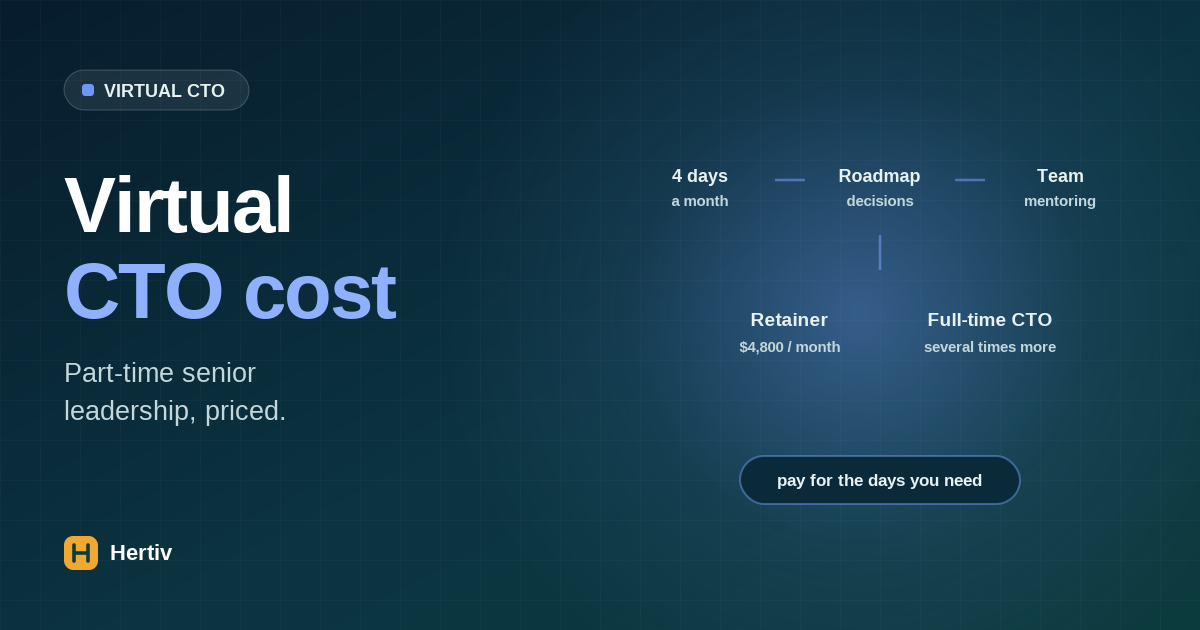
Example (hypothetical): a 40-person startup hires a virtual CTO for 4 days a month at a hypothetical rate of $1,200 a day. The retainer is 4 x $1,200 = $4,800 a month, or $57,600 a year.
The startup also budgets 2 extra days a quarter for planning and audits, which is 8 x $1,200 = $9,600 a year. The total planned spend is $57,600 + $9,600 = $67,200 a year.
For comparison, a full-time CTO salary plus hiring costs and benefits would be several times that figure. The startup accepts the trade-off: the virtual CTO does not write code or manage the team day to day, but the company gets senior decisions and a roadmap for roughly a fifth of a full-time cost.
What are the common mistakes?
The most common mistake is hiring on price alone and then being surprised by what is not included. A low fee that covers only a monthly call is not the same as a retainer that includes roadmap work, team mentoring and written decisions.
- No written outcomes. Without agreed deliverables, the engagement becomes open-ended chat and is hard to judge.
- Too few days. One day a month is rarely enough to learn your systems and give useful answers.
- Skipping the handover. If the virtual CTO leaves, undocumented decisions go with them. Ask for written notes.
- Expecting coding. A virtual CTO advises and decides; if you need hands-on building, budget for engineers too.
Agree the scope, the outcomes and the review date before the first invoice. That is what turns a fee into a service you can measure. If you want help scoping the role, start from Hertiv's virtual CTO service and ask for a written proposal.
Key takeaways
- A virtual CTO is a part-time senior technology leader, not a full-time hire
- The fee follows time and scope: days per month, responsibility and market rate
- Retainers suit steady guidance, projects suit one defined outcome
- Budget from the decisions you need, then price the time to make them
- Agree written outcomes and a three-month review before you sign
- A low fee that excludes roadmap work and mentoring is not good value
Frequently asked questions
How is a virtual CTO different from a tech consultant?
A consultant usually delivers a report or a single piece of advice and leaves. A virtual CTO stays involved over months, owns technology decisions, guides the team and is accountable for the roadmap. The consultant answers a question; the virtual CTO keeps answering as new questions arrive.
Do I still need a full-time CTO later?
Often yes, once the team and the product grow past the point where part-time leadership is enough. A virtual CTO can help you decide when that point arrives and can write the job description and interview plan for the full-time hire.
Can a virtual CTO work fully remotely?
Yes, in most cases. Roadmaps, reviews and mentoring all work over video calls and shared documents. On-site days help at the start, when the virtual CTO is learning your systems and meeting the team, and before big decisions such as a platform change.
What should be in the contract?
The contract should name the days per month, the deliverables, the response times, who owns the written output, and what happens during holidays. It should also state what is not included, such as hands-on coding or out-of-hours cover, so there are no surprises.
How do I judge whether it is working?
Judge it on the outcomes you agreed: a roadmap that the team follows, faster decisions, fewer reworks, and a hiring plan that gets filled. If after three months the same decisions are still open, the scope or the fit is wrong.
Is a virtual CTO right for a very early startup?
Usually not in the first months, when the product is still being shaped by the founders and there is little technology to steer. It becomes useful once you have paying users, a small engineering team and decisions about platform, hiring and security that keep repeating.


