Virtual CTO Companies for Startups: How to Pick One
Virtual CTO companies give startups senior technical leadership without a full-time hire. Here is what they do, who offers it and how to choose well.
On this page
Short answer
Virtual CTO companies provide part-time senior technical leadership to startups: architecture, hiring, vendor and code review, security and roadmap decisions, usually on a monthly retainer. You get judgment and direction without a full-time executive salary, but you stay responsible for execution.
What does a virtual CTO company actually do?
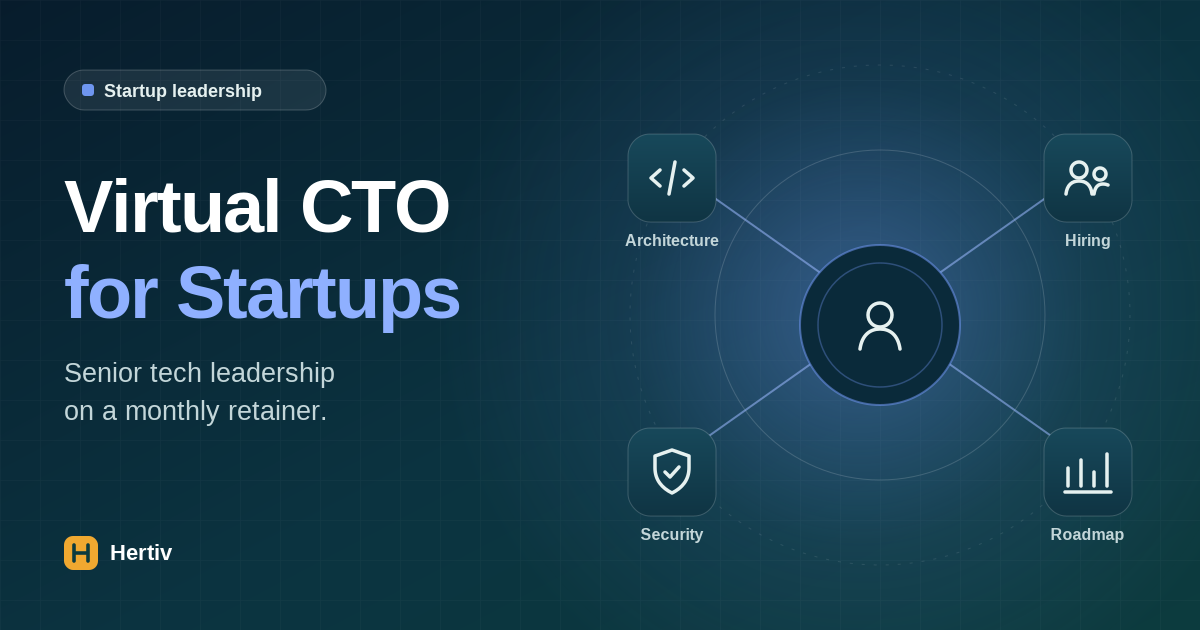
A virtual CTO company supplies an experienced technical leader to a startup on a part-time or fractional basis. The work is decision-making and oversight: architecture, technology choice, hiring, vendor management, security posture and the technical side of fundraising.
It is not the same as an outsourced development team. A virtual CTO sets direction and reviews what others build; a development agency builds. Some firms do both, which is convenient but worth checking, because the commercial incentive to keep billing build work can blur advice about whether to build at all.
Typical deliverables in the first 60 days:
- A written technical assessment of the current codebase, infrastructure and team
- A prioritised roadmap tied to product and commercial milestones
- Hiring plan with role definitions and interview loops
- Vendor and contract review, including cloud spend and third-party APIs
- A risk list covering security, data protection and single points of failure
After that, the work settles into a steady rhythm: architecture reviews, hiring interviews, investor technical due diligence and unblocking the engineering team. If you need engineering capacity alongside that leadership, virtual CTO services and software staff augmentation are often paired.
Which type of provider fits which startup?
There are four common provider types, and they suit different situations. The table is a starting point, not a ranking.
| Provider type | What you get | Typical startup stage | Watch for |
|---|---|---|---|
| Independent fractional CTO | One senior person, deep hands-on judgment | Pre-seed to seed | Limited bench if they are unavailable |
| Virtual CTO firm | Team of CTOs, backup coverage, standard process | Seed to Series A | Less continuity; ask who is named |
| Agency with CTO layer | Leadership plus a build team | Non-technical founder with budget | Advice may favour more building |
| Consultancy or advisory firm | Strategy, audits, due diligence | Fundraising or turnaround | May not review code in depth |
| Regional specialist | Local hiring, compliance and vendor knowledge | Regulated or EU/Middle East markets | Narrower technology range |
| Platform or network marketplace | Fast matching, flexible hours | Very early stage | Quality varies by individual |
1. Independent fractional CTO: best for focused, senior judgment
One experienced person, usually a former startup CTO, works a set number of days per month. You get direct access and no account layer. The trade-off is capacity: holidays, illness or a competing client can slow you down.
2. Virtual CTO firms: best for coverage and process
A firm assigns a lead CTO and can substitute another if needed, and often brings templates for audits, hiring and diligence. Ask whether the named person is an employee or a contractor, and how handover works.
3. Agencies with a CTO layer: best for non-technical founders
You get leadership and execution in one contract. That reduces coordination, but set the advisory role up so it can challenge the build plan honestly.
4. Advisory and due diligence specialists: best for specific events
Some firms focus on fundraising readiness, technical due diligence or security audits. Use them for a defined piece of work rather than ongoing leadership.
What should a startup expect to pay and commit?
Expect a monthly retainer that varies widely with seniority, region and hours, plus a shorter trial period at the start. There is no reliable public benchmark, so compare proposals on scope and named time rather than headline rate.
What matters more than price is the structure:
- Named hours per week, not "as needed". Four to eight hours a week is common for early startups; more during diligence or a rebuild.
- Named person, with a named backup and a handover process.
- A trial block, typically four to eight weeks, with a written assessment as the deliverable. You can stop there and keep the document.
- Response expectations for urgent issues such as a security incident or an outage.
- Clear exclusions: no daily project management, no line-by-line code writing unless stated.
Cost ranges depend heavily on scope and region, so treat any quoted range as indicative only. A firm with a bench and process usually costs more than an independent, and a combined leadership-plus-build contract costs more again. Budget separately for one-off work such as penetration testing or a compliance review through cybersecurity services.
Example: a seed-stage startup with an offshore team
Example (hypothetical): a seed-stage SaaS startup has a non-technical founder, two offshore developers and a product that works in demos but fails under load. They hire a virtual CTO firm for eight hours a week.
Month one is assessment: reading the codebase, reviewing the cloud setup, interviewing both developers and mapping the release process. The output is a short document listing the top risks in order.
Month two is remediation planning. The virtual CTO introduces staging environments and a review process, and rewrites the hiring brief for a senior backend engineer. The founder uses the assessment to answer investor questions about technical risk.
Month three onwards is steady: a weekly architecture call, interview support and a monthly written update for the board. Twelve months in, the startup hires a full-time CTO, and the firm runs the search and a two-month handover.
The lesson is that the value was concentrated in the first 90 days, when a set of decisions would otherwise have been made by default. A good engagement is designed to end, either by handing over or by reducing hours as the internal team matures.
How to choose a virtual CTO provider
Choose on evidence of judgment, not on pitch quality. The right provider has seen your failure mode before and can show how they diagnose it.
- Write down the decision you cannot make. It might be whether to rebuild or patch, which cloud to use, or how to hire. A provider who ignores that question in the first call is selling a template.
- Ask for a named person and their background. You want someone who has carried a production system and a team, not only advised. Ask what they owned and what broke.
- Request a paid trial with a written deliverable. Four weeks and a technical assessment is a fair test for both sides.
- Check the review habit. Ask whether they read code and pull requests, and how often. Leadership that never looks at the code drifts from reality.
- Agree the exit. Define what success looks like, when hours reduce and how handover happens.
Run reference calls with startups of similar size. Ask what changed in the first quarter and what the provider got wrong. For a broader view of how technical leadership fits with delivery, see software engineering services.
Common mistakes when hiring a virtual CTO
Most bad engagements come from a mismatch in expectations, not from a lack of skill. These are the patterns to avoid.
- Hiring a strategist for an execution problem. If the build is stalled, you need engineering capacity plus leadership, not slides.
- No written scope. "Ongoing technical leadership" means nothing when you disagree about what was delivered.
- Buying from the build team without checks. If the same firm advises and builds, ask them in writing to justify the build plan against alternatives.
- Skipping the code review. A CTO who never reviews the repository cannot spot the risks that sink diligence.
- Treating it as permanent. A virtual CTO should be a bridge to a full-time hire or a stable team, not a substitute forever.
- Ignoring security and data protection. For EU and Middle East markets, data residency and regulatory questions belong in the first month, not after launch.
When a virtual CTO is the wrong answer
A virtual CTO is poor value when the problem is capacity, not direction. If you have clear architecture and a backlog, you need engineers.
Cases where something else fits better:
- You need to ship a defined product with no team. Use custom software development with a technical advisor for oversight.
- You need to hire a full-time CTO. Run a proper search; a virtual CTO can help define the role and interview, but the hire is the goal.
- You need deep specialism. AI, blockchain or data platforms may need a specialist review on top of general leadership; consider AI consulting or data engineering for those areas.
- You need emergency security work. Bring in a security team first, then leadership to fix the process.
A useful test: if you can name the five decisions you need help with and they are all technical, a virtual CTO is likely right. If you cannot name them, spend two weeks with an advisor on a small scope before committing to a retainer.
Key takeaways
- A virtual CTO replaces decisions, not code: expect strategy, reviews and hiring input, not daily commits
- Best fit is a funded startup with a non-technical founder, an offshore team or a stalled build
- Ask for a named person, a written scope and a fixed weekly time commitment
- Beware pure advisory shops with no engineering depth behind them for due diligence and remediation
- Exit criteria matter: a good engagement makes itself unnecessary or hands over to a full-time CTO
Frequently asked questions
Is a virtual CTO the same as a fractional CTO?
Mostly yes. Both describe part-time senior technical leadership. Some firms use "virtual CTO" for a broader service with a team behind it, and "fractional CTO" for one named person working set days per month. Ask what is included and who is named.
How many hours per week does a startup need?
Early-stage startups commonly use four to eight hours a week, rising during fundraising, hiring or a rebuild. The number matters less than the rhythm: a fixed weekly call plus written output is more useful than open-ended availability.
Can a virtual CTO help with investor due diligence?
Yes, this is one of the most common reasons to hire one. The work includes preparing architecture, security and team documentation, and answering investor technical questions. It is most effective when started before diligence begins, not during it.
What should the first deliverable be?
A written technical assessment: what exists, what is risky, what to fix first and what it will cost in time. It gives you something durable if the engagement ends and a shared basis for the roadmap.
Should a non-technical founder hire a virtual CTO before developers?
Often yes, for a short scoped engagement. A few weeks of input on architecture, hiring and vendor contracts can prevent expensive rework. Keep the scope small and demand a written plan you can act on.
How do you end a virtual CTO engagement well?
Agree exit criteria at the start: reduced hours, a full-time CTO hire or a completed handover document. A short overlap between the virtual CTO and the incoming hire is usually worth the cost.


