Vector Database vs Graph Database: Which to Use?
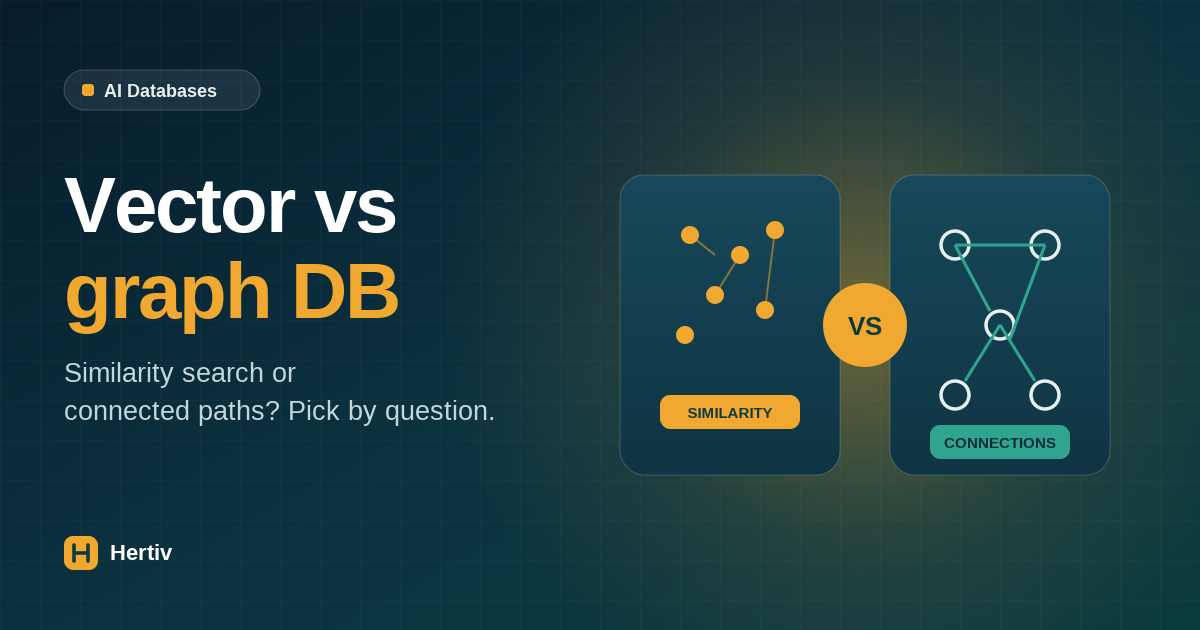
Vector databases search by meaning and similarity, while graph databases trace links between connected things. Pick by the question you ask.
On this page
Short answer
A vector database stores items as number lists called embeddings and finds the closest matches to a question, so it is best for similarity search. A graph database stores nodes and the links between them and follows those links, so it is best for questions about connections, paths and networks. The two solve different problems, and many systems use both side by side.
What is a vector database?
A vector database is a database that stores items as lists of numbers, called embeddings, and finds the items closest to a question. The numbers capture meaning, so two items with similar numbers are similar in meaning even if they share no words. That is what makes vector search different from keyword search.
An embedding is made by a model that turns text, an image or a sound clip into a fixed-length list of numbers. A support article about refunds and a question about getting money back will have embeddings that sit near each other, even though the words differ. The database stores these lists and answers a query by ranking them by distance.
Vector databases are the memory layer behind most retrieval systems. When a chatbot answers from your documents, it usually searches a vector database first, then hands the best matches to a language model. A plain explainer of what a vector database is covers the mechanics in more detail.
What is a graph database?
A graph database is a database that stores things as nodes and the links between them as edges, and answers questions by following those links. A node can be a person, an account, a product or a place, and an edge says how two nodes relate, such as bought, follows, works for or sent money to.
The strength of a graph database is traversal: starting from one node and walking the links to find paths, neighbours and patterns. Asking who is two steps away from a known fraudster, or which products are bought together most often, is a short walk through the graph rather than a set of joins across tables.
Graph databases shine where the connections matter as much as the things themselves. Fraud detection, recommendation engines, permission systems and knowledge graphs are the classic cases, because each of them is really a question about how things connect.
Vector database vs graph database: how do they compare?
The two databases solve different problems, and the table below shows the split. A vector database ranks items by likeness to a query, while a graph database follows links to find paths and patterns.
| Factor | Vector database | Graph database |
|---|---|---|
| Data model | Embeddings: lists of numbers | Nodes and edges |
| Core question | What is most similar to this? | How are these things connected? |
| Typical query | Nearest neighbours by distance | Path and pattern traversal |
| Best for | Search, recommendations, RAG | Fraud, networks, permissions |
| Well-known tools | Pinecone, Weaviate, Milvus, pgvector | Neo4j, Amazon Neptune, ArangoDB |
| Weak spot | Exact facts and relationships | Similarity and meaning |
Neither one replaces a normal database. Most systems still keep their main records in a relational or document store, and add a vector database for search or a graph database for connections. The choice is about which question you ask most often, not about which tool is newer.
The tools in the table are all in active use today. For a shortlist aimed at small teams, the guide to the best vector databases for startups compares the vector side on cost, hosting and ease of setup.
When should you choose a vector database?
Choose a vector database when the core question is about likeness: find the documents, products or people most similar to this one. Semantic search, question answering over your own documents, product recommendations and duplicate detection all fit this shape.
The test is simple. If the user types a sentence and expects the best matches, a vector database is the right tool. If the user types a product name and expects an exact record, a normal database does the job better and cheaper.
Vector search also powers retrieval-augmented generation, where a language model answers from your documents instead of from memory. The vector database finds the passages, the model writes the answer, and the passages can be shown as sources. That pattern is now the default way to build a grounded chatbot.
When should you choose a graph database?
Choose a graph database when the core question is about connections: who is linked to whom, how money or information flows, and which paths exist between two points. Fraud rings, supply chains, access control and social networks all fit this shape.
Fraud detection is the clearest case. A fraud ring is a pattern of accounts, devices and payments that share links, and a graph query can find a ring in one traversal. The same pattern in a relational database needs several joins and gets slow as the data grows.
Permission systems are another strong fit. Asking what a user can reach through their roles, teams and shared folders is a walk through the graph, and the answer stays correct as roles change. A table of permissions needs the same logic rebuilt by hand.
Example (hypothetical): a support search that uses both
Example (hypothetical): a software company gets 400 support tickets a day. Its help centre holds 10,000 articles, and agents spend too long finding the right one. The team adds a vector database for search and a graph database for links between articles, products and known issues.
First, the vector search alone: agents type the ticket text and get the closest articles. Suppose it resolves 240 of the 400 tickets without further searching, or 60 out of every 100. The remaining 160 tickets need a human to dig through related articles.
Then the team adds the graph. Each article links to the product version, the error code and the known issue it belongs to, so an agent can follow one click from an article to every related case.
Suppose that lifts the resolved share to 75 out of 100, or 300 of the 400 tickets a day. That is 60 more tickets resolved per day, or 1,200 more in a 20-day working month, from the same team.
The point is not that one database beat the other. The vector search found the starting article, and the graph found the related cases. Together they covered more tickets than either could alone, and the team kept its normal database for the ticket records themselves.
What are the common mistakes?
The most common mistakes when choosing between vector and graph databases are picking one for every job, ignoring the data model, and skipping the evaluation step.
- One database for everything. A vector database cannot answer a path question, and a graph database cannot rank by meaning. Use each where it fits.
- Skipping the data model. A graph with the wrong edge types gives wrong paths, and embeddings from the wrong model give poor matches.
- No evaluation set. Without a list of real questions and the right answers, you cannot tell whether the search is improving.
- Stale embeddings. Documents change, but embeddings do not update themselves. Rebuild them when the source changes.
- Ignoring the main store. The vector or graph database is an index on top of your records, not a replacement for them.
Key takeaways
- Vector databases rank by likeness to a query; graph databases follow links to find paths
- Use a vector database for semantic search, recommendations and retrieval for chatbots
- Use a graph database for fraud, networks, permissions and knowledge graphs
- Most systems keep a normal database for records and add one of these as an index
- Ten real user questions will tell you which database you need, or whether you need both
Frequently asked questions
Can a vector database replace a graph database?
No. A vector database ranks items by similarity to a query, while a graph database follows links between nodes to find paths and patterns. A vector search cannot tell you how two accounts are connected, and a graph traversal cannot tell you which document means the same thing as your question. They answer different questions.
Can you use both in one system?
Yes, and many teams do. A common pattern is to use a vector database to find the starting document or item, then use a graph database to follow its links to related cases, products or issues. The main records usually stay in a normal relational or document store underneath both.
What is an embedding?
An embedding is a list of numbers that represents the meaning of a piece of text, an image or a sound clip. A model creates it, and items with similar meanings get similar numbers. The database stores these lists and answers a query by finding the lists closest to the query.
Which is easier to start with?
A vector database is usually easier to start with, because the setup is to pick a model, generate embeddings and load them. A graph database needs more design work upfront, since the node and edge types decide which questions the graph can answer well.
Do graph databases handle large data?
Yes, they are built for it, but the design matters. A graph with the right edge types and indexes can traverse millions of nodes quickly, while a graph with poorly chosen edges slows down as it grows. The same is true of vector databases, where the index type shapes speed.
What should a startup pick first?
Pick the database that answers your most common user question. If users search by meaning, start with a vector database; if they ask about connections, start with a graph database. Add the second one later when the other kind of question becomes common.


