Utility Tokens vs Security Tokens: What Is the Difference?
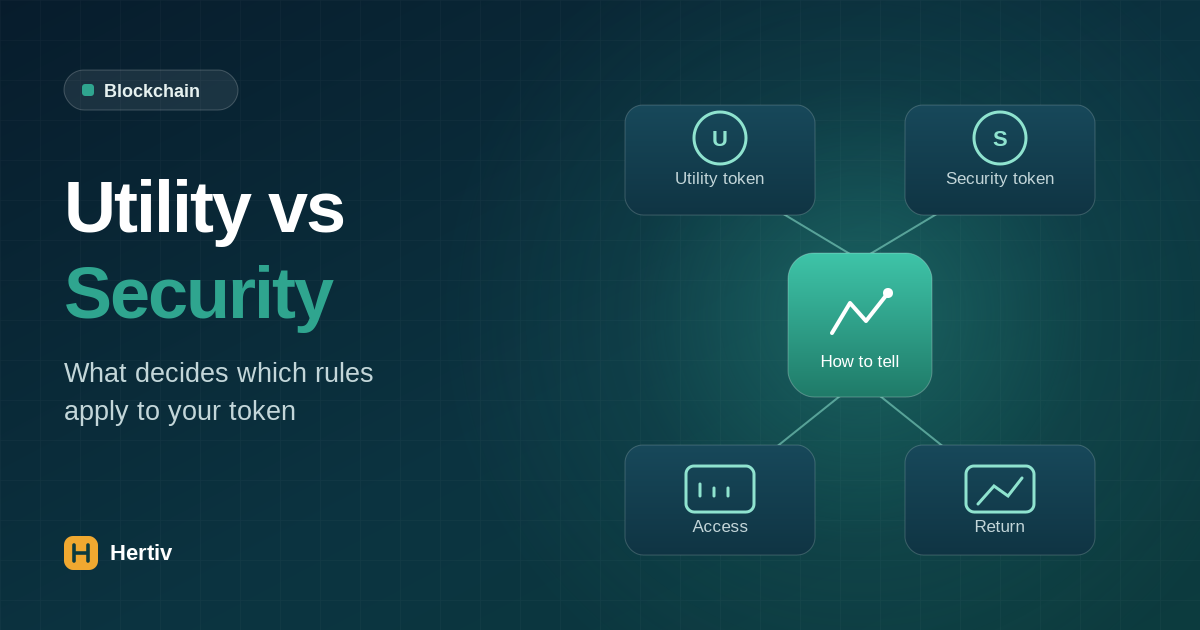
A utility token buys access to a product or service, while a security token is an investment with a claim on returns. Which rules apply depends on the difference.
On this page
Short answer
A utility token gives its holder access to a product, service or network feature, such as paying for storage or voting on a feature. A security token represents an investment in a business or asset, with an expectation of profit from someone else's work. The line between them decides which financial rules apply, so teams must classify a token before they sell it.
What is a utility token?
A utility token is a digital token that gives its holder access to a product, service or feature inside a network, rather than a share in a business. You hold it to use something, not to earn a return from someone else's work.
Common uses include paying for storage, compute or bandwidth on a decentralised network, voting on product decisions, or paying fees inside an app. The token only has value inside the system it belongs to, and its price on exchanges reflects demand for that access.
A utility token usually has a fixed role written into the product. For example, a file-storage network might charge one token per gigabyte stored, so demand for storage drives demand for the token. The holder gets a service, and the project gets a way to charge for it without a payment processor.
If you are planning a token, start by deciding what the token actually does for a holder. A token that only buys access is easier to explain to users and to regulators than one that promises returns, which is where blockchain consulting can help you classify it early.
What is a security token?
A security token is a digital token that represents an investment in a business, fund or asset, with an expectation of profit from the work of others. It is the tokenised form of a share, bond, fund unit or similar instrument.
Holders may receive dividends, interest, a share of revenue or a claim on the underlying asset, depending on how the token is structured. Because it behaves like a traditional security, it usually falls under securities rules in the country where it is sold.
Security tokens are often issued for real estate funds, private equity, venture funds and tokenised bonds. The token is a record of ownership, and the rights attached to it are set out in legal documents rather than in code alone. That is why a security token offering involves lawyers, custodians and licensed platforms as well as developers.
Teams that tokenise an asset usually work with a licensed platform and a legal adviser from the start. For the asset side of the work, see real-world asset tokenization.
Utility tokens vs security tokens at a glance
The table below sums up the practical differences. Read it as a guide to classification, not as legal advice.
| Aspect | Utility token | Security token |
|---|---|---|
| What you get | Access to a product or service | Ownership or an income claim |
| Expectation of profit | No, you get use of the product | Yes, from the issuer's work |
| Main rules that apply | Consumer and product rules | Securities rules |
| Who issues it | The product team | The issuer, with legal advisers |
| Typical buyers | Users of the product | Investors |
| Example | Storage credit or app fee token | Tokenised fund unit |
The same token can look different in different countries, because each regulator applies its own test. A token that is treated as a utility in one place may be treated as a security in another, so teams that sell across borders need advice in each market.
How regulators decide which one a token is
Regulators look at what a token actually does, not at what the team calls it. A token labelled utility that is sold with promises of rising value can still be treated as a security.
In the United States, the Howey test asks four questions: is money invested, in a common enterprise, with an expectation of profit, from the efforts of others? If the answer to all four is yes, the token is usually a security. Other countries use their own tests, but the logic is similar: if buyers expect a return from the issuer's work, securities rules apply.
Three signals push a token toward security status: marketing that talks about returns or price growth, a team that keeps control of the project after the sale, and buyers who have no reason to use the product. The more a token looks like an investment product, the more rules apply to its sale, marketing and trading.
The classification of an existing token is explained in what is a security token.
The two main offering routes are compared in ICO vs STO, which covers how an initial coin offering differs from a security token offering.
Which token fits your project?
Choose a utility token when your product needs a way to charge for access and you can point to a working use for the token on day one. If nobody needs the token to use the product, it will not hold value as a utility token.
Choose a security token when you are raising money for an asset or business and want investors to hold a recorded claim. Accept that this route needs legal work, licensed partners and limits on who can buy.
Ask these questions before you decide:
- Does the token do something inside the product? If not, it is probably not a utility token.
- Are buyers expecting a return? If yes, treat it as a security from the start.
- Is the product live? A utility token sold before the product works is hard to defend.
- Who can legally buy it? Security tokens often exclude the general public.
- What happens if the rules change? A token that later gets classed as a security can be forced off exchanges.
Some projects use both: a utility token for product access and a separate security token for investors. That split keeps the product token clean, but it doubles the work, so only do it when each token has a clear job.
Example: two teams, two tokens
Example (hypothetical): two teams each raise money with a token. Team A sells 200,000 utility tokens at $0.50 each to users of its storage app, raising $100,000. Each token buys one gigabyte of storage for a month, so a user who stores 40 gigabytes a month spends 40 tokens a month.
Team B sells 10,000 security tokens at $10 each to investors in a property fund, raising $100,000. The fund pays out 5% of the amount raised each year, which is $5,000 a year, or $0.50 per token per year. The token is a claim on that payout, and the team must report to investors and follow securities rules.
The difference is not the amount raised. Team A's buyers get storage; Team B's buyers get a return. That is why the two sales are treated differently, even though both used a token.
What are the common mistakes?
The most common mistakes in token classification are labelling a token to avoid rules, promising returns in marketing, and selling before the product works.
- Calling it utility to avoid rules. The label does not decide the classification; what buyers are promised does.
- Promising returns in marketing. Talk of price growth or profit turns a utility token into a security in the eyes of regulators.
- Selling before the product works. A utility token with no working product has no use, which weakens the utility argument.
- Skipping legal review. A short review before the sale costs far less than a forced shutdown after it.
- Letting anyone buy a security token. Many countries limit security token sales to qualified or accredited investors.
- Confusing the token with equity. A security token may carry rights, but it is not automatically a share with voting rights.
Key takeaways
- A utility token buys access to a product; a security token is a claim on an investment return
- Regulators classify a token by what it does and what buyers are promised, not by its label
- The Howey test asks whether money is invested with an expectation of profit from others' efforts
- A utility token needs a working product use on day one, or the utility argument is weak
- Security tokens need legal work, licensed partners and limits on who can buy
Frequently asked questions
Can a token be both a utility token and a security token?
Yes, in practice. A token can give access to a product and still be treated as a security if it was sold with an expectation of profit. Regulators look at the sale and the marketing, not only at the token's function, so a token can carry both roles at once.
Do utility tokens need a licence to sell?
It depends on the country and on how the token is sold. A plain utility token sold for use in a live product usually faces consumer and product rules rather than securities licensing. If the sale looks like an investment, securities rules and licences can apply.
What is the Howey test?
The Howey test is the United States test for whether something is a security. It asks four questions: is money invested, in a common enterprise, with an expectation of profit, from the efforts of others? If all four answers are yes, the asset is usually treated as a security.
Are security tokens the same as shares?
Not exactly. A security token is a digital record of a claim, which may represent shares, fund units, debt or a share of revenue. The rights depend on the legal documents behind the token, so two security tokens can carry very different rights.
Can I buy a security token on a normal crypto exchange?
Usually not. Security tokens are normally traded on licensed platforms that check who buyers are and which countries they are in. A general crypto exchange may list utility tokens, but it cannot list securities without the right licences.
What happens if a utility token is later classed as a security?
The issuer can be ordered to stop selling it, register the offering, or buy back tokens. Exchanges may delist it, and buyers may claim refunds. That is why teams get legal advice on classification before the sale, not after.


