How to Vet Blockchain Development Companies in Ukraine
There is no official register of "trusted" blockchain firms in Ukraine. Vet vendors yourself: check legal entity, smart contract audit history, references and escrow terms.
On this page
Short answer
No authority certifies "trusted" blockchain development companies in Ukraine, so trust comes from your own due diligence: a verifiable legal entity, audited smart contracts, live public projects, reference calls and a contract with clear IP ownership and payment milestones.
What does "trusted" actually mean for a blockchain vendor?
Trusted means you can verify a vendor's claims independently: its legal entity exists, its code has been audited, its deployed contracts are live on-chain, and past clients will speak to you. It is not a certification anyone issues.
Ukraine has a large engineering base and many software firms, but there is no government or industry body that ranks blockchain developers as trusted. Any list you find online is a directory, a paid placement or an editorial opinion. That does not make the firms on it bad, but the list is not evidence.
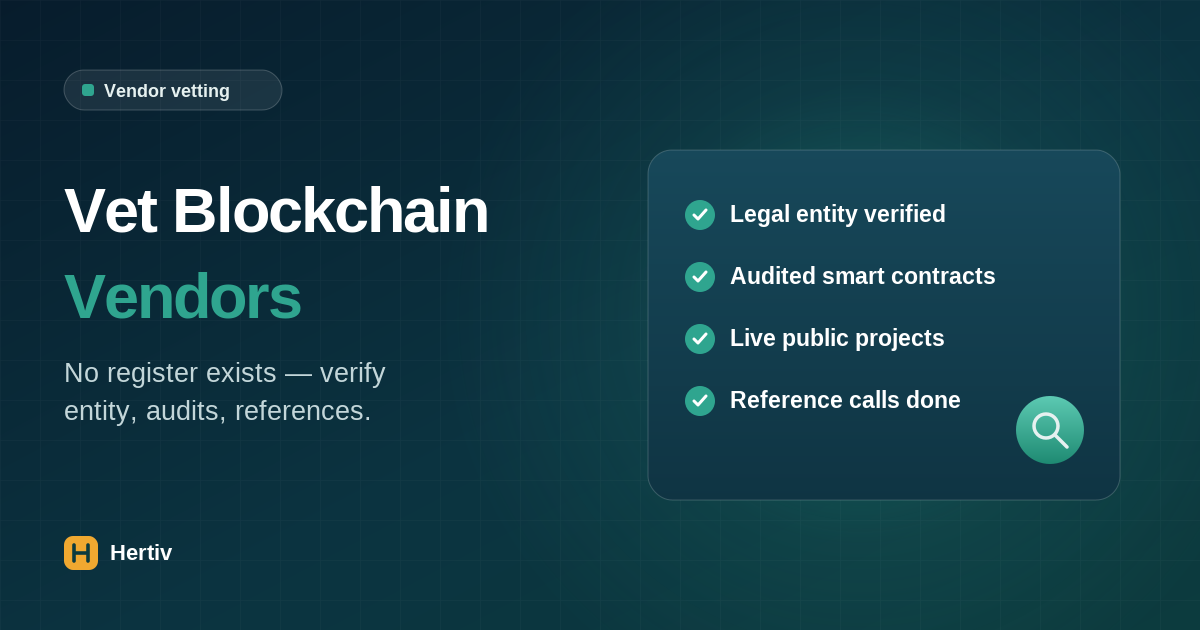
So treat "trusted" as a checklist you run yourself. Five things matter most:
- Legal entity: a registered company you can contract with, not just a Telegram contact.
- Verifiable code: public repositories, deployed contract addresses, or audited reports you can read.
- References: two or three past clients who will take a call.
- Security practice: independent audits, key management, and a clear process for upgrades.
- Contract terms: IP ownership, milestone payments, warranty and exit clauses.
If a vendor cannot satisfy the first three quickly, the conversation is over.
How do you verify a Ukrainian vendor's legal and team setup?
Ask for the registered company name, jurisdiction and registration number, then check it against the public registry of that jurisdiction. Many Ukrainian-founded firms operate through entities in the EU, UK or US, which is normal and often easier for contracting.
Then ask how the delivery team is employed. A firm may have an office in Kyiv, Lviv or another city and hire engineers as contractors or through a local entity. You want to know who signs your contract, who holds intellectual property, and which law governs disputes.
Practical checks:
- Match the contracting entity to the invoice and bank account name.
- Ask for the names and roles of the people who will actually work on your project, and confirm they are not sold to you and swapped later.
- Request a signed NDA before sharing architecture or wallet designs.
- Confirm whether any work is subcontracted, and to whom.
- Check sanctions and payment-rail constraints with your finance team before signing, since cross-border payments can have restrictions that vary by bank and country.
Example (hypothetical): a UK fintech signs with a vendor whose contracting entity is in Estonia but whose engineers are in Ukraine. The contract names Estonian law, IP assigns to the client on payment, and the bank account matches the entity name. That is a clean setup; an unsigned PDF proposal with a personal IBAN is not.
Which technical evidence should you ask for?
Ask for evidence you can check without trusting the vendor's word: deployed contract addresses, audit reports, and public repositories. A serious blockchain team expects this request.
Specifics to request:
- Deployed contracts: addresses on a public explorer for work the vendor is allowed to disclose. Check that the code is verified on the explorer.
- Audit reports: which independent firm reviewed the contracts, what severity of findings were raised, and whether they were fixed. A report with open critical findings is a red flag.
- Test coverage and CI: how contracts are tested, whether fuzzing or formal checks are used for high-value logic.
- Upgrade and key management: who holds admin keys, whether a multisig or timelock is used, and what happens if a key is lost.
- Architecture write-up: a short document explaining chain choice, custody model and failure modes for your use case.
A vendor that has built wallets, exchanges or tokenised assets should be able to discuss key management and threat models in plain language. If the answer is only about frameworks and not about risk, keep looking. Hertiv's own blockchain development services page describes the same scope from the delivery side.
How do you compare vendors side by side?
Score each vendor on the same criteria and weight them for your project. A table keeps the comparison honest and stops the loudest proposal from winning.
| Criterion | What to check | Why it matters |
|---|---|---|
| Legal setup | Entity, jurisdiction, contract terms | Protects IP and disputes |
| Relevant work | Deployed contracts or audited code | Proves the team shipped |
| Security process | Independent audit, key management | Prevents costly exploits |
| Team continuity | Named engineers, tenure | Avoids mid-project swaps |
| References | Calls with past clients | Tests the claims |
| Delivery model | Milestones, testnet gates | Keeps spend controlled |
| Communication | Written updates, time zone overlap | Reduces surprises |
| Exit terms | Code handover, documentation | You are not locked in |
Weight the criteria for your risk. A tokenised fund needs audit and legal evidence far more than raw speed. A proof of concept needs speed and a clear scope more than a long track record. For early-stage scoping, a short blockchain consulting engagement can be a cheaper way to test a team than a full build.
What should the contract and payment structure include?
The contract should tie money to verifiable delivery, and it should give you the code. Those two points prevent most disputes.
Include these terms:
- IP assignment on payment: source code, designs and deployment scripts transfer to you when each milestone is paid.
- Milestone payments: small discovery phase, then payments tied to testnet delivery, audit completion and mainnet launch.
- Audit clause: mainnet launch is gated on an independent audit with critical findings resolved.
- Source of truth: code lives in a repository you control, with the vendor given access.
- Warranty period: a defined window for fixing defects after delivery.
- Change process: written change requests with cost and schedule impact.
- Exit and handover: documentation, environment access and a knowledge-transfer period.
Avoid large upfront payments to a vendor you have not worked with. If they insist on most of the budget upfront, that is information about their finances, not your project.
How should you prioritise vendors when time is short?
Run a short, fixed process rather than an open-ended search. Two weeks is usually enough to shortlist three vendors and make a decision.
- Define the scope in one page. State the use case, chain, custody model, and what must be live. Without this, proposals are not comparable.
- Filter to five vendors. Check entity, relevant deployed work and references before any call. Drop anyone who cannot show verifiable code.
- Run one technical call each. Ask the same five questions about security, key management, audits and failure modes. Compare the answers in writing.
- Take two reference calls. Ask about delays, bugs after launch and how the vendor handled disagreements.
- Pick on evidence and terms, not price alone. The cheapest bid with no audit path is the most expensive option if a contract is exploited.
If you need broader help evaluating options across chains and architectures, an enterprise blockchain engagement can cover architecture and vendor assessment together.
What are the common mistakes when hiring blockchain developers?
Most bad outcomes come from skipping verification and letting payment run ahead of delivery. These are the patterns to avoid.
- Using a directory as due diligence. A listing, award badge or ranking is not evidence of delivery.
- Skipping the audit. Launching mainnet without an independent review of high-value contracts is the single most common avoidable risk.
- No source of truth. If the vendor owns the repository, you have no use and no exit.
- Ignoring key management. Ask who holds admin and treasury keys and how they are protected before launch, not after.
- Paying most of the budget upfront. It removes your ability to walk away.
- Not calling references. Logo walls are easy; a 20-minute call is not.
- Assuming location equals quality. Engineers in Ukraine can be excellent or average, like anywhere. Judge the specific team and its evidence.
How does Hertiv approach blockchain delivery?
Hertiv builds blockchain and Web3 systems for mid-market and enterprise teams, with audit and handover built into the delivery plan. We work from a written architecture and a milestone schedule you can review before committing budget.
Projects we commonly cover:
- Tokenised assets and real-world asset platforms.
- Stablecoin and crypto payment flows.
- Wallets, custody and key management.
- Smart contracts with independent audit before mainnet.
- dApps with standard web user experience.
We are clear about scope, and we do not claim certifications or rankings we do not hold. If your team is comparing vendors, we are happy to be one of the three you evaluate on the criteria above. You can see the full scope on our blockchain development company page and related guides on the blog.
Key takeaways
- Trust is a process, not a badge: verify entity registration, audit history and live deployments yourself
- Ask for the company's own on-chain or audited work, not just client logos
- Confirm where developers are legally employed and how payments and IP ownership work
- Insist on a smart contract audit by an independent firm before mainnet
- Use milestone-based payments tied to code review and testnet delivery
- Treat Ukrainian firms the same as any offshore vendor: contract, references, security review
Frequently asked questions
Is there an official list of trusted blockchain companies in Ukraine?
No. No government or industry body certifies blockchain developers as trusted in Ukraine. Lists you find are directories or editorial roundups. Treat them as a starting point for research, then verify each vendor's legal entity, deployed contracts, audit history and references yourself.
Is it safe to hire a blockchain development company in Ukraine?
It can be, with the same due diligence you would apply to any offshore vendor: a registered contracting entity, verifiable code and audits, reference calls, IP assignment in the contract and milestone payments. The location matters less than the evidence the specific team can show.
What should I ask a blockchain vendor before signing?
Ask for the contracting entity and jurisdiction, deployed contract addresses you can check, independent audit reports and how findings were resolved, who holds admin keys, names of the engineers assigned, two reference clients, and the IP and exit terms. Vague answers to these are the signal.
How much does blockchain development cost?
Costs vary widely by scope. A focused smart contract module is far cheaper than a full platform with wallets, payments and audits. Treat any quoted range as typical and dependent on scope, and budget separately for an independent security audit before mainnet launch.
Do Ukrainian blockchain firms work with US, UK and EU clients?
Many do, often through entities registered in the EU, UK or US to simplify contracting. Confirm which entity signs, which law governs and how payments are handled with your finance team, since cross-border payment rules vary by bank and country.
What is the biggest risk when outsourcing blockchain work?
Launching high-value contracts without an independent audit owned by you, and letting the vendor hold the only copy of the code. Both are avoidable: gate mainnet on an audit with critical findings fixed, and keep the repository under your control with IP assigned on payment.


